







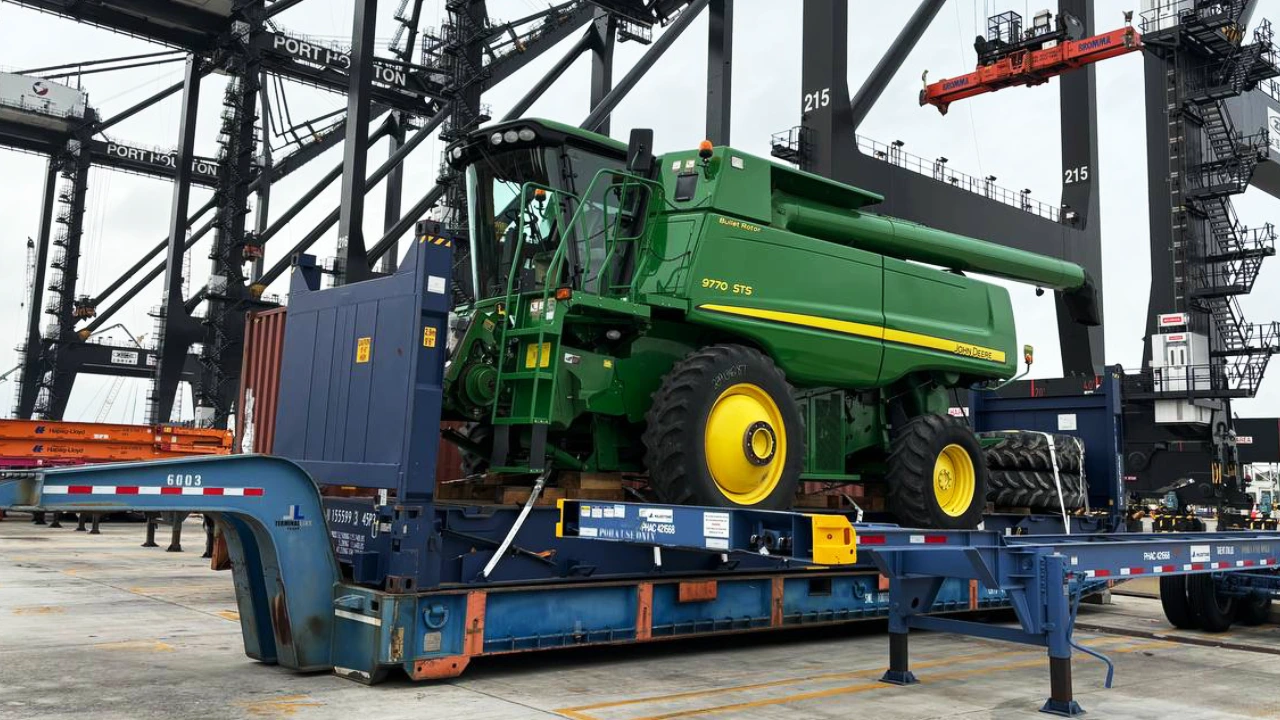
The global construction equipment industry has entered a new era. Driven by surging infrastructure investment, rapid urbanization, and a technology wave spanning electrification, autonomy, and AI-powered fleet management, the market is larger – and more competitive – than ever before.
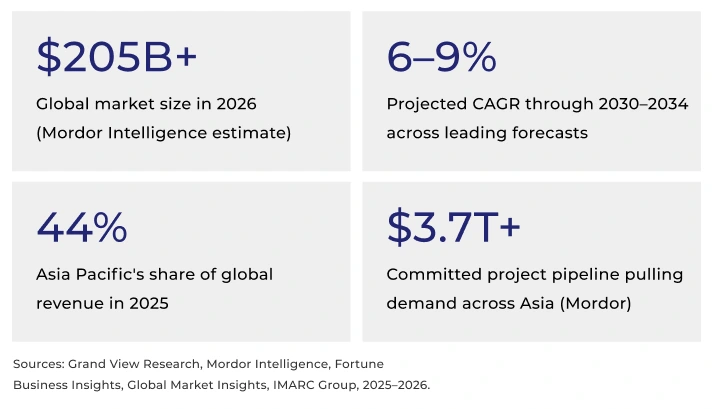
As of 2025, multiple research firms value the global construction equipment market somewhere between $167 billion and $258 billion, depending on scope and methodology. Across projections, one theme is consistent: sustained growth well into the next decade, fueled by government infrastructure commitments in the US, the Middle East, and across Asia Pacific.
Driving this expansion is a combination of factors that did not exist at the same intensity in the early 2020s: the US Bipartisan Infrastructure Law’s $1.2 trillion allocation, Saudi Arabia’s $55 billion in project awards in 2024 alone (a 57% year-on-year increase), and China’s continued leadership in both infrastructure investment and equipment manufacturing. Against this backdrop, understanding who makes the machines – and how to move them – has never been more commercially important.
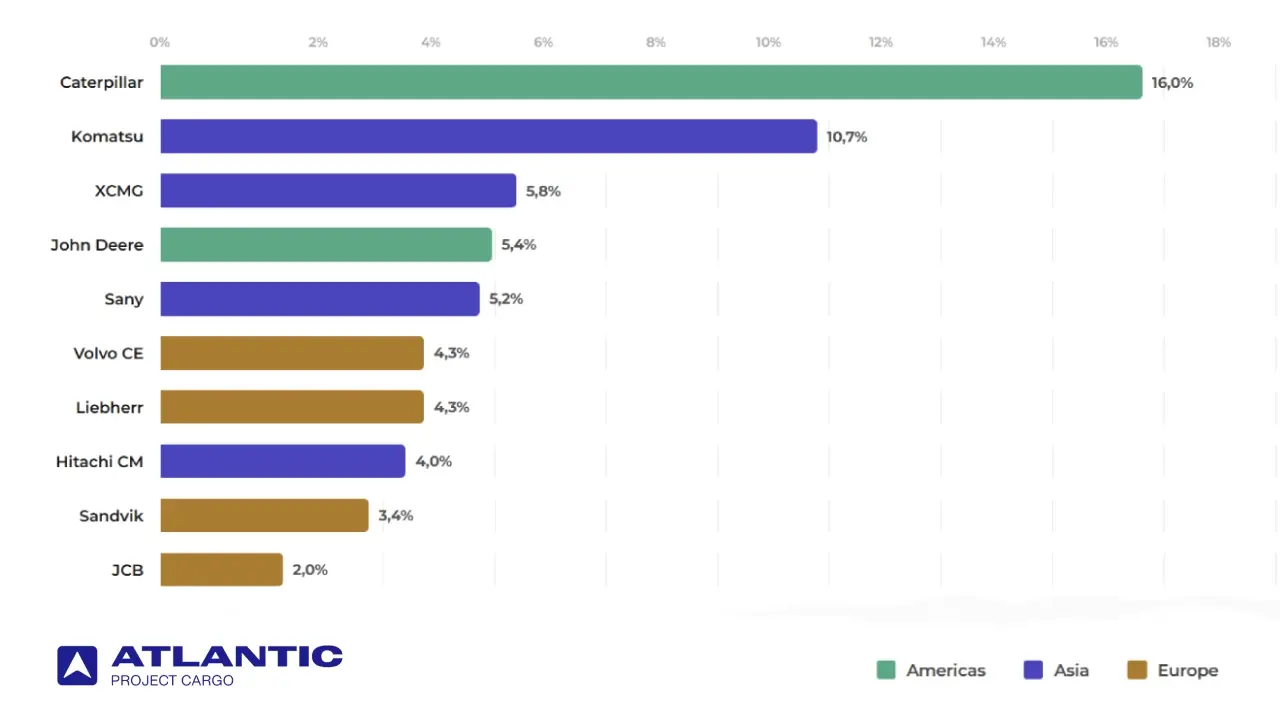
The global construction equipment market reached roughly $205 billion in 2026, with Asia Pacific accounting for around 44% of revenue. Caterpillar and Komatsu lead, while Chinese makers XCMG and Sany climb fast. The top 10 manufacturers below together hold about 60% of the global market.
Leading Global Manufacturers of Construction Equipment
The top 10 manufacturers below remain the industry’s backbone in 2025–2026. Market share figures reflect the most recent available data; the landscape continues to shift as Chinese manufacturers expand globally and established Western OEMs accelerate their technology investments.
The undisputed global leader. Caterpillar’s product range spans excavators, loaders, dozers, and motor graders, all increasingly integrated with its Cat Connect telematics platform. In late 2024, the company achieved a milestone: a fully autonomous Cat 777 off-highway truck operating at a commercial aggregates facility in Virginia – the first of its kind in that sector. Caterpillar leads construction equipment telematics globally with over 14% market share in that fast-growing segment.
Japan’s premier equipment manufacturer, consistently ranked second globally. Komatsu’s KOMTRAX telematics system – deployed across more than 600,000 machines worldwide – is the industry benchmark for connected fleet management. With consolidated revenues exceeding JPY 2.74 trillion (approximately USD 25 billion) in its 2024 fiscal year, the company is doubling down on autonomous haulage and electric drive systems for underground mining.
China’s largest construction equipment manufacturer and one of the fastest-rising global players. XCMG specializes in cranes, road machinery, and earthmoving equipment. Alongside Sany, the company has been a key beneficiary of China’s RCEP free-trade arrangements with Asia Pacific neighbors, expanding distribution into Southeast Asia, the Middle East, and Africa at pace. The top 5 global players – including XCMG – collectively held about 40% of the market in 2025.
John Deere straddles the agricultural and construction markets with a uniquely broad portfolio – tractors, loaders, excavators, and motor graders. The company has invested heavily in AI-assisted operator technologies, showcased prominently at CONEXPO-CON/AGG 2026 in Las Vegas. Its Wirtgen Group subsidiary detailed SmartDetect and SmartDetect Assist, systems designed to improve operator focus and jobsite awareness on road-building equipment.
Sany has become a formidable global force in concrete machinery and excavators. China’s broader electrification push is directly benefiting Sany and its peers: the country sold approximately 76,100 electric heavy trucks in the first half of 2025 alone, a figure that underscores the industrial ecosystem supporting these manufacturers. Sany’s international expansion has been particularly aggressive in developing markets across Africa, Latin America, and Southeast Asia.
Volvo CE continues to lead the industry’s sustainability transition. In January 2026, the company introduced the EC950 High Reach – its largest demolition excavator ever – designed for high-rise dismantling with a modular, multi-configuration design. The company’s L120 Electric wheel loader offers up to nine hours of runtime, making battery-electric compact and mid-size machinery commercially viable for a growing number of contractors. Volvo, Komatsu, John Deere, and Kubota are all launching fully electric loaders and mini-excavators through 2025–2026.
Liebherr’s reputation for engineering precision remains second to none. The company’s crane and earthmoving divisions maintain dominant positions in Europe and the Middle East – both markets experiencing a significant construction upcycle. Saudi Arabia awarded USD 55 billion in new projects in 2024; the UAE lifted awards by 200% to USD 34 billion. These Gulf markets are prime territory for Liebherr’s high-capacity crawler cranes and tower cranes serving major urban and industrial builds.
Hitachi CM is a top-tier player across Asia-Pacific, offering excavators, wheel loaders, and rigid dump trucks. In March 2024, the company forged a strategic partnership with ShareMat in France for fleet management integration – a signal of its commitment to software-defined, connected equipment. At CONEXPO 2026, Hitachi showcased its Assist Program, an in-cab operator support system designed to reduce fatigue and improve machine efficiency on complex job sites.
Primarily known for mining and rock processing equipment, Sandvik maintains a meaningful share of the broader construction machinery market. The company’s edge lies in cutting-edge materials technology and underground automation – areas of growing relevance as urban tunnel boring and underground infrastructure projects proliferate globally, particularly across Asia and the Nordic countries. Sandvik continues to grow through strategic acquisitions and digital solutions for productivity optimization.
A British institution in construction machinery, JCB is best known for backhoe loaders, telehandlers, and compact excavators. The company has accelerated its electric machinery lineup and remains the market leader for compact equipment in Europe and several emerging markets. JCB is also making inroads with hydrogen-powered prototypes – positioning itself ahead of anticipated emissions regulations across the EU and UK that will reshape machinery procurement in the coming years.
Challenges in Shipping Heavy Construction Equipment
Note: Market share figures are approximate and reflect 2022–2024 global data from Statista and Spherical Insights. The market is dynamic; Chinese manufacturers in particular continue to gain share in emerging economies.
Challenges in Shipping Heavy Construction Equipment
Shipping construction equipment – whether domestically across state lines or across oceans – remains one of the most logistically complex challenges in global freight. The 2025–2026 environment has added new layers of complexity, including tighter port capacity in major hubs, geopolitical routing pressures, and the growing prevalence of electrified and electronically sophisticated machines that require more careful handling.
Size and Weight Restrictions
Modern construction machinery is growing larger. New high-reach demolition excavators, oversized cranes, and multi-axle scrapers regularly exceed standard transportation envelopes. Each shipment may require special permits, route surveys, and pilot vehicles. Bridges, tunnels, and rail clearances create region-specific constraints that demand expert pre-planning.
Customs and Import Compliance
International shipments of construction equipment must navigate complex customs procedures across jurisdictions with markedly different rules. Correct HS code classification, certificates of origin, EPA and DOT import compliance, ISF (Importer Security Filing), and – for certain markets – Temporary Import Bonds (TIB) all require specialist knowledge. Errors cause delays, fines, and in the worst cases, cargo seizure.
Port Congestion and Routing Disruptions
Global supply chains have not fully normalized since the disruptions of the early 2020s. Port congestion continues to affect major gateway hubs in Asia, Europe, and North America in 2025–2026, while geopolitical developments have forced carriers to reroute vessels – adding days or weeks to transit times and increasing freight costs unpredictably.
Handling Technologically Advanced Equipment
Today’s machines are far more electronically complex than their predecessors. Telematics modules, electric drive systems, and onboard AI sensors can be damaged by improper lashing, salt exposure, or rough handling. Shipping procedures must account for manufacturer specifications on tilt angles, battery state of charge for electric units, and electronic system protection during ocean transit.
Cost Volatility
Freight rates remain volatile. Fuel price swings, surcharge proliferation, and infrastructure fees (port dues, terminal handling charges, inland drayage) compound into budgets that are difficult to forecast. Equipment prices themselves rose sharply – approximately 27% in 2024 – before moderating toward 16% growth heading into 2025, according to industry tracking data.
Cultural and Regulatory Variation
Moving equipment across borders means working with customs authorities, port agents, and local haulers across vastly different regulatory and cultural environments. Language barriers, varying business practices, and differing interpretations of documentation requirements make an experienced local network indispensable for reliable delivery.
The 2025–2026 Technology Wave: What It Means for Equipment Shippers
CONEXPO-CON/AGG 2026 – which drew more than 140,000 construction professionals to Las Vegas – confirmed that the trends shaping the industry today are only gaining momentum. Several technology shifts are directly relevant to how equipment is specified, procured, and ultimately shipped.
Electrification is crossing into the mainstream
Battery-electric compact equipment under 6 tonnes is now commercially viable, and multiple OEMs are pushing into mid-size categories. Diesel powertrains still dominate at roughly 92% of new equipment sales in 2025, but the shift is underway. For shippers, this means familiarity with battery management protocols during sea freight, and awareness that some destination ports and inland terminals may have restrictions on high-voltage battery systems.
Autonomous and semi-autonomous systems
Top manufacturers are integrating LiDAR, radar, computer vision, and 5G communications to enable automated dozers, graders, and haul trucks. In 2025, an Australian highway project used automated graders and rollers supervised by Trimble site systems to operate longer hours and compress the project schedule – while managing a shortage of local operators. As these systems become standard equipment on exported machines, documentation and compliance requirements will evolve accordingly.
Telematics as a standard feature
OEMs including Caterpillar, Komatsu, Kobelco, and Hitachi now ship machines with factory-integrated telematics platforms that track fuel consumption, engine hours, and hydraulic performance in real time. The global construction equipment telematics market – valued at $7.76 billion in 2025 – is growing at an 11.5% CAGR and is expected to reach $20.59 billion by 2034. For international buyers, this means machines arrive with active data connections that must be configured for the destination country’s networks and regulations.
Looking ahead to 2030 and beyond: Smart construction equipment – defined by autonomous operation and data-as-a-service models – is transitioning from a productivity-enhancing option to a core operational necessity for major contractors. The global smart construction equipment market is estimated at a 9.2% CAGR from 2026 to 2035 (IndexBox, 2026). Those who procure and operate these machines must work with logistics partners who understand both the physical and digital specifications involved.
How Atlantic Project Cargo Handles Heavy Construction Equipment Globally
Atlantic Project Cargo has specialized in the international transportation of heavy construction equipment for more than 20 years, building a network that spans 11 warehouses across North America and partnerships at every major port worldwide.
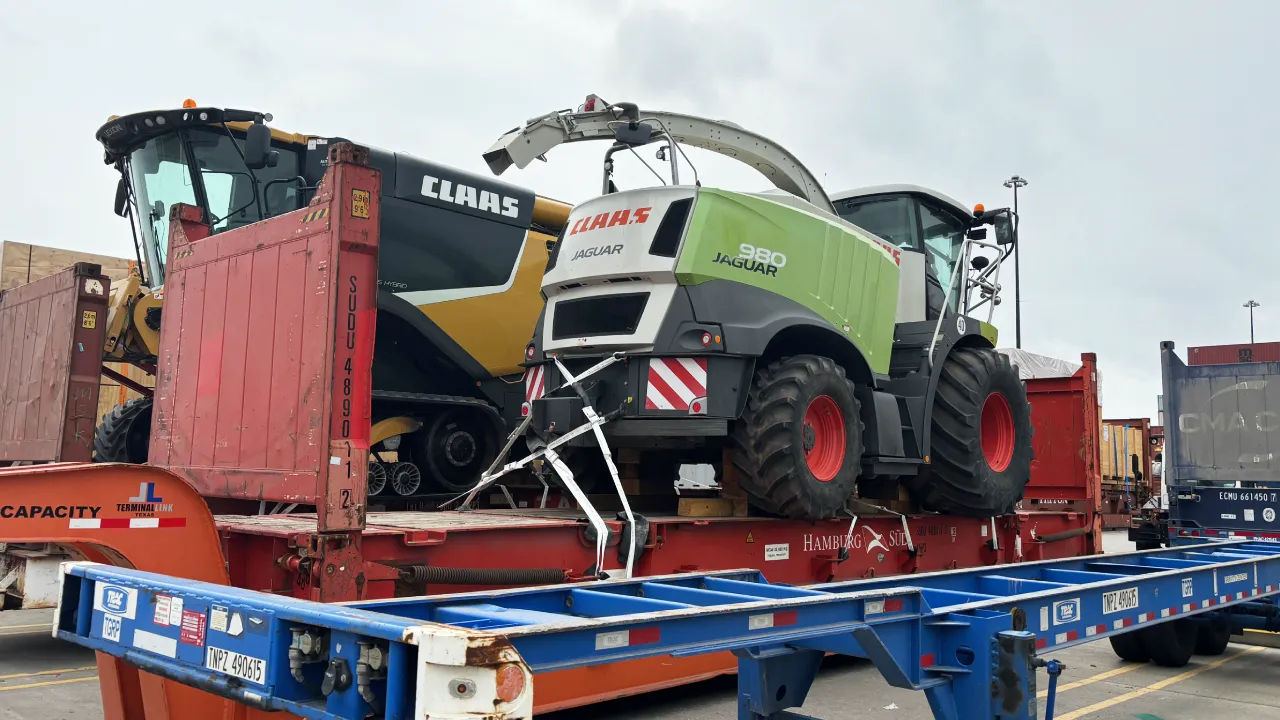
The company’s expertise covers the full spectrum of OEM brands – Caterpillar, Komatsu, Volvo CE, Liebherr, XCMG, Sany, John Deere, JCB, Hitachi, and more – across a complete range of transport modes: Roll-on/Roll-off (RoRo), breakbulk, flat-rack container, and out-of-gauge ocean freight, as well as multimodal combinations that marry ocean freight with inland rail or road for final-mile delivery.
Atlantic Project Cargo provides full customs brokerage services, including EPA and DOT import compliance, USDA equipment inspections, Importer Security Filing (ISF), and Temporary Import Bond (TIB) handling. Equipment disassembly, rigging and crating, export cargo fumigation, and comprehensive cargo insurance round out a logistics solution designed to take equipment from factory floor to job site with minimum friction.
As construction equipment becomes more technologically sophisticated – with embedded telematics, electric drivetrains, and precision hydraulics that require careful handling – the importance of working with a logistics partner who understands both the physical and regulatory dimensions of each shipment has never been greater.
Read More
Victoria Moseicuka
Victoria Moseicuka
Nick Yadryshnikov