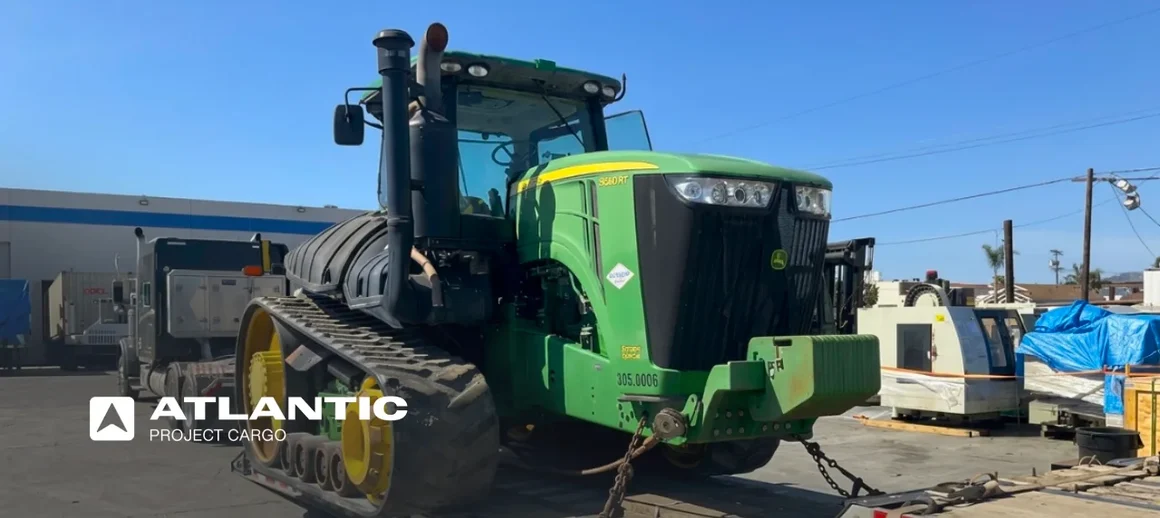
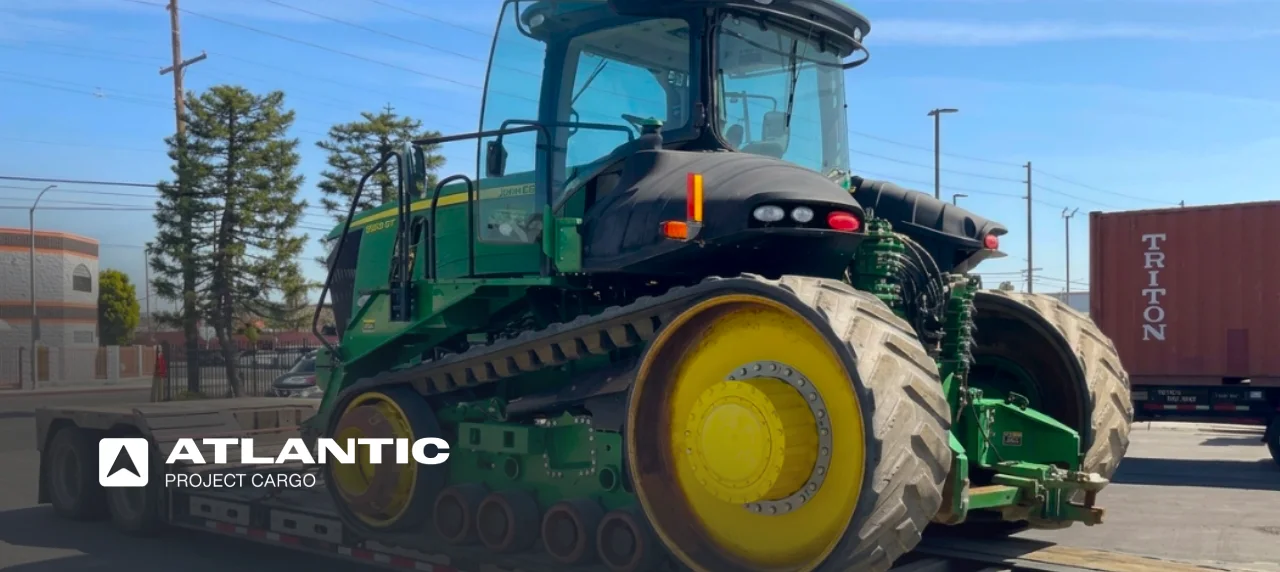
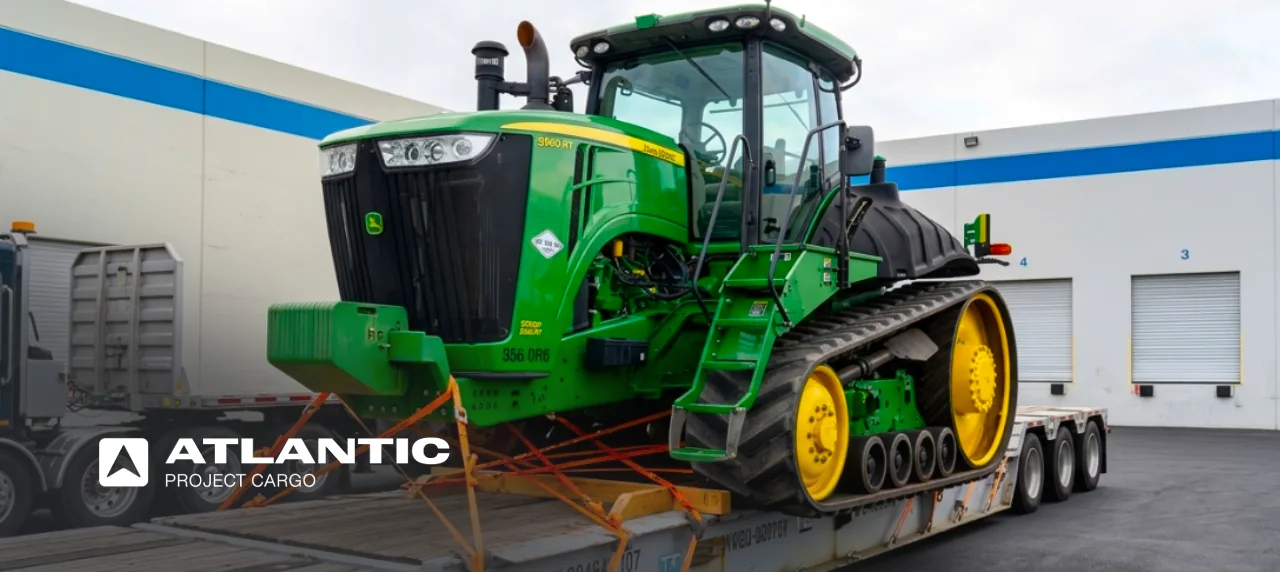
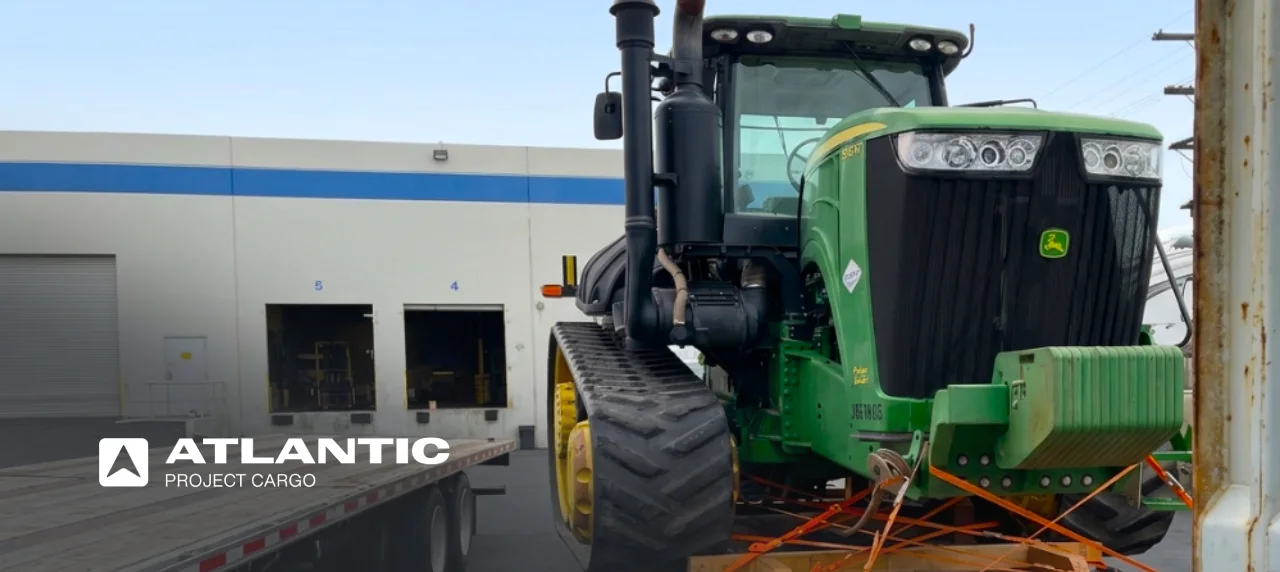
Shipping a John Deere 9560 RT Shipped United States → Australia
How Atlantic Project Cargo moved a tracked agricultural tractor from Minnesota to Brisbane — fully DAFF/BMSB-compliant during high-risk stink bug season, on schedule, with zero unexpected costs or customs holds.
Home
Projects
Shipping a John Deere 9560 RT Shipped from United States to Australia
Moving used agricultural equipment into Australia triggers some of the strictest import rules in the world. A single trace of soil, seed, or plant residue can mean the equipment gets shipped straight back to the USA. The objective: deliver on schedule, fully DAFF-compliant, with no unexpected costs.
Shipping Overview
EquipmentJohn Deere 9560 RT
OriginMinnesota, United States
DestinationBrisbane, Australia
Shipping MethodRoRo (Roll-on/Roll-off)
Cargo TypeOversized Agricultural
Transport ModeInland Heavy Haul + Ocean RoRo Freight
This case follows the export of a John Deere 9560 RT tracked tractor from Minnesota, USA to Brisbane, Australia — combining inland heavy haul, RoRo ocean freight, and strict biosecurity compliance during Australia’s high-risk BMSB (Brown Marmorated Stink Bug) season.
Key Takeaways
Why projects like this succeed — or get rejected at the border.
Australia enforces some of the strictest biosecurity laws in the world — a single trace of soil or plant matter fails inspection.
BMSB (Brown Marmorated Stink Bug) season runs 1 September to 30 April; shipping into this window without offshore treatment gets cargo flagged before the vessel docks.
AusTreat registration proves the offshore provider is approved by DAFF to perform BMSB treatment – without a valid treatment certificate from a registered provider, cargo is treated as untreated on arrival.
Used equipment hides contamination risk in tracks, filters, and battery boxes; cleaning must be as rigorous as the border inspection itself.
Incomplete or mismatched documentation is a leading cause of customs holds and daily storage fees.
Precise sequencing of fumigation, documentation, and vessel cut-offs is what separates a 46-day project from a 90-day one.
Four Risks, Four Fixes
This case follows the export of a John Deere 9560 RT from Minnesota, USA to Brisbane, Australia — timed against a strict seasonal compliance window.
Seasonal BMSB restriction
Shipping into the 1 September–30 April high-risk window without offshore treatment gets cargo flagged before the vessel even docks.
Certified offshore fumigation
Sulfuryl fluoride treatment scheduled with an approved provider and completed inside the compliance window, certification issued before loading.
Hidden contamination
Used equipment traps soil, seeds, and plant matter in tracks, filters, and battery boxes — even a trace fails Australian inspection.
Full industrial decontamination
High-pressure hot-water wash, compressed-air detailing, and manual undercarriage scrubbing, inspected to the same standard as a border agent.
Incomplete documentation
Missing certificates or serial number mismatches are among the top causes of customs holds and destination delays.
Fumigation certificates, inspection reports, and the AusTreat-registered provider’s treatment certificate prepared in parallel and submitted before vessel departure.
Sequencing failure
One missed fumigation slot or late truck can roll cargo to the next vessel, adding weeks and terminal storage fees.
Controlled stage sequencing
Fumigation, documentation, and inland transport timed precisely against the vessel cut-off, eliminating idle time end-to-end.
How the timeline played out
From booking to delivery — the full ~46-day journey, phase by phase.
Nothing improvised. Every step below was pre-planned and validated before execution began.
Inland Pickup & Route Planning
The John Deere 9560 RT’s wide track stance classifies it as oversized cargo on standard US highways. A direct, safe route from Minnesota to the East Coast export terminal was mapped in advance, with permits secured before pickup so the driver hit zero legal delays crossing state lines.
Route Pre-Analysis
Every mile mapped for clearances and restrictions before the truck moved.
Permits Secured
All oversize permits in hand at pickup — zero roadside interruptions.
Secure Handling
Loading and transit practices protected the tracks from damage in transit.
BMSB Fumigation — Critical Compliance Step
Because this shipment fell inside the 1 September–30 April window, seasonal BMSB fumigation protocols applied immediately. Treatment was coordinated with an approved provider days before port arrival — certificates expire if cargo doesn’t load within a set window.
Certified Provider
Sulfuryl fluoride treatment by an approved overseas provider.
Compliance Window
Scheduled precisely so certification stayed valid through loading.
Certification Issued
Proof of approved treatment documented before departure.
Cleaning & Decontamination
Used agricultural equipment hides dirt in microscopic crevices. Preparation included high-pressure hot-water washing, compressed-air detailing of the cabin and engine bay, and manual scrubbing of the undercarriage — air filters, battery boxes, and track assemblies checked as strictly as an Australian border agent would.
Industrial Wash
All soil, crop residue and organic material removed.
Compressed-Air Detailing
Cabin and engine bay cleared of trapped debris.
Undercarriage Check
Tracks and assemblies inspected for hidden organic matter.
Equipment condition and serial numbers were verified against the commercial invoice and bill of lading. A full documentation package — fumigation certificates, inspection reports, export paperwork, and title release — was prepared in parallel with cleaning. The BMSB treatment certificate from the AusTreat-registered offshore provider was logged and submitted before the vessel sailed, proving treatment was performed by a provider approved under DAFF’s AusTreat scheme.
Document Pack
Fumigation certs, inspection reports, export paperwork, title release.
Serial Match
Physical machine verified against invoice and bill of lading.
AusTreat Certificate Submission
Filed before departure — cargo cleared as treated, not flagged.
RoRo Shipping to Brisbane
RoRo (Roll-on/Roll-off) was selected as the safest, most economical transit method — the tractor was driven directly onto the vessel and secured below deck by specialized port drivers, avoiding the handling risk and cost of crane-lift or container dismantling.
Why RoRo
No lifting involved — driven aboard and secured, reducing handling risk.
Cost Efficiency
Avoids crane-based methods or dismantling to fit a standard container.
Specialized Handling
Port drivers experienced with tracked machinery loading.
We Can Help Ship Your Equipment to Australia!
Whether it’s a tracked tractor or a combine harvester, Atlantic Project Cargo delivers fully compliant, on-schedule shipping to any Australian port.
Full compliance handling — BMSB, DAFF, AusTreat, biosecurity inspection.
02Inland heavy haulTransport from Minnesota to the export port.4 days
03Wash & decontaminationFull industrial cleaning and pre-export inspection.3 days
04BMSB fumigationCertified offshore treatment; AusTreat certification issued.2 days
05DocumentationExport paperwork, AusTreat treatment certificate submission ahead of sailing.Parallel
06Loading & departureDriven aboard RoRo vessel, secured, sailed on schedule.Included in transit
07Ocean freightRoRo transit with tracking to Brisbane.~35 days
08Customs clearanceFirst-pass clearance at Brisbane port of entry.2 days
Total TimelinePickup → Australian customs clearance → handover~46 days
Result: Delivered Without Delays or Additional Costs
The John Deere 9560 RT arrived in Brisbane, cleared standard border checks, and passed full DAFF/border compliance on the first attempt — no re-treatment, no port delays, no unexpected costs.
Delivered
Within the tight compliance window, aligned with the planting schedule.
Cleared
First-pass DAFF/border compliance at the Australian port of entry.
As-quoted
No unexpected costs billed to the client beyond the original scope.
Operational
Put to work immediately upon delivery — no transit damage.
All success stories
Case IH 8120 Combine Shipping from the USA to Egypt
Time:38 days, pickup in Georgia to final delivery in Ismailia
This case follows the export of a used 2012 Case IH 8120 Axial-Flow combine from Albany, Georgia, sourced through JumboBee for a buyer in Ismailia Governorate, Egypt. Atlantic Project Cargo coordinated the shipment from pickup in Georgia through delivery in Egypt. The Case IH 8120 is a Class 7 single-rotor grain combine, and its weight, […]
New Holland CR9060 Combine Shipping from the USA to Peru
Time:34 days, pickup in California through delivery in Peru
The New Holland CR9060 was purchased through JumboBee by an agricultural operation on Peru’s north coast, with Atlantic Project Cargo coordinating the international transport from California to the buyer’s destination. The machine was located in the Sacramento / Central Valley area and needed to reach a grain-producing operation near Chiclayo, in the Lambayeque region of […]
Jaguar XJ220 Air Freight from New York to Singapore
This case follows the air freight of a Jaguar XJ220 from New York to Singapore, departing from John F. Kennedy International Airport. Air freight was chosen for a vehicle of this value and rarity because it shortens the door-to-door timeline and keeps the car out of the marine environment, though it comes with its own […]
What are You Searching for?
Atlantic Project Cargo uses cookies to enhance your website experience. By continuing to browse, you agree to our use of cookies. For more information, please visit our Privacy Policy.