John Deere CP690 & CP770 Cotton Picker Fleet Export Shipped United States → Brazil
How Atlantic Project Cargo synchronized, sanitized, and shipped an entire fleet of John Deere CP690 and CP770 cotton pickers from Tennessee to the Port of Paranaguá — fully MAPA-compliant, with every unit arriving together and zero delays.
Equipment
Multiple John Deere CP690 & CP770 module pickers
Cargo Type
Oversized Agricultural — Multi-Unit Fleet
Total Timeline
Not specified in source material
Method
Out-of-Gauge Flat Rack Ocean Freight
Worldwide Shipping
Americas · Europe · Asia Pacific · Africa
100,000+
Shipments Worldwide
20+ Years
In Heavy Cargo Logistics
4.9 Rating
on Google · 50+ reviews
Licensed Freight Forwarding Company
Home
Projects
John Deere CP690 & CP770 Cotton Picker Fleet Export Shipped from United States to Brazil
Moving a single piece of massive agricultural machinery across the world involves standard logistical hurdles. Moving a fleet of CP690 and CP770 units simultaneously multiplies those hurdles exponentially — Brazil enforces some of the strictest agricultural import regulations globally, and risk multiplies with every additional unit on the manifest. The objective: full compliance with Brazilian import regulations, a predictable timeline so every machine arrived before planting season prep, and zero delays or rework at the destination port.
Shipping Overview
EquipmentMultiple John Deere CP690 & CP770 module pickers
OriginVarious farms across Tennessee, United States
Transport ModeInland Lowboy Trailer + Out-of-Gauge Ocean Flat Rack Freight
ComplianceMAPA Phytosanitary · IBAMA Emissions · Receita Federal Customs
Total TimelineNot specified in source material
This case follows the export of a fleet of John Deere CP690 & CP770 cotton pickers from Tennessee, USA to the Port of Paranaguá, Brazil — combining synchronized inland transport, a dedicated in-house preparation facility in Savannah, Georgia, and strict MAPA phytosanitary compliance, executed via out-of-gauge flat rack ocean freight.
Note: unlike the JD 9650RT and Case IH cases, the source text gives no total day count for this project — only qualitative “no delay” and “synchronized” outcomes. Left unfilled below rather than invented.
Key Takeaways
Why fleet shipments succeed — or fail as a group.
Brazil’s MAPA phytosanitary rules are zero-tolerance — a few grams of foreign soil or plant material can trigger an immediate quarantine order.
Multi-unit shipments multiply risk: one unit failing inspection can delay the entire fleet.
A single in-house facility (Savannah) for disassembly, washing, and loading removes the coordination risk of fragmented third-party vendors.
A CP690 with header attached is 18.2 ft wide versus a 7.8 ft flat rack deck — header removal is mandatory, and the shipment remains out-of-gauge by design even after prep.
Receita Federal customs and IBAMA emissions rules sit on top of MAPA phytosanitary requirements — three overlapping jurisdictions, zero margin for error.
Brazilian terminal storage for out-of-gauge flat racks can exceed $250/day per unit — a 14-day delay across a 5-machine fleet would cost $17,500 in storage alone.
Four Risks, Four Fixes
This case follows the export of a fleet of John Deere CP690 & CP770 cotton pickers from Tennessee, USA to the Port of Paranaguá, Brazil — where scale multiplies every point of failure.
Inconsistent preparation across units
One machine left dirty or under-prepped jeopardizes the whole fleet’s inspection and arrival timing.
Single in-house prep facility
All disassembly, washing, and loading handled under one roof in Savannah — consistent quality and timing across every unit.
Cross-contamination between units
Cotton lint and soil from one machine can re-contaminate an already-cleaned one, restarting the process and the clock.
Isolated, dedicated wash bays
Each unit cleaned separately with high-pressure hot water and specialized degreasers to full MAPA standard, then fumigated and certified.
Documentation gaps across a large manifest
Mismatched serial numbers, engine codes, or weights across even one unit’s paperwork stalls customs clearance for the whole shipment.
Flawless per-unit documentation package
Full documentation per unit coordinated directly with Brazilian customs brokers before the vessel leaves Georgia, aligned to Receita Federal tariff classification.
Missed vessel allocation
Limited flat rack availability means unbooked space forces machines to sit at the port, accumulating fees — at scale, fast.
Flat racks secured well in advance
Vessel space and flat rack allocation booked ahead for the full fleet, with in-house prep speed controlled to never miss a cut-off date.
How the timeline played out
From synchronized farm pickups to fleet-wide delivery in Paranaguá.
Synchronized pickup
Multiple Tennessee farms, routed to Savannah: not specified
In-house prep
Disassembly, washing, fumigation, parallel per unit: not specified
Documentation
Per-unit compliance package, customs broker alignment: not specified
Flat rack loading
Center-of-gravity calculated per CP770, certified riggers: not specified
Ocean freight
Direct vessel route, Savannah to Paranaguá: not specified
Delivered
Full fleet cleared customs, deployed together: not specified
Unlike the JD 9650RT and Case IH cases, the source material gives no day-by-day or total timeline figure for this project — only that coordination “meant no machine sat idle.” Durations are marked “not specified” rather than estimated.
How Each Phase Was Handled
Nothing improvised. Every step below was pre-planned and validated before execution began.
Inland Transport to APC Facility
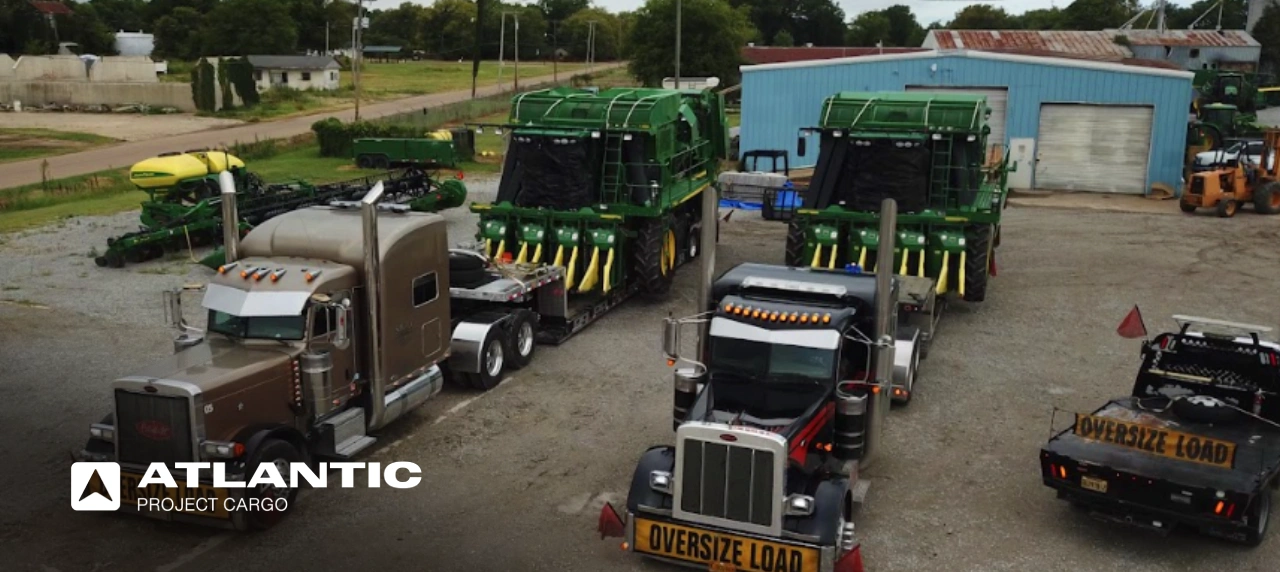
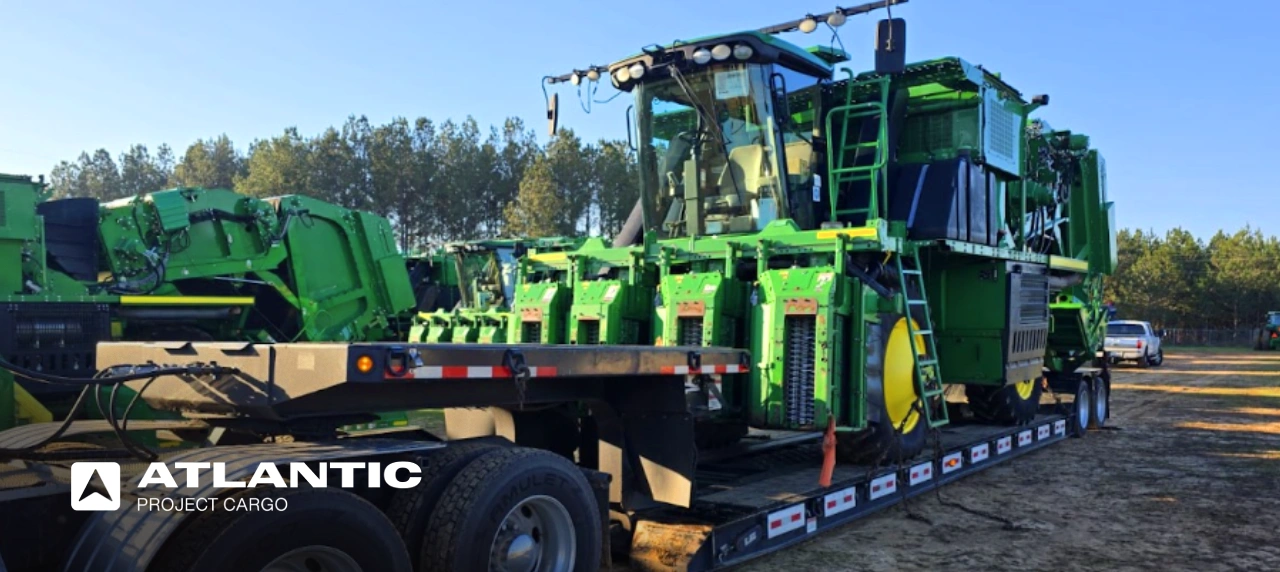
The project began with synchronized pickups from multiple locations in Tennessee. Route planning for oversized machinery required specific state permits and escort vehicles; transporting a CP770 (68,900 lbs) required specialized lowboy trailers. All transport routed directly to the Savannah facility for a controlled intake of all units, beginning parallel processing.
In-House Preparation at Savannah Facility
All work happened under one roof at the Savannah hub. No reliance on third parties meant faster turnaround and full control over quality and timing — a key differentiator when shipping multiple machines internationally, since a single facility handling disassembly, washing, and loading eliminates the friction of moving equipment between vendors.
Equipment Disassembly and Configuration
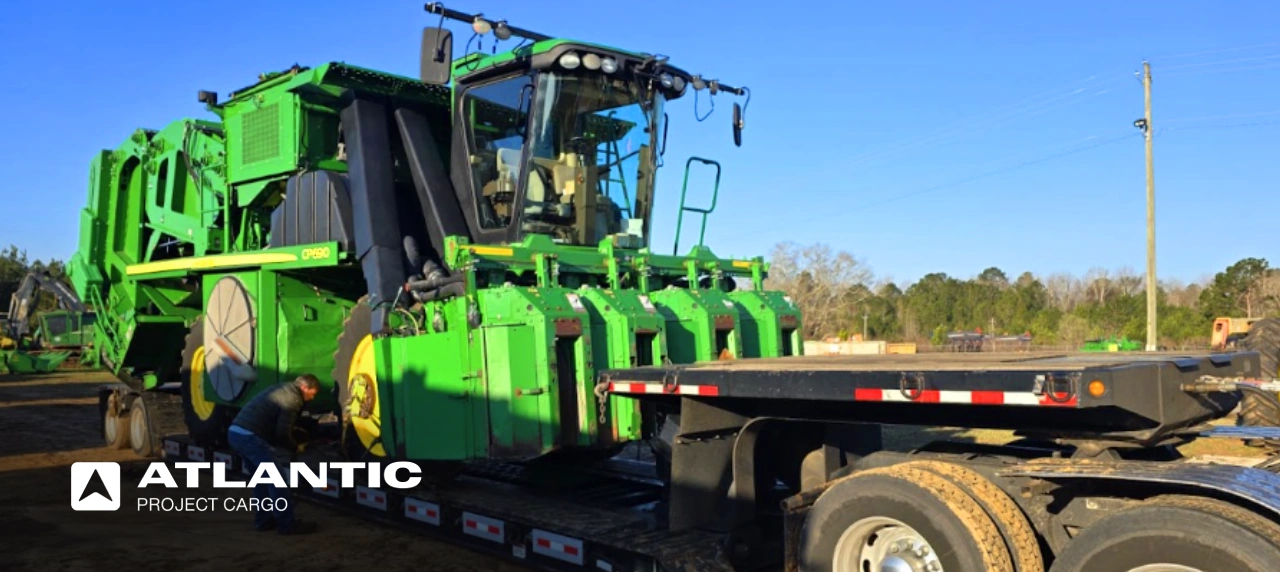
Mechanics performed strategic disassembly — header removal and picker head lowering — to optimize the footprint and ensure consistency across the order. A CP690 with header attached is 18.2 ft wide (six-row, narrow) versus a roughly 7.8 ft-wide standard 40-foot flat rack bed. Removing and separately securing the headers reduced the machine body width to around 12 feet — still exceeding the deck width and remaining out-of-gauge by design, but with reduced overhang that lowers surcharges and simplifies vessel stowage.
Phytosanitary Cleaning and Decontamination
Removing soil, cotton lint, and organic material was the most labor-intensive phase — opening access panels, removing belly pans, and deep-cleaning complex surfaces. Cotton lint is notoriously difficult to remove from hydraulic lines and cooling fans, and cross-contamination risk across multiple units is high. Dedicated, isolated wash bays kept equipment separated, using high-pressure hot water and specialized degreasers to meet MAPA requirements.
Fumigation (MAPA Compliance)
Following the wash, fumigation of all units neutralized any microscopic pests or pathogens. Compliance with Brazilian regulations dictated specific chemical applications and exposure times, with certificates issued immediately after treatment and integrated into the final documentation package to prove the cargo is sterile.
Documentation and Compliance Management
A full documentation package per unit had to be flawless. Coordination with Brazilian customs brokers ensured alignment with destination requirements before the vessel left Georgia, including exact tariff classification for advanced equipment systems under Receita Federal review.
Flat Rack Shipping to Paranaguá
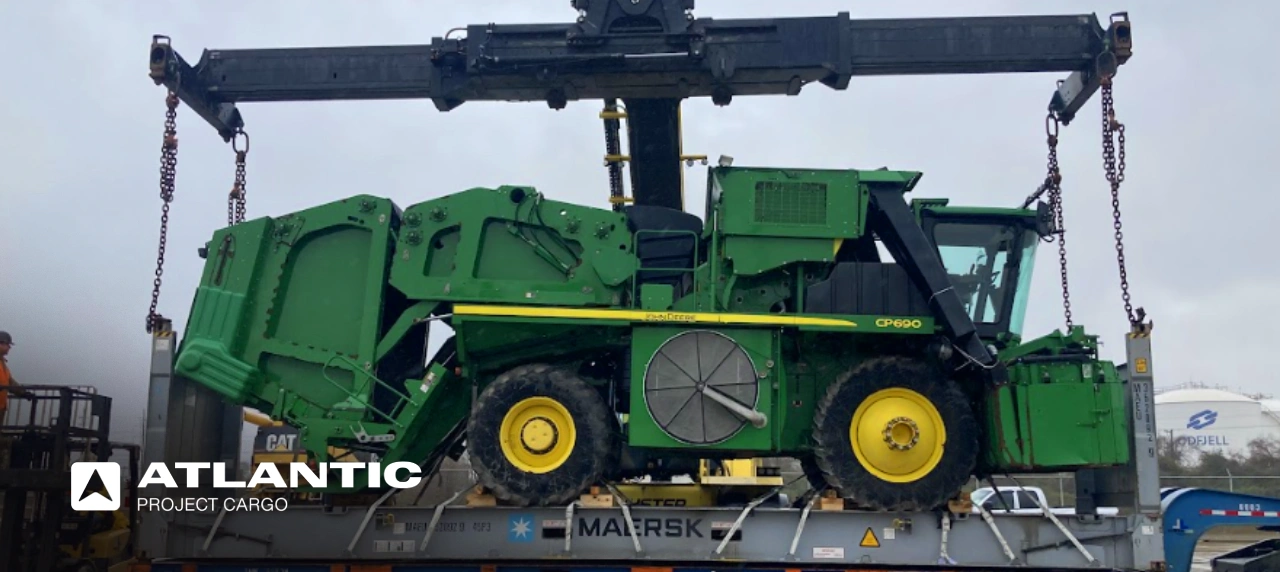
Flat rack allocation for all units was secured well in advance. Loading, blocking, bracing, and lashing required certified riggers, with the exact center of gravity calculated for each CP770 to keep the load stable during ocean transit. Pre-shipment inspections verified all lashing points met maritime safety standards, with final shipment via the Port of Savannah on direct vessel routes to South America.
We Can Help Ship Your Fleet to Brazil!
Whether it’s a single tractor or an entire fleet of cotton pickers, Atlantic Project Cargo manages synchronized, MAPA-compliant shipping to Brazil and across South America.
Full compliance handling — MAPA phytosanitary, IBAMA emissions, Receita Federal customs.
Synchronized fleet delivery with a dedicated in-house prep facility.
Transparent timeline & fixed-scope pricing, even at bulk scale.
Every phase of the shipment and what happened in it — door to door. Durations are marked “not specified” where the source material didn’t give a figure, rather than estimated.
PhaseWhat HappenedDuration
01Inland transportSynchronized pickups across Tennessee farms, routed to the Savannah facility.Not specified
02Disassembly & prepHeader removal, picker head lowering, dimension standardization per unit.Not specified
03Cleaning & decontaminationIsolated wash bays, high-pressure hot water and degreasers per unit.Not specified
04Fumigation (MAPA)Chemical treatment and certification issued per unit.Not specified
05DocumentationPer-unit compliance package, customs broker alignment ahead of departure.Not specified
07Ocean freightDirect vessel route from Port of Savannah to Paranaguá.Not specified
08Customs clearanceEvery unit cleared Brazilian customs successfully, no re-treatment.Not specified
Total Timeline: Not specified in the source material — reported outcome is “synchronized delivery” with zero delays across the fleet, without a stated total day count.
Result: Full Order Delivered Without Delays
All units arrived safely in Paranaguá. Every machine cleared Brazilian customs successfully, with no re-treatment orders, no quarantine delays, and no additional destination costs.
Delivered
Full fleet arrived safely and synchronized in Paranaguá.
Cleared
Every unit cleared Brazilian customs successfully, no re-treatment orders or quarantine delays.
As-quoted
No additional destination costs; potential $17,500+ storage-fee exposure avoided.
Operational
Synchronized delivery let the buyer deploy the entire fleet simultaneously.
All success stories
Case IH 8120 Combine Shipping from the USA to Egypt
Time:38 days, pickup in Georgia to final delivery in Ismailia
This case follows the export of a used 2012 Case IH 8120 Axial-Flow combine from Albany, Georgia, sourced through JumboBee for a buyer in Ismailia Governorate, Egypt. Atlantic Project Cargo coordinated the shipment from pickup in Georgia through delivery in Egypt. The Case IH 8120 is a Class 7 single-rotor grain combine, and its weight, […]
New Holland CR9060 Combine Shipping from the USA to Peru
Time:34 days, pickup in California through delivery in Peru
The New Holland CR9060 was purchased through JumboBee by an agricultural operation on Peru’s north coast, with Atlantic Project Cargo coordinating the international transport from California to the buyer’s destination. The machine was located in the Sacramento / Central Valley area and needed to reach a grain-producing operation near Chiclayo, in the Lambayeque region of […]
Jaguar XJ220 Air Freight from New York to Singapore
This case follows the air freight of a Jaguar XJ220 from New York to Singapore, departing from John F. Kennedy International Airport. Air freight was chosen for a vehicle of this value and rarity because it shortens the door-to-door timeline and keeps the car out of the marine environment, though it comes with its own […]
What are You Searching for?
Atlantic Project Cargo uses cookies to enhance your website experience. By continuing to browse, you agree to our use of cookies. For more information, please visit our Privacy Policy.