






Hours of operations:
9AM - 5PM / UTC -5 (EST)

Top 10 Tractor Companies in the World

Shipping Quote
Customs Duties
Drayage Rate
Do you already own this equipment?

You Can Request a New Quote Every 15 Minutes

Please wait or contact us at [email protected]

Thank you for Choosing Us!

Looking to buy or sell heavy equipment?
With JumboBee, you can trade online with financing options and worldwide shipping.

Check Inventory
Calculate Import Duties
Get a free, no-obligation estimate of your import duties!
Calculate Import Duties
Get a Drayage Estimate
Get a free drayage estimate tailored to your exact needs!
Check a Drayage Rate
Home Insights Top 10 Tractor Companies in the World

The global farm tractor market is a crucial segment of the agricultural industry, with an expected total value of around $104 billion in 2023.

While specific rankings can vary slightly depending on methodology and data sources, here’s a comprehensive overview of the Top 10 tractor producers worldwide.

Global Tractor Market Overview

India is now the largest tractor market in the world by unit volume. It surpassed the United States years ago and has not looked back. In 2025, India set a new record with over 1.02 million tractors sold domestically in 2025 – or approximately 1.23 million including exports – an average of roughly 2,800 domestic units per day. (AgroReview) Tens of thousands of smallholder farmers enter the mechanized market every year, supported by rural credit programs and government subsidy schemes that have made tractor ownership achievable at income levels where it previously was not. That demand base is what puts Indian manufacturers among the largest tractor companies on earth.

The global agricultural machinery market sits somewhere between $175 and $230 billion, depending on how the category is defined and which research firm you ask – but every estimate points in the same direction: steady growth driven by mechanization in developing economies and technology adoption in established ones. (Strategic Market Research) China and the U.S. lead in market value rather than unit count, reflecting the higher price point of the equipment sold in those markets.

European manufacturers hold a dominant position at the premium end – high-horsepower machines for large-scale arable and livestock operations in Germany, France, the UK, and Scandinavia. Japan built its global position on compact and sub-compact tractors, a segment that turns out to have enormous global demand from small farms, orchards, hobby properties, and municipal operations.

The markets with the most growth ahead are Sub-Saharan Africa and Latin America, where mechanization rates are still well below global averages. Infrastructure is catching up, financing is becoming more accessible, and several of the top tractor manufacturers on this list are competing hard for the first-mover position in those regions.

Get Your Free Quote Today!

Top 10 Tractor Manufacturers in the World

Any serious tractor manufacturer's list has to account for more than raw revenue. A company with $5 billion in sales that dominates an entire global segment deserves a place here over a larger conglomerate where tractors are a minor division buried inside a broader industrials portfolio. The ranking below weighs revenue, global sales presence, product range, and market share together.

John Deere

The largest tractor manufacturer in the world by revenue, and probably the most recognized agricultural equipment brand anywhere. Deere reported total revenues of approximately $45.7 billion in fiscal year 2025, with production and precision agriculture as the core of that. (John Deere)

What makes Deere interesting right now is not the size – it has been the biggest for a long time – but the direction. The company has spent the last decade positioning itself as an agricultural technology platform rather than just an equipment manufacturer. The Operations Center software, autonomous steering systems, remote machine diagnostics, and data integration across the full equipment lineup all point to a future where the tractor is one node in a broader farm management system, not a standalone machine.

The hardware is still excellent. The 8R series now spans into the 440–540 horsepower range with the latest generation, with precision agriculture systems standard across the lineup. The 9R and 9RX go larger for the biggest commercial operations. At the other end, the compact utility lineup serves the small property and specialty crop markets that Kubota built its business on.

Mahindra & Mahindra

By unit volume, Mahindra sells more tractors per year than anyone else on earth. That fact is not well known outside the industry, largely because the brand’s dominance is concentrated in India, where it holds around 44 percent market share – and because its North American business, while real and growing, is still modest compared to Deere or Kubota in terms of visibility. (Mahindra & Mahindra)

The company’s growth in the U.S. has come from the compact and utility segment, where Mahindra competes on durability and price against Kubota and the smaller Deere offerings. In export markets across Africa and Southeast Asia, the combination of affordable pricing and machines designed for rough conditions and minimal dealer infrastructure gives Mahindra structural advantages that premium European brands cannot easily match.

AGCO Corporation

AGCO’s structure is unusual among the top tractor manufacturers globally. The company does not sell a single tractor under its own name – instead, it owns and operates Fendt, Massey Ferguson, Valtra, and Challenger as distinct brands with their own market identities, dealer networks, and customer bases. Total 2025 revenues came in at approximately $10 billion. (AGCO Corporation)

Fendt is the brand that gets the most attention, and for good reason. Built in Marktoberdorf, Germany, the Fendt lineup – particularly the 900 Vario series – is what large arable farmers in Europe point to when the question of the best available tractor comes up. The engineering is serious, the price is high, and the customers tend to be deeply loyal.

Massey Ferguson covers a far broader geographic range, with a presence in over 140 countries and a product lineup that spans small developing-market machines to large commercial tractors. Valtra serves Scandinavian markets with a similar premium positioning to Fendt.

Kubota

Kubota’s global tractor business was built almost entirely on compact and sub-compact machines, and that remains where the company is strongest. The North American market grew dramatically over the past two decades as hobby farming, rural property, and specialty agriculture created sustained demand for capable small tractors – exactly the segment Kubota understood better than anyone.

The M7 series represents a conscious push toward larger horsepower and the kind of commercial farming operations where Deere and CNH brands have historically dominated. It is a genuine competitor in its class, though Kubota’s core identity and strongest customer relationships remain below 100 horsepower. Manufacturing happens across Japan, the United States, and France, which gives the company more supply chain flexibility than a single-origin operation would.

CNH Industrial

Two names carry CNH Industrial’s agricultural business: Case IH and New Holland. The company – incorporated in the Netherlands but headquartered in Basildon, UK – reported approximately $18.1 billion in total consolidated revenues in 2025, with agriculture representing the majority of that. (CNH Industrial)

Case IH is the premium brand, strongest in North America, Australia, and parts of South America, with the Magnum and Steiger series serving large-scale grain and row crop operations at the top of the horsepower range. New Holland has a broader international spread, with serious footholds in Europe, Latin America, and developing markets. The two brands share engineering platforms in certain areas, which makes sense from a cost standpoint, while the company works to keep them commercially distinct enough that they are not simply competing with each other.

CLAAS

Ask a serious arable farmer in Germany or France what combine they run, and there is a good chance the answer is CLAAS. The company built its global identity on harvesting equipment, and the Lexion combine series is a benchmark in its class. The tractor business – the AXION and ARION series – has become significant in its own right, particularly in European premium markets where build quality and operator environment matter as much as raw specifications.

CLAAS is still family-owned, which at revenues around $5.5 billion, is increasingly unusual among the largest tractor companies in Europe. That ownership structure allows for long investment horizons that publicly traded competitors cannot always match.

Deutz-Fahr

The SDF Group – which owns Deutz-Fahr alongside the SAME and Lamborghini Trattori brands – has roots in German diesel engine manufacturing going back over a century. That heritage shows in the engineering approach: the 9 Series and TTV Series tractors are built for performance and longevity, and the brand maintains a loyal following in Germany, Italy, and Central and Eastern Europe, where it has been distributed and supported for decades.

Outside Europe, Deutz-Fahr has a smaller footprint. North American presence is limited. But within its core markets, the brand competes credibly at the premium end and holds a respected position among top tractor manufacturers serving the European arable sector.

Sonalika

Sonalika’s growth over the past decade is one of the more striking stories among the largest tractor manufacturers globally. The Indian company went from a regional player to a serious international exporter by combining competitive pricing with steadily improving product quality and aggressive market entry across Africa, Southeast Asia, and parts of the Americas.

The company now ranks among India’s top three manufacturers by market share and has made clear through its investment and distribution decisions that it intends to compete well beyond its domestic base. The trajectory mirrors what Mahindra did in earlier decades – build a strong home position, then use the volume and margin to fund international expansion.

LS Tractor

South Korea’s primary tractor manufacturer has built a meaningful export business, particularly in the United States, where LS competes in the compact and utility segments. The company also manufactures tractors under contract for other brands, which gives it production scale that the LS label alone would not justify.

Independent dealer network development in North America has been a priority, and the brand is gaining recognition in the sub-100-horsepower segment as a value alternative to Kubota – quality that has improved consistently, at prices that are competitive.

Yanmar

Yanmar was founded in 1912 and built the world’s first practical small diesel engine in 1933, and its agricultural equipment business grew directly from that core. The compact tractor lineup reflects the engineering precision you would expect from a company whose primary identity is powertrain development.

In Asia, particularly in wet field rice paddy applications, Yanmar machines are designed for conditions that general-purpose tractors handle poorly. In North American and European markets, the brand competes in the hobby and small property segment, often sold through dealer networks shared with Kubota.

Comparison of Leading Tractor Manufacturers

The table below pulls together the full tractor manufacturers list covered in this article, giving a quick reference across country of origin, estimated revenue, and primary market positioning.

Manufacturer
John Deere
Mahindra
AGCO
Kubota
CNH Industrial
CLAAS
Deutz-Fahr
Sonalika
LS Tractor
Yanmar
Country
USA
India
USA
Japan
UK
Germany
Germany
India
South Korea
Japan
Est. Revenue
$45.7B (total)
$14B+ (farm equipment)
$10B
$17.5B (total)
$18.1B (total)
~$5B
~$2B
Rapidly growing
~$50-100M
$7B+ (total)
Known For
Full range, precision agriculture
Compact tractors, global unit volume
Fendt, Massey Ferguson, Valtra
Compact and sub-compact tractors
Case IH, New Holland
Harvesting, premium European tractors
German engineering, European markets
Emerging market expansion
Compact tractors, OEM contracts
Diesel engines, compact segment

Most Popular Tractor Models Worldwide

John Deere 8R – Ranges from 230 to 540 horsepower across the full lineup, with the latest high-horsepower models topping out at 540 hp rated – with precision agriculture integration standard across all variants.

John Deere 6M – Where the 8R is for large operations, the 6M is the utility workhorse – used across mixed farming in Europe, Australia, and the Americas for a wide enough range of tasks that it ends up on farms that would otherwise run two different machines.

Kubota M7 – Kubota’s move into the mid-to-large segment. It competes credibly against offerings from Deere and New Holland in the class, and has opened doors in European markets where Kubota’s reliability record has built real trust.

Case IH Magnum – A long-running reference point in North American high-horsepower farming. Multiple generations of development have kept it competitive, and it remains a first-consideration machine for serious grain operations.

New Holland T7 – One of New Holland’s highest-volume platforms globally, used across arable, livestock, and mixed operations in Europe and Latin America.

Fendt 900 Vario – The premium standard. Stepless transmission, an operator environment that is noticeably better than most of the competition, and performance figures that make the price easier to justify for operations running the machine hard across long seasons.

Tractor Market Trends

Mechanization is still in early stages across large portions of the global farming sector. In Sub-Saharan Africa, tractor density per hectare remains extremely low by any international comparison. As rural financing improves and infrastructure develops, the largest tractor companies with established distribution in those markets will have a structural head start over competitors trying to enter later.

Precision agriculture is becoming standard rather than optional at the commercial end of the market. Auto-steer, yield mapping, variable rate application – these tools have proven their return on investment clearly enough that resistance among commercial farmers has largely evaporated. The debate now is over data ownership and interoperability between systems, not whether the technology is worth using.

Autonomous operation is progressing faster than many expected. John Deere’s fully autonomous 8R demonstration in 2022 was not a concept exercise – the company has been testing and refining the system with commercial intent. AGCO and CNH have active autonomous development programs. Full commercial deployment is not imminent for most markets, but the direction is established.

Electric powertrains for high-horsepower tractors remain a longer-term proposition than for on-road vehicles. The energy demands of sustained field work at 300-plus horsepower are difficult to meet with current battery technology at reasonable machine weight. Hybrid systems and hydrogen are both being explored, but diesel will dominate the large tractor segment for the foreseeable future.

How Tractors Are Shipped Internationally

The international tractor trade is substantial and routine. Manufacturers ship from production facilities to regional distribution centers. Dealers import used equipment where price differentials between markets make it profitable. Development programs move machines to markets where local manufacturing does not yet exist.

RoRo – roll-on, roll-off shipping – is the standard method for most tractor movements. Equipment is driven onto the vessel under its own power, secured to the car deck, and driven off at the destination. It eliminates crane handling, reduces damage risk, and is cost-effective for equipment that fits within standard RoRo height and weight restrictions.

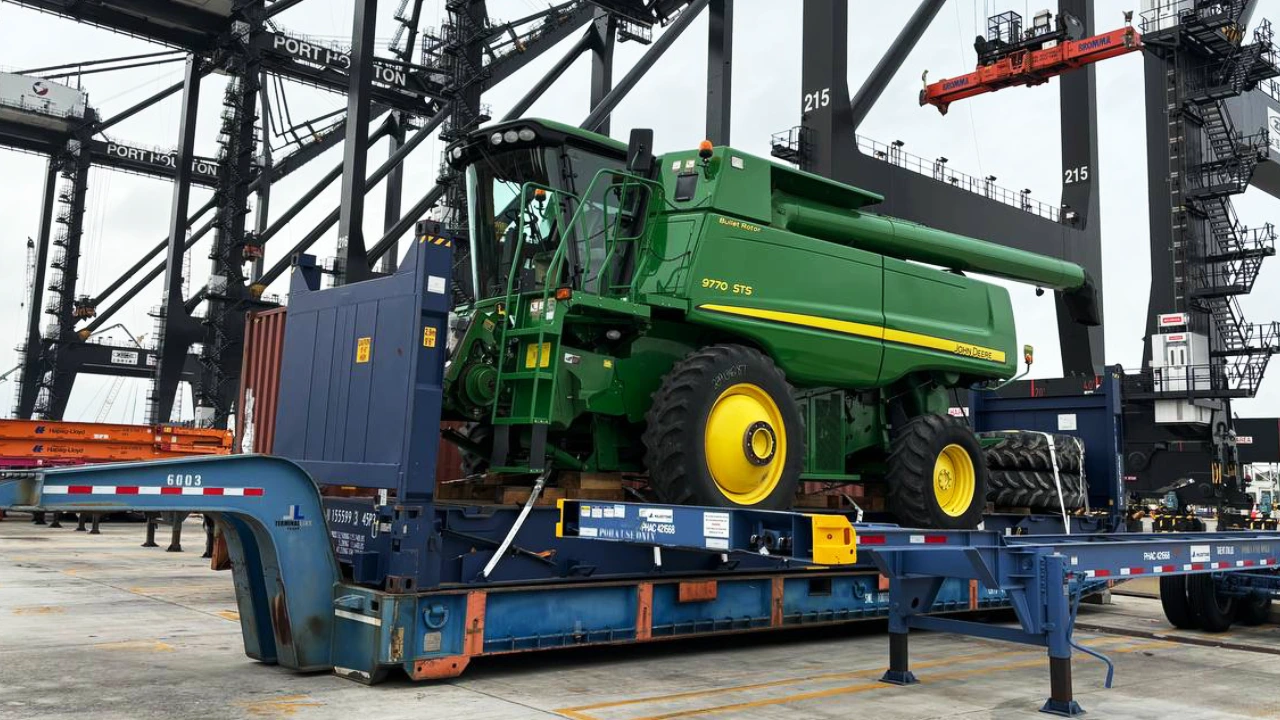
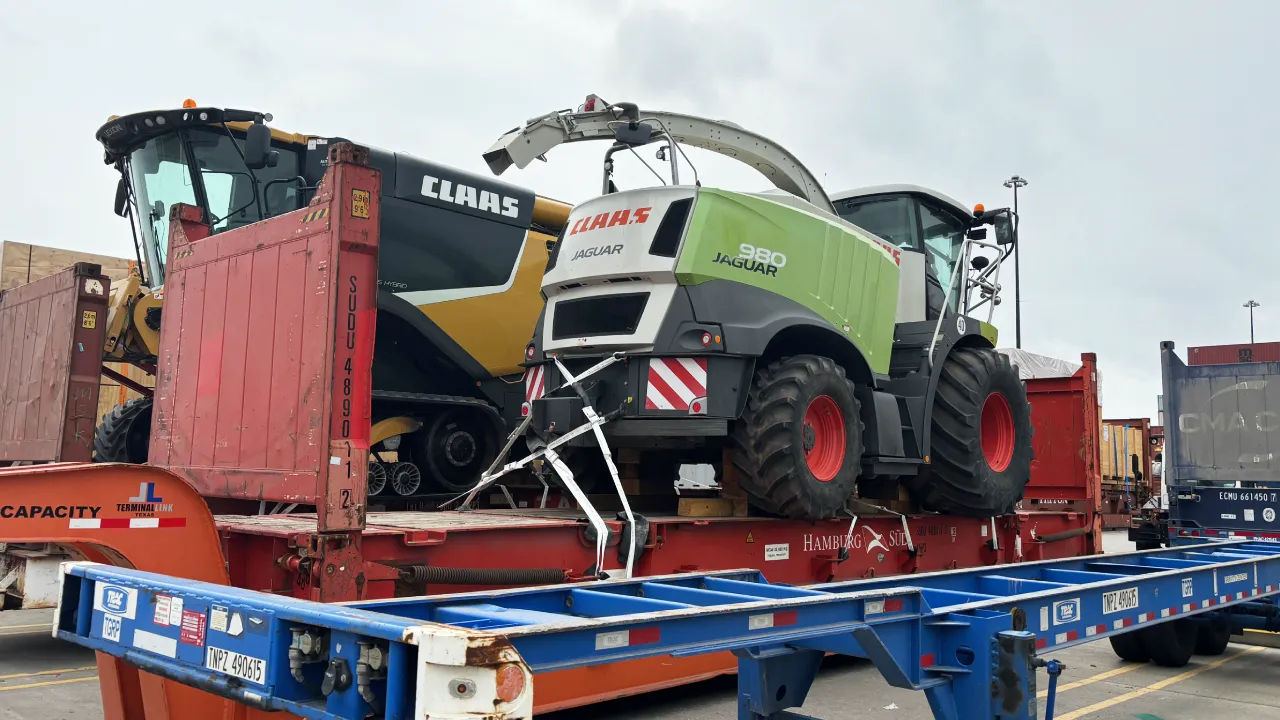
Flat rack containers are an alternative for heavy equipment transport that needs more physical protection than an open car deck provides. The tractor is crane-loaded onto the flat rack, secured, and shipped on standard container vessels. High-cube containers work for smaller tractors and parts shipments where enclosed transport makes sense.

International Tractor Shipping with Atlantic Project Cargo

Atlantic Project Cargo handles international transportation for tractors and broader agricultural equipment – from single units to larger multi-machine programs. Services include RoRo shipping, flat rack transport, export documentation, customs clearance coordination, and cargo insurance. For agricultural equipment shipping moving through ports that require specialized handling or multi-modal routing, the team coordinates directly with terminals and carriers across the full logistics chain.

Where Buyers Purchase Tractors Today

The used tractor market has shifted substantially online. Buyers who previously depended on local auctions and nearby dealer lots now search international inventory through platforms that aggregate listings across multiple countries. Platforms like JumboBee let buyers compare models, vet sellers, and think through the logistics of an international purchase before committing – which in practice means factoring shipping costs and timelines into the purchase decision rather than treating them as an afterthought.

The practical effect is that the used equipment market is more liquid than it has ever been. A tractor sitting on a lot in Germany can find a buyer in Chile. A fleet of machines coming off lease in the United States can move to West Africa. The logistics infrastructure to support those transactions has developed alongside the platforms that make them possible.

Frequently Asked Questions

By revenue, John Deere. By unit volume, Mahindra & Mahindra, which sells more tractors per year than any other company – driven by its dominant position in India and growing international sales.

It depends heavily on what you need. For large commercial operations with full precision agriculture integration, John Deere and Fendt are the consistent benchmarks. For compact tractors and overall value, Kubota and Mahindra are strong. For premium performance in European markets, Fendt, CLAAS, and Deutz-Fahr are the reference points.

India produces the highest number of tractor units annually, followed by China and the United States. Europe, Japan, and South Korea are significant manufacturing centers, particularly for premium and specialized equipment. Most of the top tractor manufacturers have production facilities spread across multiple countries rather than concentrated in a single location.

It varies by region and horsepower class. The John Deere 6M and Massey Ferguson mid-range series are among the highest global sellers. In India, Mahindra utility models like the 575 DI have sold in very large numbers over an extended period.

A standard tractor via RoRo from the U.S. to Europe typically runs $1,500 to $4,000, depending on the specific route and vessel schedule. Larger machines, flat rack requirements, or destinations without direct RoRo service push that figure higher. Customs duties and import taxes at the destination are separate and vary significantly by country.

Roll-on, roll-off is the standard method for moving tractors internationally. Equipment drives onto the vessel and is secured to the car deck – no crane handling, which reduces damage risk. It is well-established and cost-effective for machines within standard RoRo dimensions.

Trans-Atlantic from the U.S. to Europe is typically two to four weeks in transit. Trans-Pacific runs three to five weeks. Add customs clearance at the destination port – a few days in well-organized ports, longer in markets where documentation processing is slower or inspections are more common.

Need to Ship a Tractor Internationally?

Atlantic Project Cargo handles international tractor and agricultural equipment transportation worldwide – RoRo shipping, flat rack transport, customs clearance, export preparation, all coordinated through one provider. Contact our team to request a quote and plan your shipment.

Read More

May 21, 2026
Port Congestion Explained: Why Shipping Delays Happen and How to Reduce Risk
A ship does not sit at anchor for two weeks because of bad luck. It sits there because somewhere between the vessel's arrival and the...
May 19, 2026
Hurricane Season 2026: Why Yacht Owners Need to Move Now, Not Later
Every year, the Atlantic hurricane season catches yacht owners off guard. Storms don't wait for logistics to catch up — and neither does transport availability....
February 26, 2026
The Difference Between 3PL vs 4PL
As global supply chains grow more complex, companies increasingly rely on outsourced logistics partners to move goods efficiently, control costs, and manage risk. This is...
Share via