
Moving massive machinery across borders takes a lot more than a standard flatbed. Combines, tractors, and sprayers have extreme weights and awkward shapes that make transporting them a major headache. If you are trying to figure out how to ship farm equipment safely, you have to navigate a maze of domestic transport rules, strict environmental standards, and complex port operations.
Whether you are exporting a single tractor or an entire fleet, mastering international agricultural logistics means perfectly coordinating oversized load permits, specialized trucking, and rigorous border inspections.
From draining hydraulic fluids to passing intense cleanliness checks, every step carries unique risks. This guide breaks down what you need to know to get your heavy machinery safely to its final global destination.
What Types of Agricultural Equipment Can Be Shipped?
Agricultural machinery comes in countless shapes, sizes, and configurations. Understanding equipment dimensions and weight differences is critical because these factors directly dictate shipping complexity, trailer requirements, and ocean freight methods.
Self-propelled machinery considerations also play a major role. Equipment that can drive onto a vessel under its own power opens up cheaper and faster shipping routes compared to static machinery that requires crane lifting.
Below are common types of agricultural equipment shipped globally:
- Tractors: Ranging from compact utility models to massive articulated four-wheel-drive units. Shipping complexity depends on tire width, cabin height, and total weight. Standard tractors easily fit inside shipping containers or roll onto specialized vessels, while heavy-duty models require oversized cargo handling.
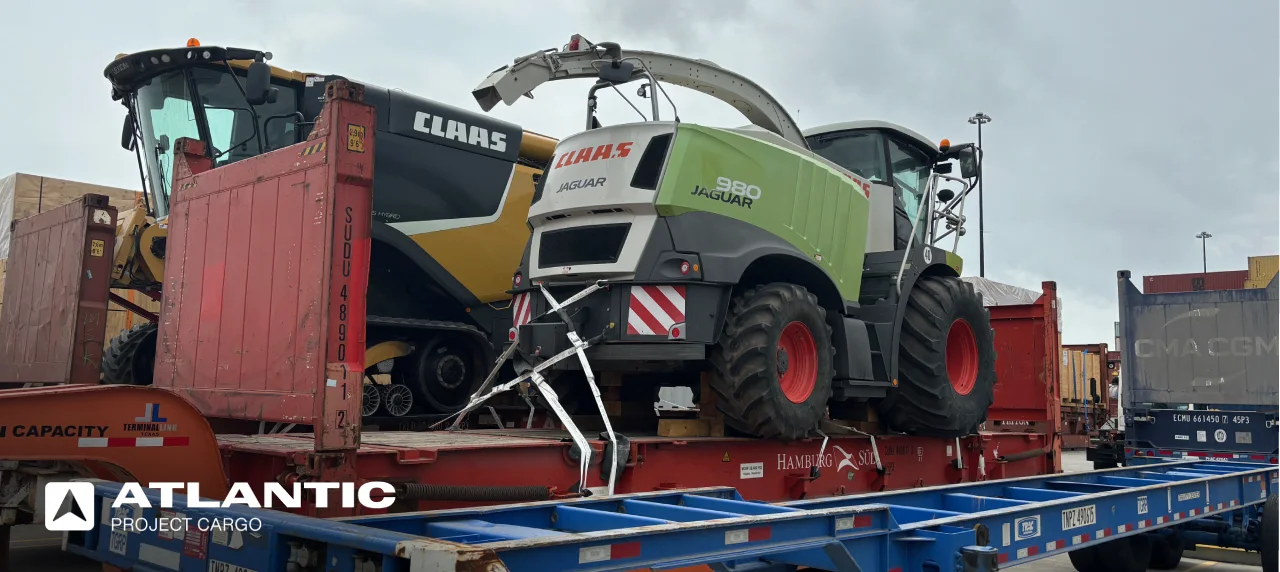
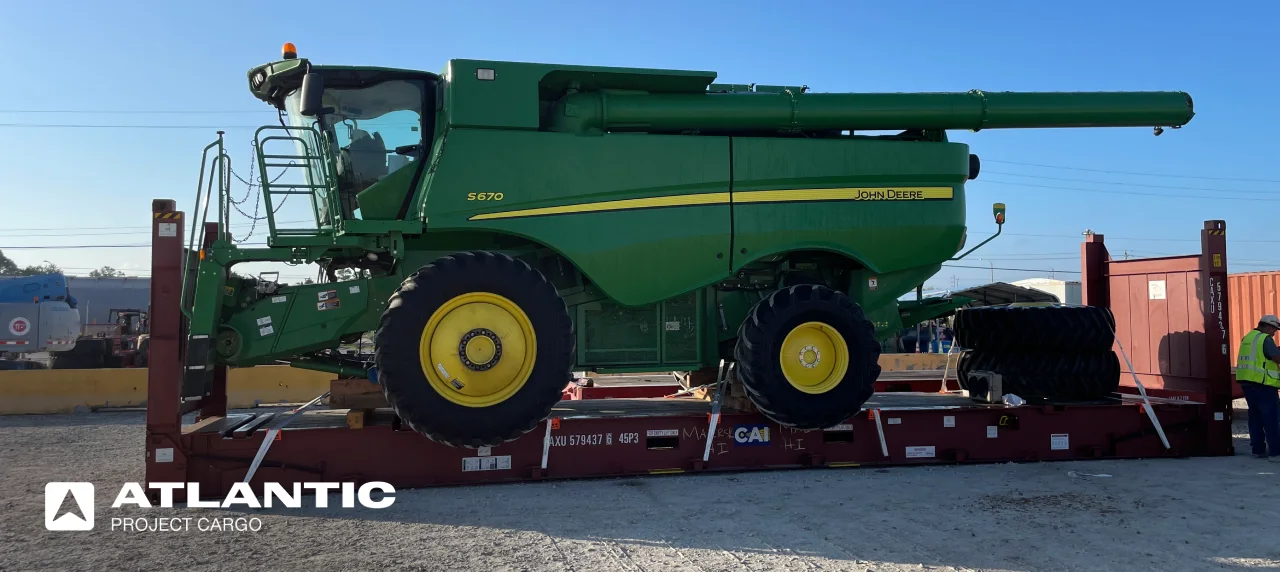
- Combines: Representing some of the most complex items in international agricultural logistics. Combines are exceptionally heavy, tall, and wide. Headers must almost always be removed and shipped separately on specialized trailers or flat racks.
- Harvesters: Similar to combines, forage and specialty crop harvesters feature irregular dimensions. High centers of gravity require careful weight distribution during inland trucking and ocean transit.
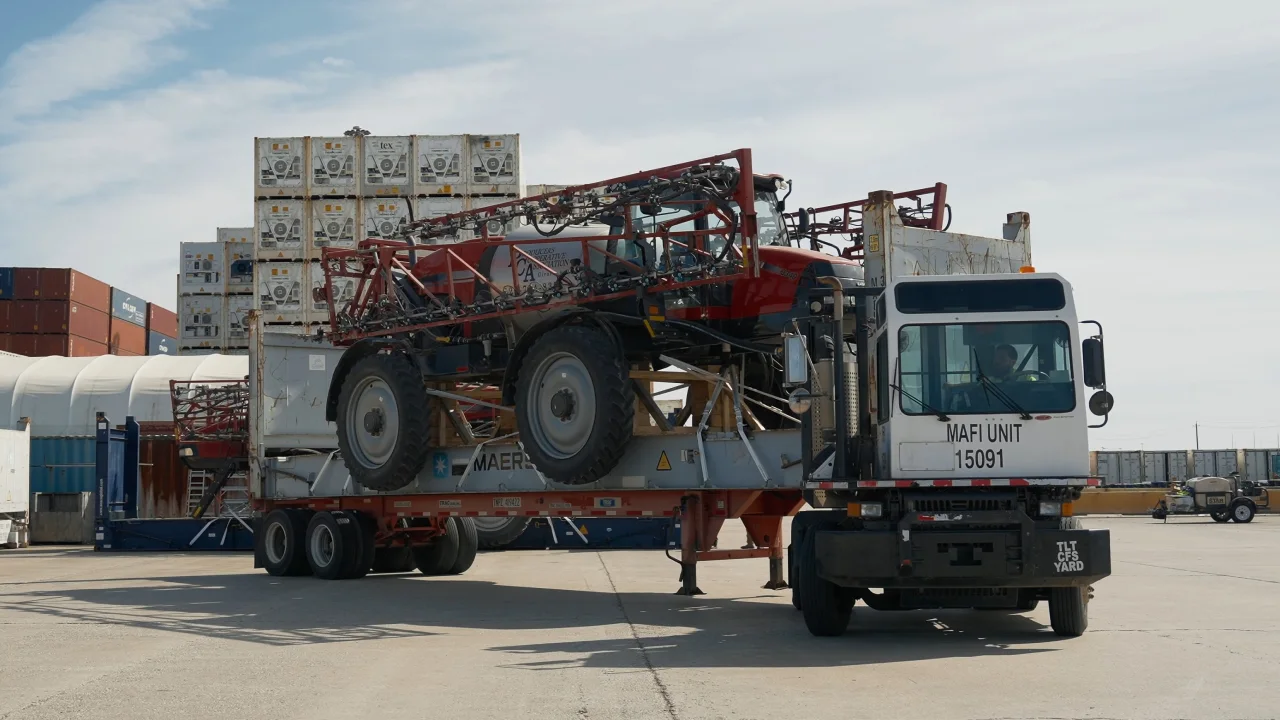
- Sprayers: Self-propelled sprayers have extremely wide track widths and high ground clearance. Transporting sprayers often requires specialized lowboy trailers to accommodate their awkward stance and keep their overall height below bridge clearance limits.
- Seeders and planters: Incredibly wide when deployed, though many fold for transport. Large units frequently exceed standard legal widths even when folded, necessitating out-of-gauge cargo permits.
- Balers: Round and square balers are generally easier to ship. Round balers tend to be bulky but usually fit within standard flatbed dimensions, making domestic and international transport straightforward.
- Irrigation systems: Center pivot irrigation systems consist of long metal pipes, motors, and wheels. These are almost always dismantled entirely and shipped inside standard 40-foot shipping containers to maximize space and protect components.
- Grain carts: Large capacity grain carts feature massive flotation tires and wide bodies. Because they are not self-propelled, they must be towed onto vessels or lifted via crane onto flat rack containers.
- Farm implements: Plows, cultivators, tillers, and mowers are typically static cargo. Depending on size, they are shipped in enclosed containers, strapped to flat racks, or bundled together as breakbulk cargo.
- Compact agricultural equipment: Skid steers, compact track loaders, and mini excavators used on farms are highly versatile and easy to ship. Their small footprint allows multiple units to fit inside a single shipping container.
How Agricultural Equipment Shipping Works
Executing a successful international shipment requires flawless coordination between multiple specialized parties. The full logistics process involves several distinct phases, each carrying specific operational requirements.
Seller, Farm, or Auction Pickup
Logistics begin at the origin point. Heavy machinery is picked up directly from rural farms, dealership lots, or auction sites. Pickup locations often lack loading docks, requiring specialized trailers with hydraulic ramps or detach systems to load equipment safely from ground level.
Inland Trucking and Drayage
Once loaded, machinery travels over highways to the designated departure port. Inland trucking for farming equipment often involves flatbeds, step decks, or Removable Gooseneck trailers. If the cargo is oversized, logistics providers must secure state-by-state permits and arrange escort vehicles. Drayage refers to the short-haul trucking of cargo between a port terminal, rail yard, warehouse, or nearby staging area. Drivers operating within port zones typically require specific security clearances.
Port Delivery and Handling
Upon arriving at the port, equipment undergoes rigorous receiving procedures. Port authorities inspect machinery for leaks, verify dimensions, and check documentation. Self-propelled machinery is driven to staging areas, while static cargo is unloaded via heavy-duty forklifts or reach stackers.
Cargo Securing and Ocean Freight
Loading equipment onto ships requires extreme precision. Stevedores drive self-propelled machinery onto specialized vessels and lash it to the deck using heavy-duty chains. For static cargo, crane operators lift flat racks onto the ship, where crews secure the cargo using steel cables, blocking, and bracing techniques to withstand ocean turbulence.
Customs Clearance
Before crossing international borders, all machinery must clear customs. This involves submitting commercial invoices, packing lists, export declarations, and environmental compliance forms. Customs officials may physically inspect the cargo to ensure compliance with biosecurity and trade regulations.
Final Delivery Coordination
After arriving at the destination port and clearing import customs, machinery is loaded back onto domestic trucks for final delivery. International routing requires deep knowledge of local infrastructure, as rural destination farms often feature narrow roads, low hanging trees, and unpaved access points that challenge heavy haul drivers.
Need Help Shipping Farm Equipment Internationally?
Atlantic Project Cargo coordinates inland transport, ocean freight, customs clearance, and oversized cargo logistics for tractors, combines, harvesters, and agricultural machinery worldwide.
Get Your Free Quote Today!
Best Shipping Methods for Agricultural Equipment
Selecting the correct shipping method depends entirely on equipment size, operational status, budget, and destination infrastructure. Focus on when each method is operationally appropriate to avoid unnecessary costs or transit delays.
Flatbed and Lowboy Transport
Domestic transport across North America relies heavily on open-deck trucking. Standard flatbeds handle smaller implements, tractors, and containerized parts. However, heavy machinery hauling requires specialized equipment.
- RGN trailers: Removable Gooseneck trailers detach at the front, creating a natural ramp that allows tractors and combines to drive directly onto the deck. RGN trailers also sit extremely low to the ground, providing crucial overhead clearance for tall machinery.
- Permits for oversized loads: When machinery exceeds legal width, height, or weight limits, logistics teams must route the shipment around low bridges and construction zones, securing municipal and state permits along the entire route.
RoRo Shipping
Roll-on/Roll-off shipping is the most efficient method for operational machinery. Vessels function like massive floating parking garages with heavy-duty ramps.
- Best for operational machinery: If equipment can steer, brake, and drive, it qualifies for RoRo.
- Cost-efficiency: Because machinery is driven on and off the ship rather than lifted by expensive cranes, port handling fees are significantly lower.
- Fast loading: RoRo shipping tractors and combines takes minutes compared to hours of crane work.
- Port requirements: Not all ports have RoRo infrastructure, meaning inland transport distances might increase if the closest port only handles container ships.
Flat Rack Shipping
When machinery cannot be driven, or when dimensions exceed standard container sizes, flat rack shipping is the primary solution.
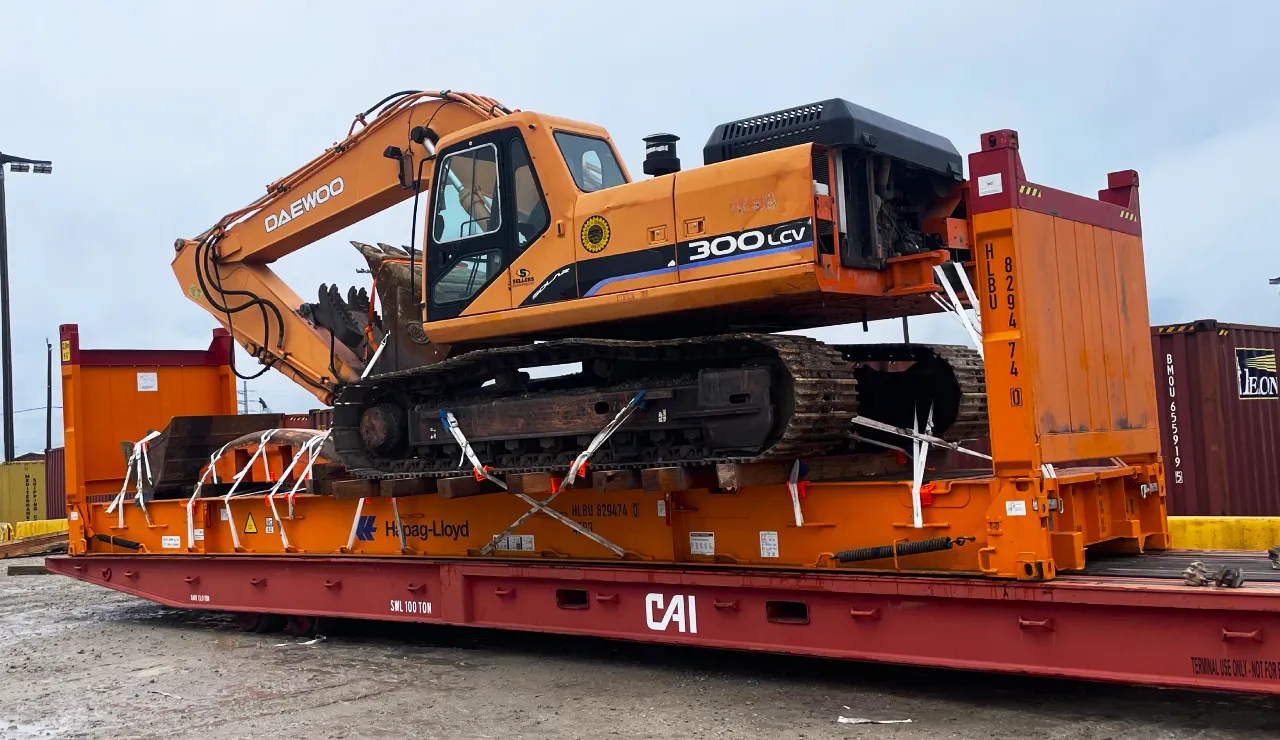
- Oversized machinery: Flat racks are open platforms with collapsible end walls but no sides or roof, allowing wide or tall equipment to overhang the edges.
- Irregular cargo dimensions: Combines with removed headers or massive static grain carts fit perfectly on flat racks.
- Disassembled equipment: Large farm implements can be strapped securely to the steel floor of a flat rack. Cargo is then lifted onto the deck of a container ship, which offers more global port destinations than RoRo vessels.
Container Shipping
Standard 20-foot and 40-foot enclosed containers offer the highest level of security and weather protection.
- Smaller equipment: Compact tractors, skid steers, and mowers fit easily inside standard containers.
- Attachments and spare parts: Buckets, plows, and replacement engines are safely boxed and shipped via container.
- Enclosed protection: Containers shield sensitive electronics and exposed metal from saltwater corrosion and harsh weather during transit.
Air Freight and Air Cargo Charters
While ocean freight for farm equipment is the industry standard for full machines, aviation plays a critical role in agricultural logistics.
- Urgent agricultural machinery: When a vital machine breaks down during peak harvest season, waiting weeks for ocean transit is not an option.
- Critical spare parts: Heavy-duty transmissions, hydraulic pumps, or electronic control units are frequently flown globally to minimize farm downtime.
- Emergency equipment delivery: Air cargo charters can transport entire compact tractors or specialized attachments overnight, though this method is exceptionally expensive and reserved for high-stakes operational emergencies.
RoRo vs Flat Rack for Farm Equipment
Choosing between RoRo and flat rack shipping is the most common dilemma in international agricultural logistics. Both methods handle heavy machinery, but they operate under completely different logistical frameworks.
| Feature | RoRo Shipping | Flat Rack Shipping |
|---|---|---|
| Costs | Generally lower due to minimal crane use and faster loading times. | Higher due to crane lifting fees, lashing materials, and out-of-gauge surcharges. |
| Loading | Driven directly onto the vessel via heavy-duty ramps. | Lifted via crane onto the vessel deck. Requires complex lashing and blocking. |
| Cargo protection | Typically stored on covered lower decks with good weather protection; upper open decks may have some exposure depending on vessel type and deck assignment. | Exposed to the elements on the deck of a container ship. Requires shrink-wrapping. |
| Equipment suitability | Perfect for operational tractors, combines, and self-propelled sprayers. | Ideal for non-running machinery, static implements, and massive oversized cargo. |
| Port availability | Limited to specialized RoRo ports with ramp infrastructure. | Available at almost any major global container terminal. |
| Operational requirements | Machinery must have functioning brakes, steering, and sufficient fuel. | Machinery must feature designated lifting points and strong lashing rings. |
When analyzing RoRo shipping tractors versus flat racks, RoRo almost always wins on price and safety, provided the tractor runs. However, if you are shipping a non-operational combine purchased from an auction, flat rack shipping becomes the mandatory alternative. Self-propelled sprayers often utilize RoRo, while wide, static farm implements require flat racks.
Not Sure Which Shipping Method Fits Your Equipment?
Our logistics specialists help determine the safest and most cost-effective transport solution based on equipment dimensions, destination, and shipping timeline.
Get Your Free Quote Today!
Preparing Agricultural Equipment for Shipping
Proper preparation prevents catastrophic delays at the port. Shipping lines and customs officials maintain zero tolerance for hazardous leaks or biosecurity threats. Learning how to ship farm equipment correctly starts long before the truck arrives for pickup.
- Machinery cleaning: This is the most critical step. Equipment must be thoroughly power-washed to remove all dirt, mud, seeds, and plant debris. USDA cleaning requirements for imported farm machinery are incredibly strict to prevent the spread of invasive pests and soil-borne diseases.
- Fluid draining: Fuel tanks must not exceed one-quarter full – the maximum permitted by vessel fire safety regulations.
- Battery handling: Batteries on non-running equipment or containerized machinery must be disconnected, and terminal ends taped to prevent accidental sparking.
- Loose parts securing: Mirrors, antennas, GPS domes, and exhaust stacks should be removed and stored safely inside the locked cabin.
- Tire pressure: Tires must be inflated to manufacturer specifications to ensure safe loading on RoRo ramps and prevent shifting during ocean transit.
- Disassembly requirements: Removing combine headers, dual wheels, or folding sprayer arms drastically reduces overall dimensions, potentially saving thousands of dollars in oversized shipping surcharges.
- Equipment inspections: Conduct a thorough walk-around inspection, taking detailed photographs of all existing scratches, dents, and mechanical conditions prior to shipping.
- Documentation: Ensure all serial numbers and VIN plates are clearly visible, clean, and match the export paperwork exactly.
USDA, EPA, and Customs Requirements for Agricultural Machinery
Navigating government regulations is the most legally complex aspect of farm equipment export and import. Failure to comply with federal standards results in cargo seizures, massive fines, and forced re-exportation at the owner’s expense.
USDA Inspection Requirements
The United States Department of Agriculture Animal and Plant Health Inspection Service mandates that all imported agricultural machinery must be entirely free of foreign soil, plant matter, and debris. Contamination risks are taken very seriously. If inspectors find even a single clump of dirt in a tractor wheel well or a handful of grain hidden inside a combine auger, the equipment will be flagged.
Soil and debris restrictions mean the machinery must either be meticulously cleaned at a designated port facility at great expense, or it will be denied entry entirely. Reference the USDA APHIS Agricultural Commodity Import Requirements (ACIR) database for current requirements.
Equipment originating from countries with active Foot-and-Mouth Disease (FMD) status carries an additional requirement: an original steam cleaning certificate issued by that country’s government animal health authority must accompany the shipment. Standard power washing alone is not sufficient for machinery imported from FMD-affected regions, which include parts of South America, Asia, and Africa. Confirm current FMD country status through APHIS before shipping.
EPA Regulations
The Environmental Protection Agency heavily regulates imported diesel engines. All self-propelled machinery requirements dictate that imported tractors, combines, and harvesters must meet current US emission standards. Importers must complete EPA Form 3520-21 to declare the machinery’s emissions compliance status, applicable Tier rating, or qualifying exemption category.
Importing older, non-compliant used machinery imports often requires obtaining specific exemptions or proving the equipment is strictly for export or testing purposes.
Customs Clearance
Clearing customs requires flawless import and export documentation. Required documents include the original Bill of Lading, a detailed commercial invoice, a packing list, and the equipment title or certificate of origin. Customs brokers facilitate this process, ensuring all Harmonized System codes accurately reflect the specific type of agricultural machinery being moved, which directly dictates the import tariffs and taxes applied to the shipment.
What Affects Agricultural Equipment Shipping Costs?
Budgeting for international agricultural logistics requires analyzing multiple dynamic variables. Because every machine is different, flat-rate pricing does not exist in heavy machinery logistics.
- Dimensions: Height, width, and length dictate the amount of space cargo occupies on a vessel. Oversized dimensions trigger out-of-gauge surcharges because the cargo blocks adjacent container slots.
- Weight: Extreme weight requires specialized multi-axle trailers for inland trucking and heavy-lift cranes at the port, increasing handling fees.
- Shipping method: RoRo is generally the most cost-effective, while air freight is the most expensive. Flat racks fall in the middle but incur additional lashing and securing costs.
- Origin and destination: Shipping along major trade routes is cheaper than routing equipment to remote, low-volume ports.
- Inland trucking distance: Transporting a combine from a rural farm in the Midwest to a coastal port often costs as much as the ocean freight itself.
- Permits: Oversized load permits, civilian escorts, and police escorts add significant costs to domestic highway transport.
- Port handling: Terminal handling charges, crane lifting fees, and mandatory port inspections fluctuate based on the specific port authority.
- Customs fees: Import duties, processing fees, and broker charges depend entirely on the equipment’s declared value and destination country regulations.
- Dismantling: Paying mechanics to remove combine headers or dual tires incurs upfront costs but often saves money by reducing overall shipping dimensions.
- Seasonality: Space on RoRo vessels becomes scarce and expensive during peak global harvest seasons when agricultural equipment movement spikes.
- Fuel costs: Ocean carriers and inland truckers apply dynamic fuel surcharges that fluctuate based on global oil markets.
Need an Accurate Farm Equipment Shipping Estimate?
Get a customized quote based on machinery dimensions, transport method, pickup location, and destination country.
Get Your Free Quote Today!
Common Challenges in Farm Machinery Shipping
Moving heavy machinery across the world rarely goes exactly as planned. Logistics experts must proactively manage a variety of operational hurdles to prevent delays and cost overruns.
- Oversized cargo restrictions: Many rural roads and older bridges simply cannot support the weight or height of modern agricultural machinery, requiring extensive route surveys and detours.
- Port congestion: Global supply chain bottlenecks frequently cause vessels to wait at anchor, delaying loading schedules and pushing back final delivery dates.
- Customs delays: A single missing document or a mismatched serial number can trap equipment in customs holds for weeks, incurring daily port storage fees.
- Weather exposure: Flat rack cargo is exposed to harsh saltwater spray and extreme weather. Without proper shrink-wrapping and anti-corrosion treatments, machinery arrives severely degraded.
- Permit delays: State transport departments can take days to approve oversized transport permits, stalling inland trucking operations.
- Equipment damage risks: Loading heavy machinery onto steel vessel decks involves inherent risks. Improper lashing leads to cargo shifting, causing severe structural damage during rough seas.
- Route limitations: Not all global ports possess the crane capacity or RoRo ramps required to handle massive combines or harvesters, forcing logistics providers to route cargo through distant alternative ports.
- International regulations: Changing import laws, sudden tariff implementations, and strict biosecurity updates constantly alter the landscape of international agricultural logistics.
- Non-running machinery: Transporting equipment with dead engines, broken hydraulics, or missing wheels requires expensive towing, specialized winches, and mandatory flat rack shipping, complicating the entire process.
Farm Equipment Auctions and International Shipping
Purchasing machinery from heavy equipment auctions presents a unique set of logistical challenges. Buyers must coordinate rapid equipment removal while managing complex international shipping workflows.
Auction purchases operate on strict timelines. Once the gavel drops, buyers usually have only a few days to remove the machinery from the auction yard before facing steep storage penalties. Equipment pickup requires dispatching specialized heavy-haul trucks to crowded auction sites, loading the machinery efficiently, and executing auction-to-port logistics seamlessly.
Export preparation is critical for auction machinery. Used equipment often requires intense power washing to meet biosecurity standards and mechanical servicing to ensure it can drive onto RoRo vessels. Title and document coordination is another major hurdle, as auction houses must release clear titles and bills of sale before customs brokers can file export declarations.
Once export clearance is granted, logistics teams manage port delivery, ensuring the machinery arrives within the vessel’s strict receiving window. For international purchasers, managing these moving parts from another continent is nearly impossible without a dedicated logistics partner.
This is where the Atlantic Project Cargo and JumboBee heavy equipment marketplace ecosystem provides immense value. Auction buyers, dealers, and exporters can source verified machinery through JumboBee and immediately transition into seamless international buyer logistics through Atlantic Project Cargo, ensuring a smooth transition from auction yard to international destination.
How Atlantic Project Cargo Ships Agricultural Equipment Worldwide
Successfully executing global heavy machinery logistics requires deep industry expertise and a robust global network. Atlantic Project Cargo handles every phase of the supply chain, ensuring your equipment arrives safely and compliantly.
Our logistics teams manage comprehensive inland transport coordination, securing the necessary permits, escort vehicles, and specialized RGN trailers to move oversized loads from rural farms to major coastal ports. We leverage strong partnerships with top ocean carriers to provide reliable RoRo and ocean freight solutions, ensuring operational machinery boards vessels quickly and cost-effectively.
For oversized or non-running equipment, our flat rack agricultural equipment specialists handle complex dismantling, crane lifting, and heavy-duty cargo lashing. We navigate regulatory hurdles through integrated customs brokerage, managing all export documentation, tariff classifications, and USDA/EPA coordination to prevent border delays.
From analyzing international routing options to managing delicate port logistics, Atlantic Project Cargo delivers end-to-end multimodal transportation solutions tailored specifically for the agricultural sector.
Looking for Reliable Agricultural Equipment Shipping?
Atlantic Project Cargo handles tractors, combines, harvesters, implements, and oversized agricultural machinery through fully coordinated international logistics solutions.
Get Your Free Quote Today!
FAQ Section
The best method depends on the machinery. In many cases, Roll-on/Roll-off shipping is the safest and most cost-effective method for operational, self-propelled equipment like tractors and combines. For static implements, non-running machinery, or severely oversized equipment, flat rack shipping is the industry standard. Smaller implements and spare parts are best shipped inside standard enclosed shipping containers.
Costs vary wildly based on dimensions, weight, distance, and shipping method. Inland trucking for oversized machinery can cost thousands of dollars due to permits and escorts. Ocean freight rates fluctuate based on global fuel prices and seasonal demand. Additionally, terminal handling charges, customs duties, and mandatory agricultural inspections all factor into the final price. Requesting a custom quote based on exact machinery specifications is the only way to get an accurate cost.
Yes, RoRo shipping tractors is the most common and efficient way to transport them internationally. As long as the tractor is fully operational, has working brakes, functioning steering, and inflated tires, it can be driven directly onto the vessel’s deck via heavy-duty ramps, bypassing expensive crane lifting fees.
For compact equipment that fits inside a standard 20- or 40-foot container without modification, container shipping is the most economical option. For larger, self-propelled machinery that exceeds container dimensions, RoRo is generally cheaper than flat rack shipping because it avoids heavy-lift crane charges and out-of-gauge surcharges.
Yes, any used agricultural machinery entering the United States faces rigorous USDA APHIS inspections. The equipment must be entirely free of soil, seeds, plant debris, and foreign pests. If inspectors find contamination, the machinery will be held at the port for mandatory, expensive decontamination, or it may be denied entry entirely. Thorough power washing prior to export is mandatory.
Preparing a combine requires extensive work. The massive header must be removed and shipped separately. Dual wheels are often removed to reduce the overall width and avoid extreme oversized cargo penalties. The machine must be meticulously power-washed to remove all field debris. Hydraulic fluids should be checked for leaks, fuel tanks reduced to no more than one-quarter full, and all loose cabin items secured.
For massive, irregular, or non-running oversized equipment, flat rack shipping is the best solution. Flat racks allow the equipment to overhang the sides and top of the container base. Cargo is lifted onto the vessel using heavy cranes and lashed securely to the deck. For operational oversized equipment, heavy-duty RoRo vessels with high ramp weight capacities are the preferred choice.
Yes, compact agricultural equipment like skid steers, mini excavators, small utility tractors, and ATVs fit easily inside standard shipping containers. Large machinery can also utilize container shipping if it is heavily disassembled. Shipping in containers provides excellent protection against weather, saltwater corrosion, and theft during transit.
Transit times depend heavily on the origin and destination ports. Ocean transit across the Atlantic can take 15 to 30 days, while trans-Pacific routes may take 20 to 40 days. However, total logistics time must account for inland trucking, permit approvals, port staging, customs clearance, and vessel availability. A complete international shipment generally takes anywhere from 4 to 8 weeks from farm pickup to final delivery.
Farm equipment export requires specific documentation to clear customs smoothly. Essential documents include the original Bill of Lading, a detailed Commercial Invoice listing the equipment’s value, a Packing List detailing dimensions and weights, and the original Title or Certificate of Origin to prove ownership. Additionally, environmental compliance forms like EPA declarations are required for self-propelled machinery engines.
Read More
Victoria Moseicuka
Nick Yadryshnikov
Victoria Moseicuka