
Hours of operations:
9AM - 5PM / UTC -5 (EST)

Heavy Equipment Shipping: Complete International Transport Guide

June 12, 2026
Shipping Quote
Customs Duties
Drayage Rate
Do you already own this equipment?

You Can Request a New Quote Every 15 Minutes

Please wait or contact us at [email protected]

Thank you for Choosing Us!

Looking to buy or sell heavy equipment?
With JumboBee, you can trade online with financing options and worldwide shipping.

Check Inventory
Calculate Import Duties
Get a free, no-obligation estimate of your import duties!
Calculate Import Duties
Get a Drayage Estimate
Get a free drayage estimate tailored to your exact needs!
Check a Drayage Rate
Home Insights Heavy Equipment Shipping: Complete International Transport Guide
Reviewed by
Nick Yadryshnikov Senior Account Manager

Moving massive machinery across oceans requires precision, engineering, and deep regulatory knowledge. Heavy equipment shipping is a highly specialized logistics process that moves oversized, overweight, and complex machinery between countries. Unlike standard container freight, heavy equipment transport involves intricate route planning, precise dimensional calculations, and strict compliance with international customs and environmental regulations.

Global industries rely on international heavy equipment shipping to maintain operations. Agricultural enterprises need combine harvesters before planting seasons. Construction firms wait on excavators to break ground. Mining operations require massive dump trucks to extract resources. Industrial facilities depend on specialized manufacturing units to keep production lines moving.

Shipping heavy equipment overseas is complex because every machine presents a unique physical profile. Minor differences in width, height, or weight drastically change shipping costs and risk levels. Oversized equipment shipping demands specialized expertise to navigate bridge weight limits, port crane capacities, vessel deck clearances, and strict agricultural washing requirements.

Request Heavy Equipment Shipping Quote

What Is Heavy Equipment Shipping?

Heavy machinery logistics involves coordinating multiple transportation modes to move large-scale machinery from a factory or job site in one country to a final destination in another. This process goes far beyond simply loading cargo onto a ship.

Oversized cargo transportation requires careful synchronization of domestic flatbed trucking, port terminal handling, ocean freight, and destination inland delivery. International heavy haul shipping experts must balance physical cargo dimensions against available vessel space and budget constraints.

When machinery exceeds standard dimensions, it becomes Out-of-Gauge cargo, known as OOG cargo. OOG cargo cannot fit inside standard 20-foot or 40-foot shipping containers. Multimodal transportation is essential here, seamlessly connecting lowboy trailers on highways with specialized Roll-on/Roll-off vessels or flat rack containers on ocean freighters.

Domestic transport focuses on highway permits and bridge clearances. International transport adds layers of port logistics, export documentation, customs clearance, and global freight coordination. Managing these moving parts requires an experienced freight forwarder like Atlantic Project Cargo.

Types of Heavy Equipment Commonly Shipped Internationally

Different machines require entirely different logistical approaches. Below are primary equipment categories and their specific transport requirements.

Excavators

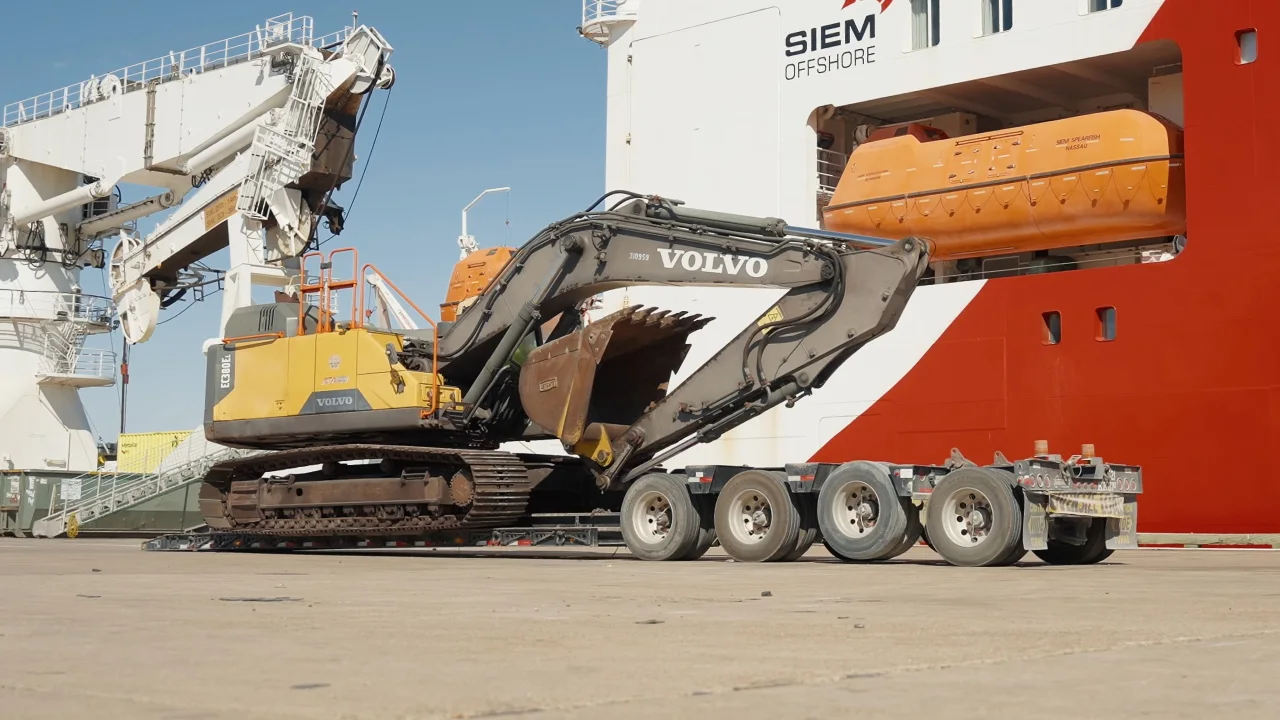
Typical dimensions range from 6 to 12 meters in length, 2.5 to 3.5 meters in width, and 3 to 4 meters in height.

Typical weight range spans 14,000 to 50,000 kilograms.

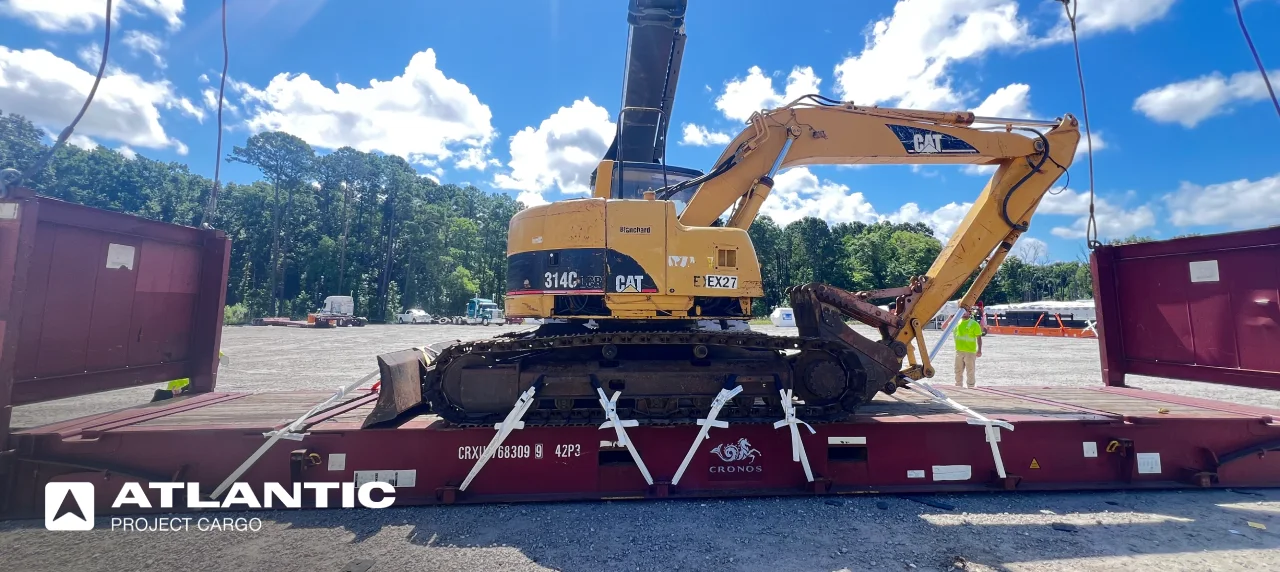
Common shipping methods include RoRo and flat rack shipping.

Transport challenges involve managing the boom and arm length.

Disassembly considerations often include removing the bucket, stick, and sometimes the tracks to reduce overall height and width, lowering shipping costs.

Bulldozers

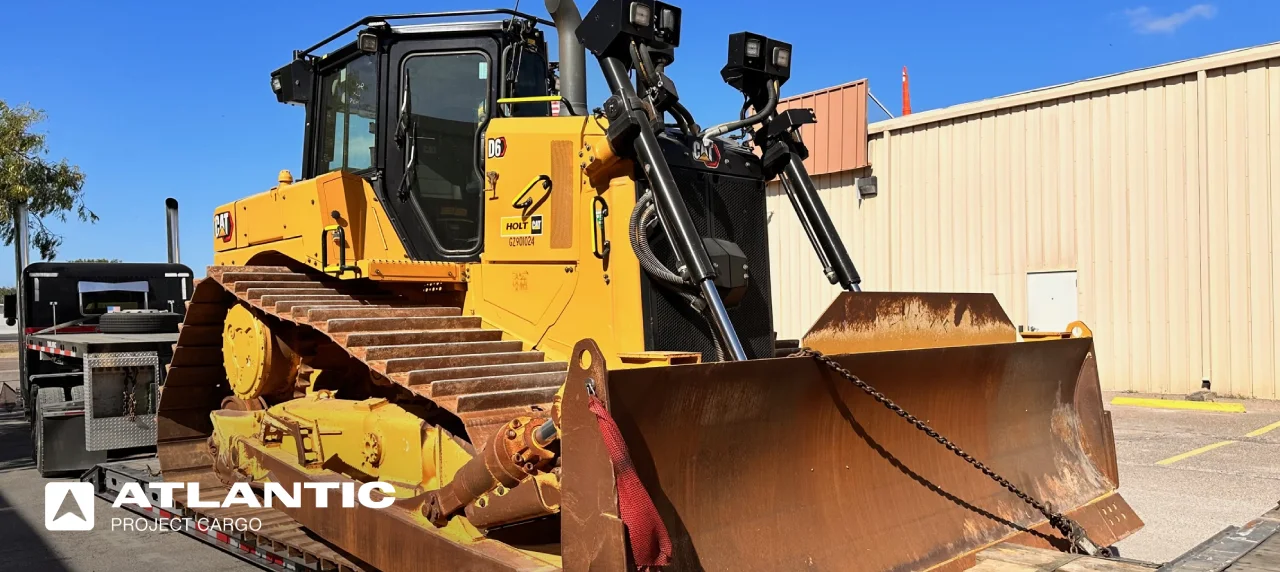
Typical dimensions range from 4 to 9 meters in length, 2.5 to 4.5 meters in width, and 3 to 4 meters in height.

Typical weight range spans 18,000 to 70,000 kilograms.

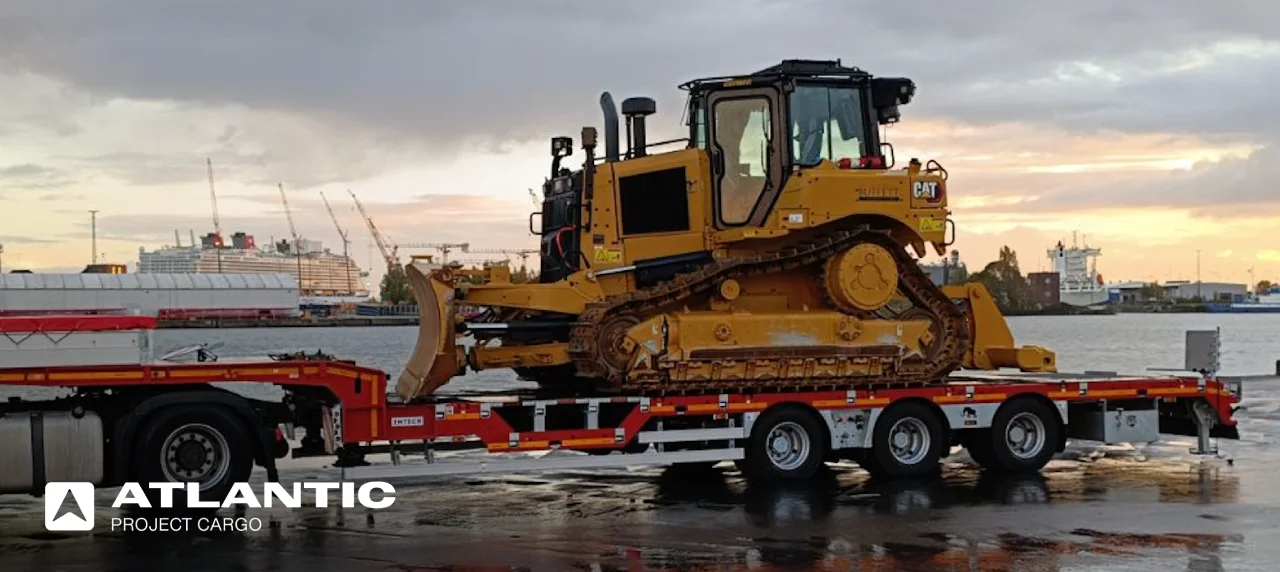
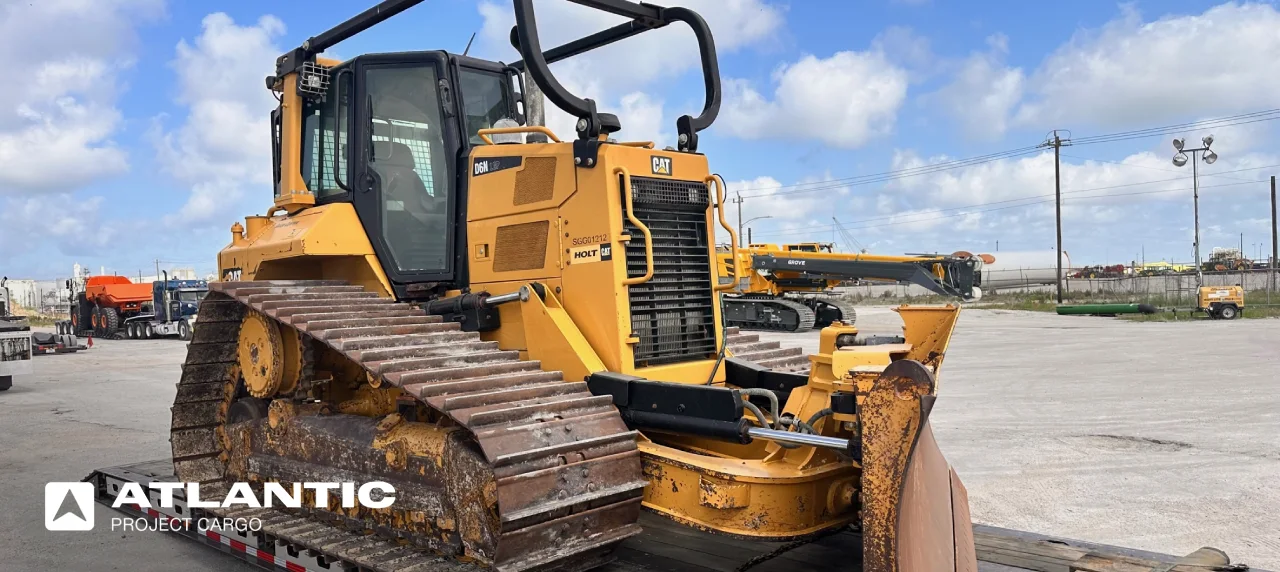
Common shipping methods include RoRo for self-propelled units and breakbulk for ultra-heavy models.

Transport challenges center around extreme weight density and wide blades.

Disassembly considerations usually require removing the front blade and rear ripper to fit standard transport widths.

Tractors

Typical dimensions range from 3 to 6 meters in length, 2 to 3 meters in width, and 2.5 to 3.5 meters in height.

Typical weight range spans 3,000 to 15,000 kilograms.

Common shipping methods include standard container shipping for smaller models and RoRo for larger agricultural tractors.

Transport challenges include strict USDA washing requirements for used agricultural machinery.

Disassembly considerations involve removing dual wheels and exhaust stacks to fit inside standard ocean containers.

Combine Harvesters

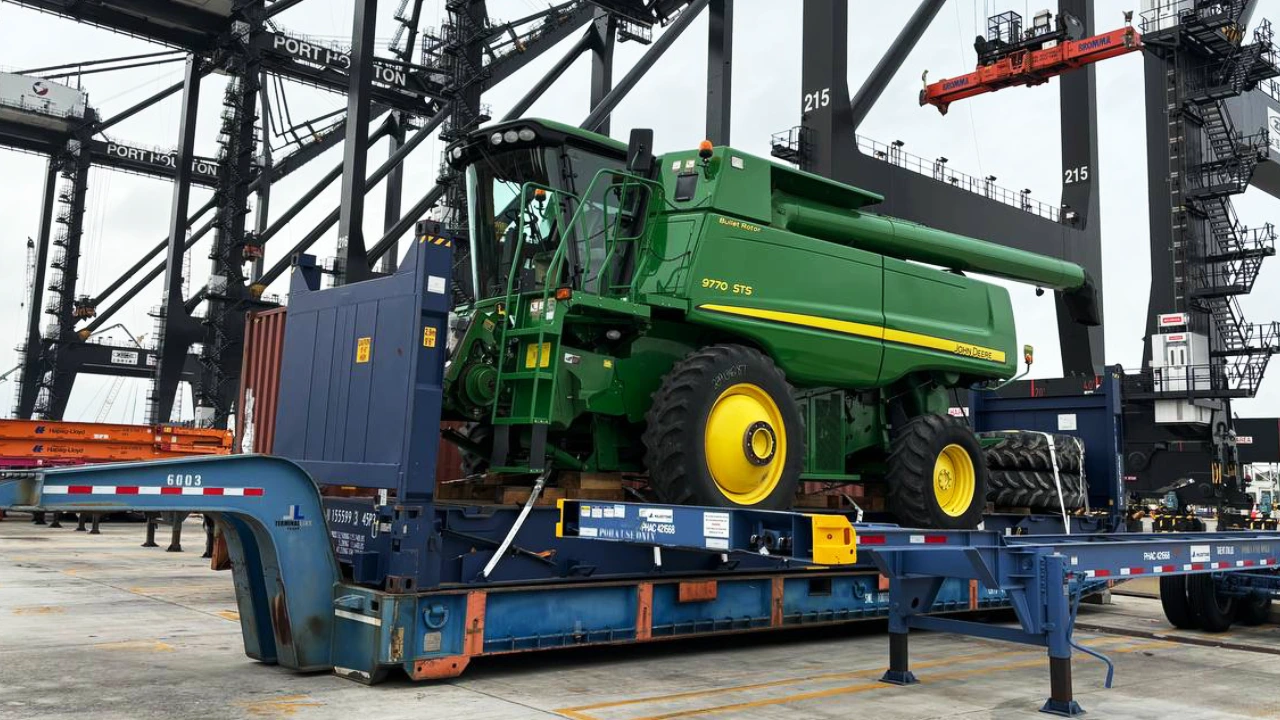
Typical dimensions range from 8 to 11 meters in length, 3.5 to 4.5 meters in width, and 3.8 to 4.5 meters in height.

Typical weight range spans 14,000 to 25,000 kilograms.

Common shipping methods rely heavily on RoRo and flat rack containers.

Transport challenges include extreme width and height, making inland trucking highly restricted.

Disassembly considerations require removing the header, wheels, and sometimes the cabin to reduce dimensions and avoid severe OOG surcharges.

Cranes

Typical dimensions vary widely, often exceeding 15 meters in length and 4 meters in height.

Typical weight range spans 30,000 to over 100,000 kilograms.

Common shipping methods include breakbulk shipping and specialized vessel cargo charters.

Transport challenges involve massive counterweights and long boom sections.

Disassembly considerations are mandatory, requiring the separation of booms, counterweights, and outriggers into multiple shipments.

Wheel Loaders

Typical dimensions range from 6 to 9 meters in length, 2.5 to 3.5 meters in width, and 3.2 to 3.8 meters in height.

Typical weight range spans 10,000 to 35,000 kilograms.

Common shipping methods feature RoRo transport due to wheeled mobility.

Transport challenges include securing articulated joints during ocean transit.

Disassembly considerations include removing the front bucket and cab roof if height restrictions apply.

Mining Equipment

Typical dimensions often exceed all standard road and port limits.

Typical weight range spans 50,000 to 300,000 kilograms.

Common shipping methods require breakbulk shipping and heavy-lift vessels.

Transport challenges involve coordinating specialized port cranes and multi-axle modular trailers.

Disassembly considerations require complete teardowns, shipping tires, dump bodies, and chassis as separate breakbulk pieces.

Industrial Machinery

Typical dimensions depend entirely on the manufacturing plant specifications.

Typical weight range spans 5,000 to 80,000 kilograms.

Common shipping methods utilize flat rack shipping and standard containers for smaller parts.

Transport challenges include protecting sensitive electronic components from saltwater and humidity.

Disassembly considerations involve unbolting modular factory components and utilizing export rigging and crating services.

Equipment Compatibility Table

Equipment Type Typical Shipping Method Requires Disassembly OOG Risk
Excavators RoRo / Flat Rack Sometimes High
Bulldozers RoRo / Breakbulk Yes (Blade) High
Tractors Container / RoRo Sometimes (Wheels) Low to Medium
Combines RoRo / Flat Rack Yes (Header/Wheels) Very High
Cranes Breakbulk Always Extreme
Wheel Loaders RoRo Sometimes (Bucket) Medium
Mining Equipment Breakbulk Always Extreme
Industrial Machinery Flat Rack / Container Varies High

Heavy Equipment Shipping Methods

Selecting the right shipping method dictates your budget, transit time, and cargo safety. International heavy equipment shipping primarily relies on five distinct ocean and air freight methods.

RoRo Shipping

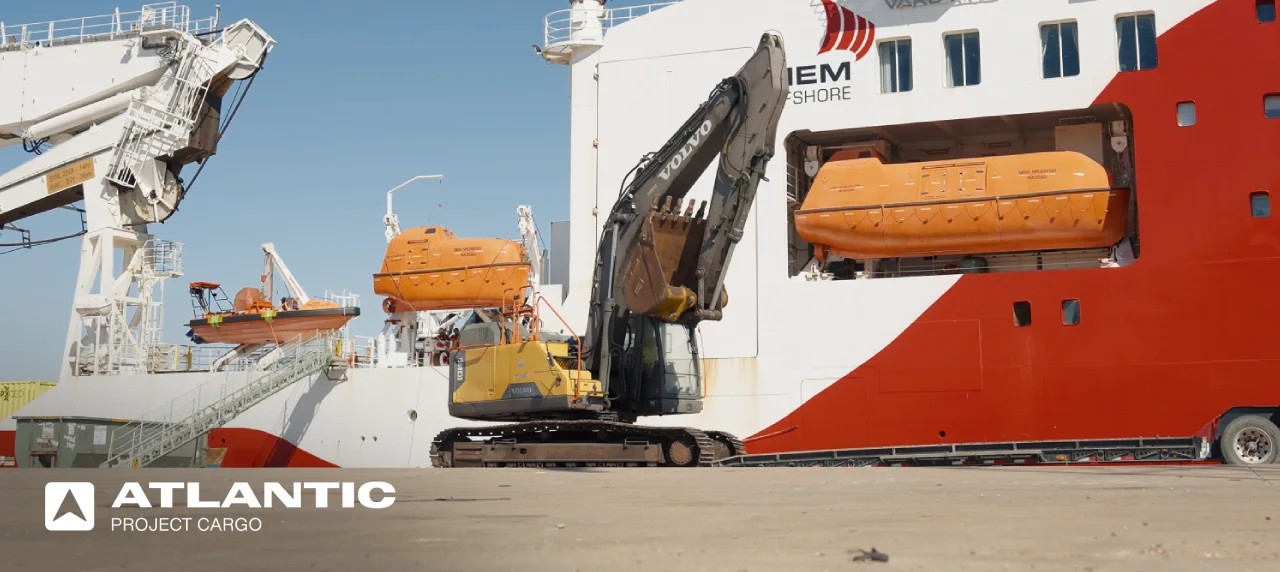
Roll-on/Roll-off shipping involves driving self-propelled machinery directly onto the vessel deck via a heavy-duty ramp.

How it works: Port workers drive your equipment into the ship belly, parking it securely on designated decks, much like a floating parking garage.

Best use cases include tractors, wheeled loaders, motor graders, and any operational equipment with wheels or tracks.

Limitations apply to non-operational equipment, static machinery, and cargo exceeding the vessel ramp height or weight capacity.

Cost advantages are significant because RoRo eliminates expensive port crane lifting fees and flat rack container leasing costs.

Self-propelled machinery compatibility is extremely high, making RoRo the preferred method for the global construction and agricultural sectors.

Flat Rack Shipping

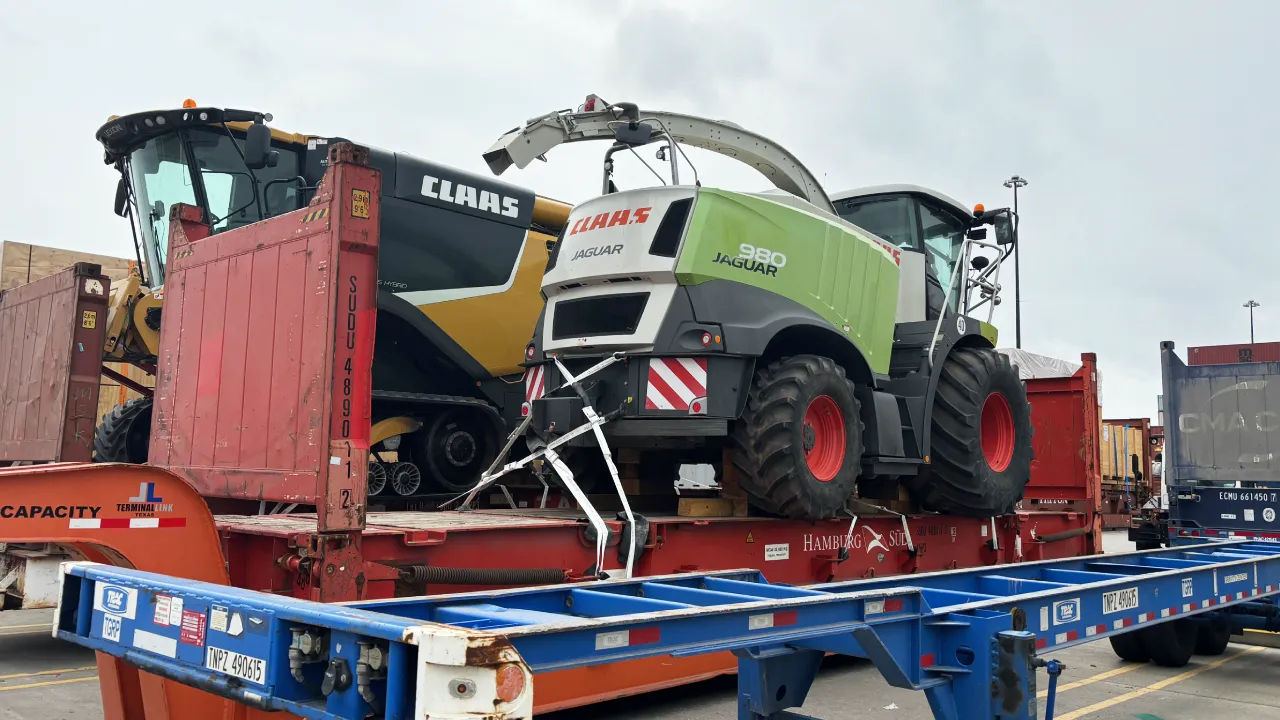
Flat rack containers have a reinforced floor and two collapsible end walls, lacking side walls and a roof.

Oversized cargo applications allow machinery to protrude from the top and sides of the container.

Top/side loading allows port operators to lift heavy machinery transport units onto the rack using heavy reach stackers or overhead cranes.

Securing heavy machinery requires heavy-duty lashing chains, steel wire, and specialized blocking and bracing techniques.

OOG cargo compatibility makes flat racks perfect for excavators and industrial machinery that cannot roll onto a vessel but are too large for standard closed containers.

Breakbulk Shipping

Breakbulk shipping involves loading massive cargo directly into the hold or onto the deck of a specialized vessel, without using standard containers.

Project cargo heavily relies on breakbulk for massive infrastructure components.

Ultra-heavy equipment exceeding 40 tons or 12 meters in length often mandates this method.

Crane loading utilizes heavy-lift ship cranes or massive shore-based gantry cranes to hoist cargo.

Industrial shipments like gas plant equipment, petrochemical vessels, and massive mining dump trucks use breakbulk exclusively.

Container Shipping

Standard 20-foot, 40-foot, and 40-foot High Cube containers offer the most secure enclosed transport.

When containers are suitable: Smaller tractors, skid steers, mini-excavators, and dismantled machinery parts fit perfectly.

Dismantling requirements often force shippers to remove wheels, tracks, and cabs to slide machinery inside.

Standard container limitations restrict cargo width to 2.35 meters and height to 2.39 meters (2.70 meters for High Cube).

Machinery compatibility is limited to compact equipment, though containerization offers the cheapest base freight rates and maximum protection against ocean elements.

Air Freight

Air freight utilizes cargo aircraft for rapid global transit.

Urgent shipments facing critical project deadlines rely on air cargo charters.

Spare parts required to fix broken down machinery often fly via air freight to minimize costly operational downtime.

High-value cargo such as sensitive industrial robotics benefits from the smooth transit and minimal handling of air transport.

Method Comparison Table

Method Best For Cost Level Transit Speed Key Limitations
RoRo Wheeled & tracked operational equipment Moderate Moderate Cargo must be self-propelled
Flat Rack Oversized non-drivable equipment High Moderate Exposed to ocean elements
Breakbulk Ultra-heavy project cargo Very High Slow Requires specialized heavy-lift ports
Container Compact or dismantled equipment Low Moderate Strict size and weight limits
Air Freight Urgent parts and high-value machinery Extreme Very Fast Strict weight and dimension limits

Which Heavy Equipment Shipping Method Should You Choose?

Choosing between RoRo, flat rack, and breakbulk requires analyzing your equipment dimensions, operational status, and budget.

When RoRo works best: Choose RoRo if your equipment runs, drives, and steers, and if the destination port has RoRo ramp facilities. It is generally the safest and most economical way to ship agricultural and construction vehicles.

When flat rack is required: Opt for flat racks when your equipment is non-operational, static, or slightly exceeds standard container dimensions, but is not large enough to justify an entire breakbulk charter. Flat racks are essential for industrial machinery and static chemical equipment.

When breakbulk is unavoidable: Breakbulk is required when cargo exceeds the safe working load of flat racks (typically around 40 to 45 metric tons) or is too wide for standard container ship cell guides.

When containers are cost-effective: Use standard containers if your equipment is compact, or if the cost of labor to dismantle the equipment is lower than the OOG surcharges associated with flat rack shipping.

When air freight makes sense: Select air transport only when the cost of project downtime exceeds the premium cost of air cargo.


Shipping Decision Matrix

Cargo Status Dimensions Recommended Method Secondary Option
Operational Standard RoRo Container (if small)
Operational Oversized RoRo Breakbulk
Non-Operational Fits Container Container Flat Rack
Non-Operational Oversized Flat Rack Breakbulk
Non-Operational Massive (40t+) Breakbulk Vessel Charter

How to Ship Heavy Equipment Internationally

Successfully shipping heavy equipment overseas involves a sequential, highly coordinated logistics chain. Missing a single step can result in thousands of dollars in port storage fees.

Equipment inspection

Conduct a thorough mechanical and physical inspection. Document existing scratches, dents, and mechanical issues. Verify if the equipment is fully operational, as this determines RoRo eligibility.

Measuring dimensions

Measure the exact length, width, and height down to the centimeter. Include all attachments, exhaust pipes, mirrors, and protruding bolts. Incorrect measurements lead to rejected cargo at the port.

Cleaning & preparation

Wash the equipment thoroughly. Remove all dirt, mud, seeds, and plant matter. International agricultural regulations demand spotless machinery to prevent the spread of invasive species and soil-borne pathogens.

Disassembly

Remove easily detachable parts like buckets, blades, and dual tires. Lowering the overall volume and footprint drastically reduces ocean freight costs and inland trucking permit requirements.

Documentation

Gather the original commercial invoice, packing list, and title or bill of sale. Prepare the Shipper Letter of Instruction. Accurate paperwork ensures smooth export customs clearance.

Choosing a transport method

Consult with your freight forwarder to evaluate RoRo, flat rack, or container options based on your exact dimensions and destination port capabilities.

Port logistics

Coordinate inland drayage using specialized lowboy or step-deck trailers. Secure necessary state and local oversize trucking permits to move the equipment from the origin site to the export port.

Customs clearance

Submit export declarations to origin customs. Ensure your customs broker handles all EPA, DOT, and export compliance filings well before the vessel departure date.

Ocean freight coordination

Book vessel space weeks in advance. Coordinate the delivery window at the port terminal, ensuring the cargo arrives before the strict vessel cut-off date.

Final delivery

Arrange import customs clearance, pay applicable import duties, and coordinate destination inland trucking to deliver the machinery to the final job site.

Shipping Process Timeline

Day 1: Equipment measurement and method selection

Day 3: Freight booking and inland transport scheduling

Day 7: Disassembly and rigorous cleaning

Day 10: Inland transport to export port terminal

Day 12: Export customs clearance processing

Day 15: Cargo loading onto ocean vessel

Day 15-45: Ocean transit

Day 46: Import customs clearance and duties payment

Day 48: Final inland delivery to destination

What Makes Equipment Out-of-Gauge (OOG)?

Out-of-Gauge cargo is any freight that exceeds the physical dimensions of standard ocean shipping containers. Understanding these limits is crucial for heavy equipment logistics.

Standard container limitations define the baseline. A standard 40-foot High Cube container has internal dimensions of roughly 12.03 meters in length, 2.35 meters in width, and 2.70 meters in height. The door opening is slightly smaller. If your machinery exceeds any of these numbers, it is OOG.

Overwidth cargo exceeds 2.35 meters. This is common with combine harvesters, large bulldozers, and wide-track excavators. Overwidth cargo on a flat rack requires the shipping line to leave adjacent container slots empty on the vessel, resulting in lost slot revenue which is billed back to you as an OOG surcharge.

Overheight cargo exceeds 2.70 meters. Tall tractor cabs, crane cabins, and industrial silos frequently hit this limit. Overheight flat racks cannot have other containers stacked directly on top of them under deck, again resulting in lost slot surcharges.

Overweight cargo exceeds the payload capacity of standard containers, typically around 26,000 to 28,000 kilograms. Extremely heavy cargo requires specialized flat racks or direct breakbulk loading to ensure vessel stability.

When flat rack/open top shipping becomes necessary: The moment your equipment hits 2.4 meters wide or 2.7 meters high, you must transition from standard containers to specialized OOG equipment.

Container Dimension Examples

Container Type Max Length Max Width Max Height Max Payload
20ft Standard 5.89m 2.35m 2.39m 28,000 kg
40ft High Cube 12.03m 2.35m 2.70m 28,600 kg
40ft Flat Rack 11.98m 2.374m (floor width between stanchions: ~2.23m) Open 39,600–47,300 kg (carrier-dependent)

Note: Flat rack width figures reflect internal usable width. The narrower between-stanchion measurement (~2.23m) applies to cargo resting on the floor between the end posts.

Heavy Equipment Shipping Costs

Calculating heavy equipment shipping cost requires analyzing multiple dynamic variables. Base ocean freight is only one piece of the puzzle.

Dimensions dictate the core freight rate. Ocean carriers charge based on volume, typically measured in cubic meters (CBM) or weight measure (W/M). A machine that is 10 meters long, 3 meters wide, and 3 meters high equals 90 CBM.

Weight impacts inland trucking costs and port crane fees. Extremely dense machinery may trigger heavy-weight surcharges on ocean vessels due to deck strength limitations.

Shipping method changes the pricing structure entirely. RoRo charges per CBM. Flat racks charge a base container rate plus OOG surcharges for lost slots. Breakbulk charges per revenue ton.

Fuel prices, known as Bunker Adjustment Factors (BAF), fluctuate monthly based on global oil markets and directly impact the final invoice.

Permits for inland trucking add significant costs. Oversized loads require route surveys, state highway permits, and sometimes police escorts.

Port fees include terminal handling charges, wharfage, and heavy-lift crane usage.

Route selection influences price. Direct routes cost more but save time. Transshipment routes (changing ships mid-voyage) are cheaper but increase transit time and damage risk.

Insurance premiums are calculated based on the commercial value of the machinery and the route risk profile.

Seasonality affects vessel space. Shipping agricultural equipment right before harvest season often involves peak season surcharges.

Realistic Shipping Scenarios

Tractor shipping scenario: Moving a John Deere 8R tractor from Baltimore, USA to Bremerhaven, Germany via RoRo. Dimensions: 6.0m x 2.5m x 3.3m (49.5 CBM). At an illustrative 2026 RoRo rate of approximately $110 per CBM, the base ocean freight is $5,445. Note: RoRo rates experienced significant volatility in late 2025 due to USTR Section 301 fees on non-US-built vessels, followed by a one-year fee suspension (November 2025–November 2026). Actual rates vary by carrier and booking date – request a current quote before budgeting.

Excavator shipping scenario: Moving a Caterpillar 320 excavator from Savannah, USA to Jebel Ali, UAE via Flat Rack. The excavator is overwidth and overheight. Flat rack base rate: $4,500. Lost slot OOG surcharges for overwidth/overheight: $3,200. Flat rack lashing and securing at port: $1,200. Total ocean segment: $8,900.

Combine transport scenario: Moving a New Holland CR9070 from Houston, USA to San Antonio, Chile. Due to massive dimensions, it requires RoRo transport. Dimensions: 10.5m x 3.5m x 4.0m (147 CBM). At $135 per CBM, ocean freight is $19,845. Inland trucking requires specialized lowboys and escorts, adding $4,500 for domestic transport.

Avoid guessing your logistics budget. For precise, real-time calculations tailored to your exact machinery, use our Heavy Equipment Shipping Estimation.

How to Reduce Heavy Equipment Shipping Costs

Smart logistics planning can shave thousands of dollars off your final invoice.

Disassembly

Removing the boom from an excavator or the header from a combine reduces the total cubic volume. Since RoRo rates are based on CBM, reducing volume directly reduces cost. Disassembly also brings OOG cargo back into standard gauge, eliminating expensive lost slot surcharges on flat racks.

Consolidation

If shipping multiple smaller machines, consolidate them onto a single 40-foot flat rack rather than shipping them individually via RoRo. Combining cargo maximizes space efficiency.

Choosing the right port

Inland trucking is incredibly expensive for oversized loads. Choose an export port closest to the equipment origin, even if the ocean freight rate is slightly higher. A shorter truck ride often saves more money than a cheaper ocean rate from a distant port.

RoRo vs Flat Rack economics

Always compare RoRo and flat rack quotes. If your equipment is drivable, RoRo is almost always cheaper because it avoids flat rack lashing costs and OOG space surcharges.

Route optimization

Work with a freight forwarder who has access to multiple carriers. Sometimes routing cargo through a different regional hub yields much lower freight rates.

Booking ahead

Vessel space for heavy machinery transport fills up fast. Booking 4 to 6 weeks in advance protects you from last-minute spot market rate spikes.

Reducing storage and demurrage fees

Ensure all customs paperwork, titles, and commercial invoices are flawless before the cargo arrives at the port. Customs holds result in massive daily port storage and demurrage fees.

Cost-Saving Checklist

  • Remove all detachable blades, buckets, and attachments
  • Drain unnecessary fluids to reduce weight
  • Compare RoRo rates against Flat Rack dismantling costs
  • Secure inland oversize permits early to avoid rush fees
  • Verify equipment starts on the first try to avoid RoRo towing fees
  • Wash equipment before reaching the port to avoid terminal cleaning fee


Heavy Equipment Shipping Regulations & Compliance

As of 2026, international regulatory bodies enforce strict compliance for machinery transport. Atlantic Project Cargo specializes in navigating these complex legal frameworks.

Oversized permits

Domestic transport requires state-by-state oversize permits. Each state has different rules regarding travel times, holiday restrictions, and maximum axle weights.

EPA & DOT requirements

Importing heavy equipment into the United States requires strict Environmental Protection Agency (EPA) compliance. New equipment engines must meet current Tier 4 Final emissions standards. Used or older equipment may qualify under transition provisions or grandfather exemptions – importers must file EPA Form 3520-21 and declare the applicable compliance category. Consult your customs broker to determine which exemption pathway applies to your specific machine.

DOT Form HS-7 is required if the machinery is classified as a motor vehicle capable of operating on public roads. Most off-road construction and agricultural equipment is exempt from this requirement, but road-going variants such as boom trucks and certain crane carriers must declare compliance.

USDA cleaning requirements

The United States Department of Agriculture (USDA) enforces zero-tolerance policies for imported soil and organic matter. Used agricultural and construction equipment must undergo rigorous USDA Equipment Inspection and washing to prevent the introduction of foreign pests.

Fumigation

Some destination countries require wooden export rigging and crating to be fumigated and stamped with ISPM-15 certification to prove it is free of wood-boring insects.

Customs documentation

Accurate Harmonized System (HS) codes must be applied to the commercial invoice. Incorrect HS codes lead to cargo seizures and severe financial penalties.

Export/import restrictions

Certain high-tech industrial machinery falls under dual-use export controls, requiring special licenses from the Bureau of Industry and Security to ensure the equipment is not used for unauthorized military purposes.

Escort vehicle requirements

Moving massive mining machinery often requires civilian pilot cars or active police escorts to manage traffic, block intersections, and ensure safe highway transit.


Preparing Heavy Equipment for Shipping

Proper preparation prevents damage, delays, and unexpected fees at the port terminal.

Cleaning

Pressure wash the entire machine. Pay special attention to the undercarriage, wheel wells, radiator grills, and tracks. Even a handful of dried mud can trigger a customs hold and mandatory port-side cleaning, which is exorbitantly expensive.

Fluid draining

Reduce fuel levels to a maximum of one-quarter tank. Drain all water systems to prevent freezing during winter ocean transits. Ensure hydraulic systems are sealed and not leaking.

Battery disconnect

For containerized or flat rack shipping, disconnect the battery cables and tape the terminals to prevent accidental sparks or battery drain. For RoRo shipping, ensure the battery is fully charged so port workers can drive the machine.

Securing loose parts

Zip-tie doors shut, tape over fragile glass gauges, and secure all loose cables. Remove antennas, mirrors, and GPS monitors, storing them safely inside the locked cabin.

Measuring dimensions

Re-measure the equipment after complete preparation. Ensure the dimensions match the booking confirmation exactly.

Photographing equipment

Take high-resolution, timestamped photos of the equipment from all angles, including the interior, undercarriage, and engine bay. This is your primary defense in case of an insurance claim.

Inspection documentation

Complete a signed mechanical condition report noting all existing wear and tear before handing the equipment over to the inland trucker.

Pre-Shipping Checklist Block

  • Pressure wash undercarriage and tracks
  • Reduce fuel to 1/4 tank
  • Remove GPS screens and fragile attachments
  • Tape exhaust pipes to prevent saltwater intrusion
  • Verify battery charge for RoRo loading
  • Take 360-degree timestamped photographs
  • Measure final L x W x H dimensions
  • Prepare commercial invoice and title


Heavy Equipment Shipping Insurance

Ocean freight is inherently risky. Vessels encounter violent storms, extreme rolling, and saltwater spray. Standard carrier liability pays pennies on the dollar based on cargo weight, not commercial value.

Cargo insurance is non-negotiable for international machinery shipping. You must purchase comprehensive all-risk coverage that protects the equipment from origin door to destination door.

Marine insurance covers specific physical damage caused during ocean transit, including heavy weather damage, shifting cargo, and loading/unloading accidents at the port.

General average is a maritime law principle you must understand. If a vessel suffers a major emergency (like a fire or grounding), the captain may jettison cargo to save the ship. Under General Average, all cargo owners on the ship must proportionally share the financial loss, even if their specific equipment survived untouched. Without cargo insurance, you will be personally liable to post a General Average bond – potentially tens of thousands of dollars – before your machinery is released. Cargo insurers post this bond on behalf of insured clients, which is one of the most practical reasons comprehensive marine insurance is essential.

War & strike risks coverage protects your investment if the vessel travels through geopolitically unstable regions where piracy, blockades, or port strikes occur.

Damage protection requires proper documentation. If equipment arrives damaged, you must note the damage on the delivery receipt immediately; otherwise, the insurance claim will be denied.

Heavy Equipment Shipping Transit Times

Transit times depend heavily on port congestion, ocean carrier schedules, and the specific shipping method. Direct RoRo routes are generally faster than transshipped container routes.

USA to Argentina: Shipping heavy equipment from the US East Coast to Buenos Aires typically takes 25 to 35 days on direct RoRo vessels.

USA to Chile: Shipping from the US Gulf Coast to San Antonio or Valparaiso requires transiting the Panama Canal, taking roughly 20 to 30 days.

USA to Europe: The transatlantic route from Baltimore or Brunswick to Bremerhaven or Zeebrugge is highly efficient, usually taking 12 to 18 days.

USA to Middle East: Shipping from the US to Jebel Ali, UAE, often involves transshipment in Europe, extending transit times to 35 to 45 days.


Transit Comparison Table

Origin Region Destination Region Estimated Transit Time Route Notes
US East Coast Northern Europe 12 - 18 Days Direct RoRo routes frequent
US Gulf Coast South America West 20 - 30 Days Panama Canal transit required
US West Coast Australia / Oceania 25 - 35 Days Direct sailings available
US East Coast Middle East 35 - 45 Days Often requires transshipment
US Gulf Coast West Africa 30 - 40 Days Limited direct heavy-lift vessels

Common Heavy Equipment Shipping Mistakes

Logistics errors in oversized equipment shipping compound quickly, leading to massive financial penalties.

Incorrect dimensions represent the most common and costly mistake. If you estimate your machinery is 2.5 meters wide, but it actually measures 2.65 meters due to protruding wheel hubs, the flat rack booking will be rejected at the terminal, incurring dead freight fees and rebooking surcharges.

Improper cleaning leads to immediate customs rejection. Agricultural machinery arriving with soil in the tracks will be quarantined and subjected to expensive mandatory port washing.

Choosing the wrong shipping method wastes money. Paying for a flat rack and expensive crane loading when the equipment is perfectly drivable and eligible for RoRo is a massive budgetary error.

Poor cargo securing on flat racks results in cargo shifting during heavy seas. If machinery breaks loose, it can destroy neighboring containers and damage the vessel, making you liable for millions in damages.

Missing permits for inland trucking results in police impounding the truck, missing the vessel cut-off date, and paying thousands in port demurrage waiting for the next ship.

Underinsured cargo leaves you exposed to total financial ruin in the event of a vessel fire or General Average declaration.

Poor route planning, such as sending oversized cargo to a destination port that lacks heavy-lift shore cranes, will strand your machinery on the vessel.

Real Heavy Equipment Shipping Example

To illustrate the complexity of heavy equipment logistics, review this real-world 2026 shipping scenario handled by our project cargo team.

Equipment: New Holland CR9070 Combine Harvester

Route: Illinois, USA to Buenos Aires, Argentina

Shipping Method: RoRo plus inland trucking

Challenges

  • Oversized dimensions made standard highway travel impossible without escorts.
  • USDA cleaning requirements demanded absolute eradication of midwestern soil.
  • Export coordination required synchronizing the inland arrival exactly with the RoRo vessel loading window.
  • Secure loading required managing the massive 15,875 kg base weight and extreme width.

Solution

  • Inland pickup utilized a specialized multi-axle lowboy trailer with civilian pilot cars to navigate state highways from Illinois to the Port of Baltimore.
  • Inspection and cleaning preparation took place at a specialized wash facility near the port, ensuring zero organic matter remained on the headers or tracks.
  • RoRo vessel booking was secured five weeks in advance to guarantee deck space during the busy South American agricultural import season.
  • Customs coordination involved pre-clearing the commercial invoice and verifying Argentine import licenses before the vessel departed.

Result

  • Safe delivery of the combine harvester without a single scratch.
  • No customs delays occurred in Buenos Aires because the machinery passed agricultural quarantine inspections on the first attempt.
  • Optimized shipping cost was achieved by removing the front header and shipping it on a separate standard trailer, reducing the primary unit’s width and saving $4,200 in RoRo volume charges.

Key Takeaways

  • Accurate dimensional measurement dictates the entire logistical plan.
  • Disassembling wide attachments drastically reduces ocean freight costs.
  • Spotless cleaning is mandatory for agricultural machinery moving internationally.
  • Advanced booking secures space and stabilizes budget forecasting.

Choosing the Right Heavy Equipment Shipping Company

Entrusting multi-million dollar machinery to a standard parcel forwarder is a recipe for disaster. You need a specialized project cargo partner.

Experience dictates success. Heavy machinery logistics requires decades of institutional knowledge regarding port capabilities, vessel deck strengths, and international customs nuances.

Licensing proves legitimacy. Ensure your freight forwarder is an FMC-licensed Non-Vessel Operating Common Carrier (NVOCC) with a proven track record.

Project cargo expertise means the company understands center of gravity calculations, lifting points, and heavy-duty lashing protocols.

Customs brokerage integration is vital. A company that handles both the physical freight and the customs clearance prevents communication breakdowns and port delays.

Compliance support ensures your machinery meets all EPA, DOT, and dual-use export regulations.

Loading/disassembly services provide hands-on value. Forwarders who manage the physical dismantling, export rigging, and crating offer true door-to-door solutions.

Multimodal transportation capabilities allow the forwarder to seamlessly link specialized trucking, rail transport, and ocean freight into one cohesive itinerary.

Atlantic Project Cargo delivers on all these fronts. With over 20 years of experience, 100,000 completed projects, and a dedicated team of international cargo experts, we provide tailored, full-service logistics for your most complex oversized freight.

Heavy Equipment Shipping FAQ

Container shipping is the cheapest method if the equipment is small enough to fit inside a standard 40-foot container. For larger equipment, RoRo shipping is generally the most cost-effective method because it avoids expensive flat rack leasing, OOG surcharges, and port crane lifting fees.

Yes, RoRo is almost always cheaper than flat rack shipping. Flat racks incur base container rates, specialized lashing costs, heavy crane lifting fees, and expensive Out-of-Gauge surcharges for taking up multiple container slots on the vessel. RoRo simply charges based on total cubic volume.

Yes, compact machinery like skid steers, mini-excavators, and small tractors fit easily into standard containers. Larger machinery can sometimes fit if it undergoes extensive disassembly, removing cabs, wheels, and tracks.

Costs vary wildly based on dimensions, weight, and route. Shipping a standard tractor via RoRo to Europe might cost $4,000 to $6,000. Shipping a massive, oversized mining dump truck via breakbulk to South America can exceed $50,000. Use our Heavy Equipment Shipping Calculator for precise estimates.

Yes. Domestic inland trucking requires state-specific oversize and overweight permits. If the cargo is excessively large, you will also need route surveys, utility bucket trucks to lift power lines, and police escorts.

You generally need a Commercial Invoice, Packing List, Bill of Sale or Title, Shipper Letter of Instruction, and specific customs documents depending on the cargo, such as EPA forms or export licenses.

Ocean transit times range from 12 days for direct transatlantic routes to over 45 days for complex routes requiring transshipment through multiple global ports. Inland trucking and customs clearance add another 1 to 2 weeks to the total timeline.

While basic carrier liability is automatically included, it is practically worthless for high-value machinery, paying only a few dollars per pound. Comprehensive all-risk cargo insurance is essential and highly recommended to protect against physical damage, vessel sinking, or General Average declarations.

Any freight that exceeds the internal dimensions of a standard 40-foot High Cube container is Out-of-Gauge. Generally, this means anything wider than 2.35 meters, taller than 2.70 meters, or heavier than standard container payload limits.

Yes, via RoRo or breakbulk shipping. However, shipping equipment fully assembled maximizes its cubic volume and dimensions, resulting in significantly higher ocean freight costs and more expensive inland trucking permits.

Machinery must be meticulously washed to remove all soil, mud, seeds, and plant debris. The USDA and foreign agricultural ministries will quarantine and reject equipment that shows any signs of organic contamination.

Fuel should be reduced to a maximum of one-quarter tank to minimize fire risk while ensuring the equipment has enough fuel to be driven on and off the RoRo vessel.

If self-propelled equipment slated for RoRo shipping breaks down and cannot be driven onto the vessel, the port terminal will charge expensive towing fees, or the ocean carrier may reject the cargo entirely, forcing you to rebook as static cargo on a flat rack.

Yes, Atlantic Project Cargo provides comprehensive in-house customs brokerage services, handling all export declarations, import duties, and regulatory compliance filings.

Yes, modern freight forwarding utilizes advanced tracking systems. We provide real-time updates regarding inland truck positioning, vessel departure, ocean transit progress, and final port arrival.

Need to Ship Heavy Equipment Internationally?

Navigating the complexities of heavy machinery transport requires a partner who understands the operational realities of oversized cargo. One miscalculated dimension or missed customs form can derail your entire project timeline and budget.

Atlantic Project Cargo provides end-to-end multimodal transportation solutions. From securing domestic oversize permits and executing meticulous equipment disassembly, to handling USDA inspections and booking prime RoRo vessel space, we manage every detail of your international heavy equipment shipping needs.

Stop guessing your logistics costs. Partner with the global experts who have successfully moved over 100,000 projects worldwide.

Request Heavy Equipment Shipping Quote

Calculate Import Duties

Check Drayage Rate

Read More

June 11, 2026
Atlantic Project Cargo Announces Strategic Partnership with Boats Sales NW
Pacific Northwest yacht brokerage joins forces with project cargo specialist to deliver turnkey yacht transport worldwide.   Atlantic Project Cargo is pleased to announce a...
Reviewed by
Victoria Moseicuka
May 21, 2026
Port Congestion Explained: Why Shipping Delays Happen and How to Reduce Risk
A ship does not sit at anchor for two weeks because of bad luck. It sits there because somewhere between the vessel's arrival and the...
Reviewed by
Olena Bondarenko
May 20, 2026
Top 10 Tractor Companies in the World
The global farm tractor market is a crucial segment of the agricultural industry, with an expected total value of around $104 billion in 2023. While...
Reviewed by
Nick Yadryshnikov
Share via