
Hours of operations:
9AM - 5PM / UTC -5 (EST)

Frozen Poultry Export from the USA: Cold Chain Logistics & Reefer Shipping Guide

August 16, 2026
Shipping Quote
Customs Duties
Drayage Rate
Do you already own this equipment?

You Can Request a New Quote Every 15 Minutes

Please wait or contact us at [email protected]

Thank you for Choosing Us!

Looking to buy or sell heavy equipment?
With JumboBee, you can trade online with financing options and worldwide shipping.

Check Inventory
Calculate Import Duties
Get a free, no-obligation estimate of your import duties!
Calculate Import Duties
Get a Drayage Estimate
Get a free drayage estimate tailored to your exact needs!
Check a Drayage Rate
Home Insights Frozen Poultry Export from the USA: Cold Chain Logistics & Reefer Shipping Guide
Reviewed by
Nick Yadryshnikov Senior Account Manager

Key Takeaways


  • Temperature control must be maintained from processing and cold storage through inland transportation, ocean transit, and final delivery.
  • Exporters must coordinate FSIS inspection, health certificates, labeling, and other documentation to avoid delays or rejection at destination.
  • Frozen poultry should be properly frozen before loading, with correct airflow and loading practices maintained throughout transport.
  • Direct transfer from a refrigerated trailer to an ocean reefer minimizes handling, dwell time, and exposure to ambient temperatures.
  • Gensets keep refrigerated containers operating during inland transportation between cold storage facilities, processing plants, and ports.

Frozen poultry export from the USA requires an unbroken cold chain from the processing plant to the final destination, coordinated across refrigerated trucking, cold storage, USDA inspection, reefer container loading, ocean transport, and customs clearance. A single delay or gap in coordination can compromise product quality or trigger a rejection at destination.

Exporting frozen poultry from the United States is a high-stakes, multi-step process. Because poultry is highly perishable and subject to strict global sanitary rules, maintaining an uninterrupted thermal profile is critical.

Logistics involves multiple stakeholders: processing plants, refrigerated motor carriers, cold storage facilities, federal inspectors, ocean carriers, and customs agencies. This comprehensive guide outlines every operational stage required to export frozen chicken and poultry successfully, followed by an operational case study from Atlantic Project Cargo (APC) demonstrating these principles in action.

Note: Informational only, not legal/regulatory/veterinary advice; USDA, MAFF, and carrier requirements change and should be confirmed directly.

Overview of the Frozen Poultry Export Process

Exporting temperature-sensitive meat products requires seamless handoffs between specialized service providers.

To manage this pipeline safely, shippers must execute each phase with precision:

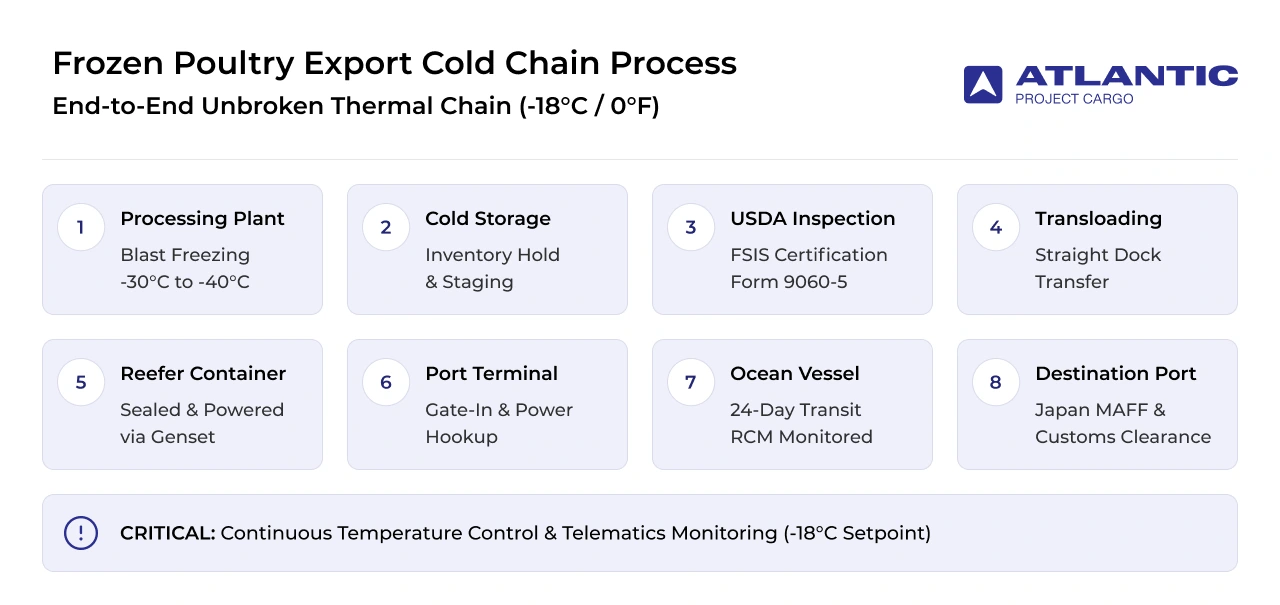
  1. Processing & Blast Freezing: Reducing core product temperature quickly to halt microbial growth.
  2. Cold Storage Handling: Holding cargo at deep-freeze levels while staging for export.
  3. Regulatory Inspection: Obtaining required USDA health certificates.
  4. Transloading & Containerization: Transferring cargo into refrigerated ocean equipment safely.
  5. Inland Transportation: Moving reefer containers to port terminals via genset-equipped trucks or rail.
  6. Ocean Freight: Maintaining continuous airflow and power during sea transit.
  7. Import Customs Clearance: Clearing destination food safety inspections and border controls.

Step 1 — Processing and Export Preparation

Every international poultry shipment begins at a processing facility operating under USDA Food Safety and Inspection Service (FSIS) jurisdiction.

Blast Freezing

After slaughter and dressing, chicken parts must be rapidly frozen using blast freezers operating between -30°C and -40°C (-22°F to -40°F). Fast freezing prevents large ice crystals from forming inside the muscle tissue, which preserves meat texture, moisture, and color upon thawing. Cargo must achieve a solid core temperature of -18°C (0.4°F) or lower before export packing.

Packaging Requirements

Export cargo requires heavy-duty, moisture-resistant corrugated cartons (master cases). Polyethylene inner liners protect meat from freezer burn and prevent blood leakage, which can contaminate adjacent cargo or damage reefer floors during transit.

Palletization and Unitization

Cartons are stacked on standardized pallets (typically 48×40-inch wooden or plastic pallets) or unitized on slip-sheets to optimize container volume. Corner boards and stretch wrapping secure the loads, preventing shifting during road transport and ocean movement.

Step 2 — Cold Storage Operations

Refrigerated warehouses act as critical buffer zones between production schedules and vessel sailing dates.

Purpose of Cold Storage

Exporters rarely load ocean containers directly at the processing plant due to scheduling conflicts, port cutoffs, or the need to consolidate volume from multiple production runs. Public Refrigerated Warehouses (PRWs) provide secure, temperature-controlled storage until equipment and export documentation are fully aligned.

Major Cold Storage Providers

Logistics providers frequently partner with industry-leading cold storage networks such as Lineage Logistics and Americold to manage port-adjacent inventory, offer USDA staging docks, and execute export transloading.

Operational Benefits

  • Buffer Management: Prevents ocean carrier demurrage and detention fees by holding product off-dock until vessels are open for gates.
  • Lot Staging: Enables USDA inspectors to examine full shipment lots in a sanitary, controlled environment.
  • Value-Added Services: Provides facilities for labeling, export stamping, re-palletization, and container packing.

Step 3 — USDA Inspection and Export Certification

No commercial lot of frozen poultry can leave the U.S. without regulatory authorization from the USDA FSIS.

Regulatory Compliance

Before booking freight, exporters must verify that the processing facility is approved to export to the specific destination country. Importing nations maintain strict sanitary regulations, often requiring specialized plant audits or specific processing protocols.

Inspection Process

An FSIS inspector examines the consignment at the processing plant or designated export cold storage facility. The inspector verifies:

  • Product pulp temperatures (must remain at or below -18°C / 0°F).
  • Packaging integrity and legible plant stamp numbers.
  • Shipping marks and country-of-origin labeling.

Essential Certification

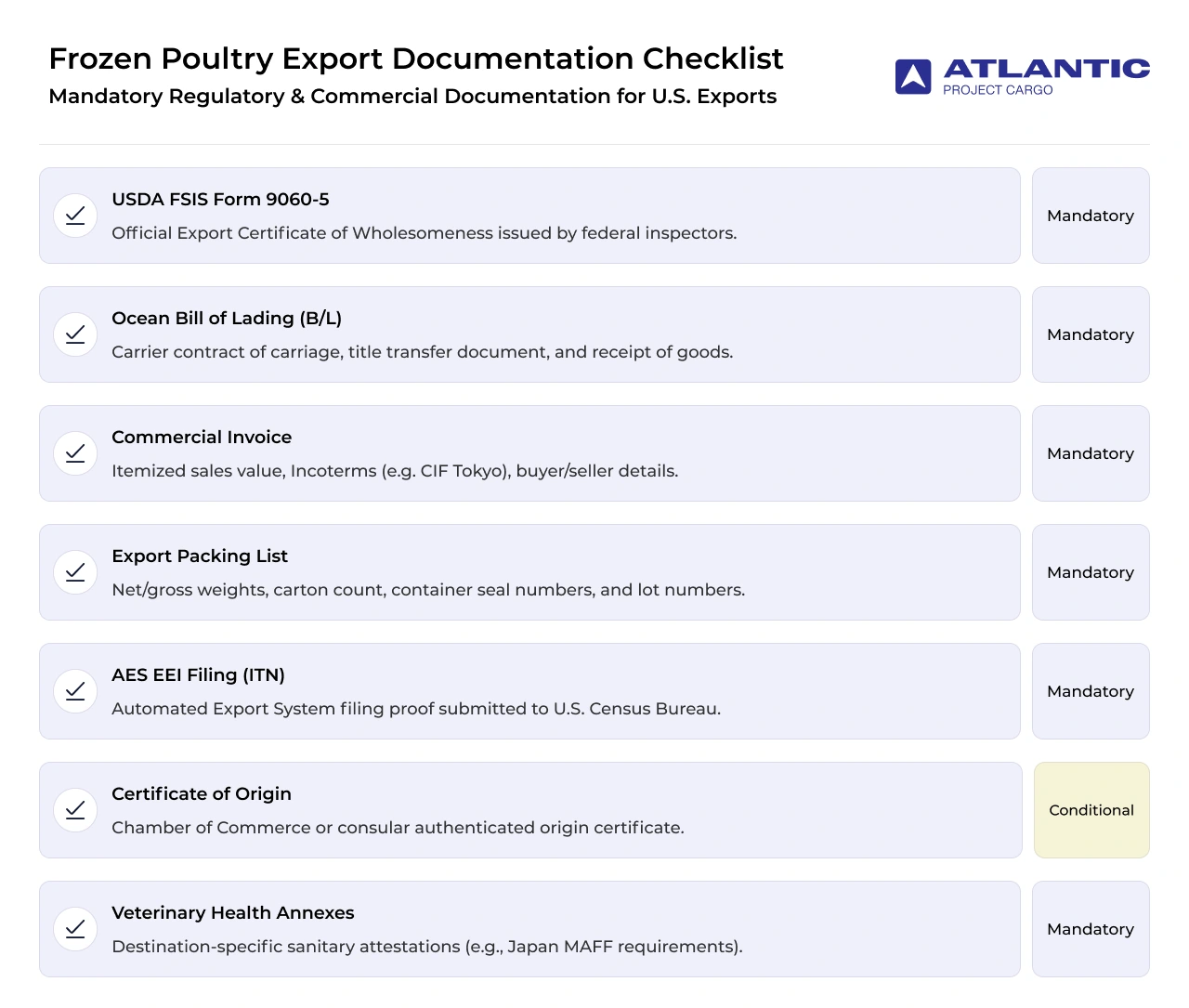
Once the inspector confirms pulp temperature, packaging integrity, and labeling meet requirements, they issue FSIS Form 9060-5 (Meat and Poultry Export Certificate of Wholesomeness) along with destination-specific veterinary attestations, certifying the lot as inspected and compliant.

Step 4 — Straight Transloading into Reefer Containers

Transloading involves moving cargo from inland refrigerated over-the-road trailers into 40-foot High-Cube ocean reefer containers.

Exporters can choose between Straight Transloading (direct trailer-to-container movement across a cold dock) and traditional Cold Storage & Loading.

Factor Straight Transloading Traditional Cold Storage Loading
Handling Minimal: Direct transfer from truck to ocean container Higher: Offloaded, stored in rack, then re-handled to load
Cold Chain Risk Lower: Reduced dwell time in transit dock area Moderate: Extended exposure during multiple dock movements
Speed Faster: Immediate turnaround (1–2 hours) Slower: Dependent on warehouse queue and dock appointments
Best For Time-sensitive shipments, single-origin full loads Consolidated orders, multi-plant sourcing, long-term holds
Flexibility Low: Requires exact timing alignment between carriers High: Warehouses offer flexible staging windows

Exporters use straight transloading when speed is paramount and inland trucks can sync directly with ocean reefer container availability, lowering dwell times and ocean detention risks.

Step 5 — Loading the Reefer Container

Loading an ocean reefer container requires strict adherence to thermodynamic principles. Unlike domestic trailers, ocean reefer units are designed to maintain cargo temperature, not to pull down warm cargo.

Pre-Trip Inspection (PTI)

Ocean carriers perform a automated electronic check (PTI) on the reefer unit before dispatching it to ensure the refrigeration machinery, sensors, software, and physical structural integrity are flawless.

Temperature & Airflow Management

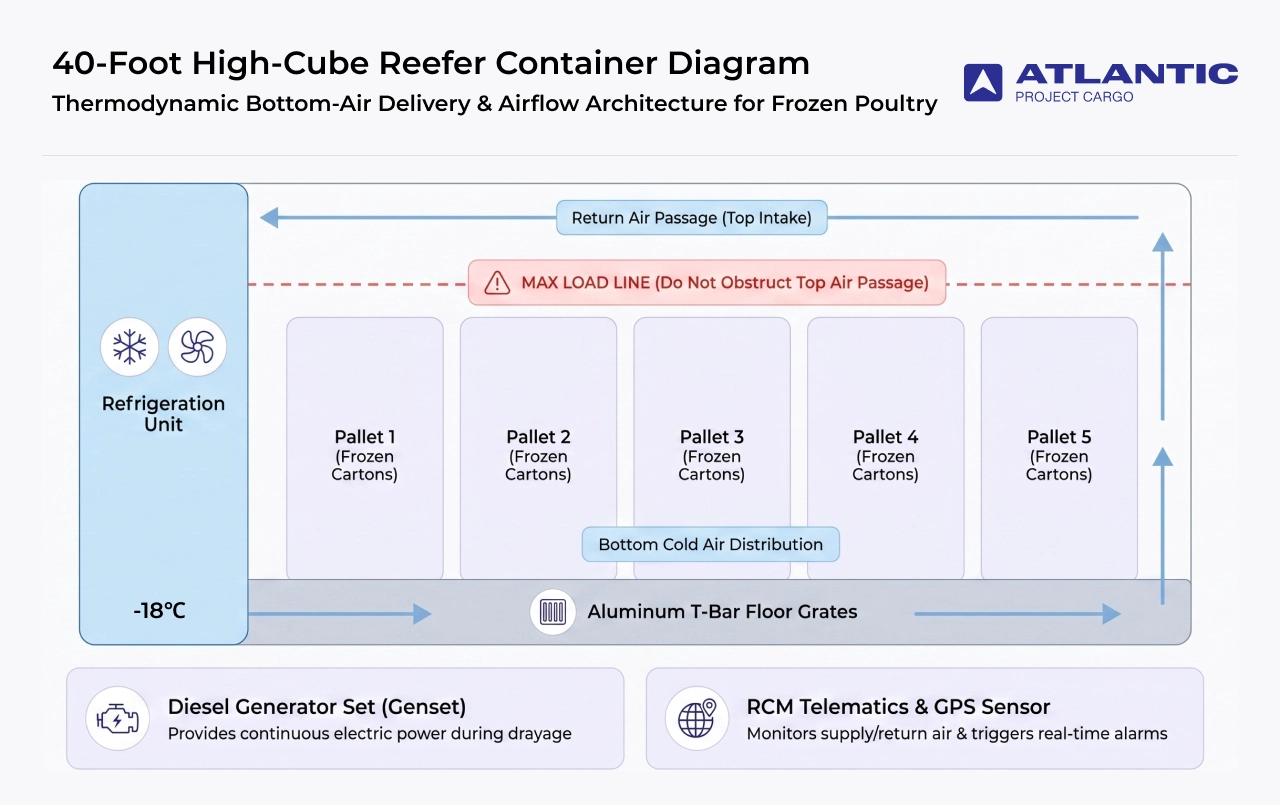
  • Bottom-Air Delivery: Cold air blows down from the cooling unit, travels forward through aluminum “T-bar” floor grates, flows around cargo pallets, and returns through the ceiling space.
  • Solid Block Loading: Frozen goods require air to circulate around the load rather than through it. Cartons must be packed tightly without gaps to prevent short-circuiting the air current.
  • Max Load Line: Cargo must never be stacked above the painted red line inside the container. Blocking the top ceiling air passage starves the rear of the container of cold air, causing hot spots and spoilage.

Step 6 — Inland Transportation and Port Delivery

Moving loaded containers to ocean terminals requires specialized transport equipment to prevent thermal deviation.

Refrigerated Drayage and Gensets

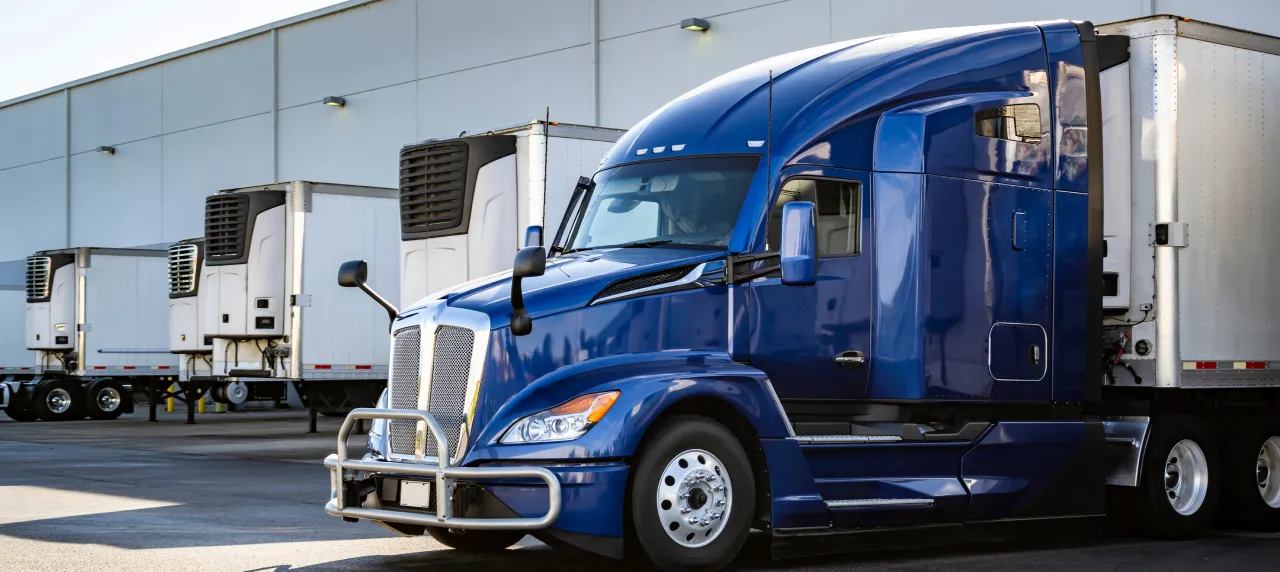
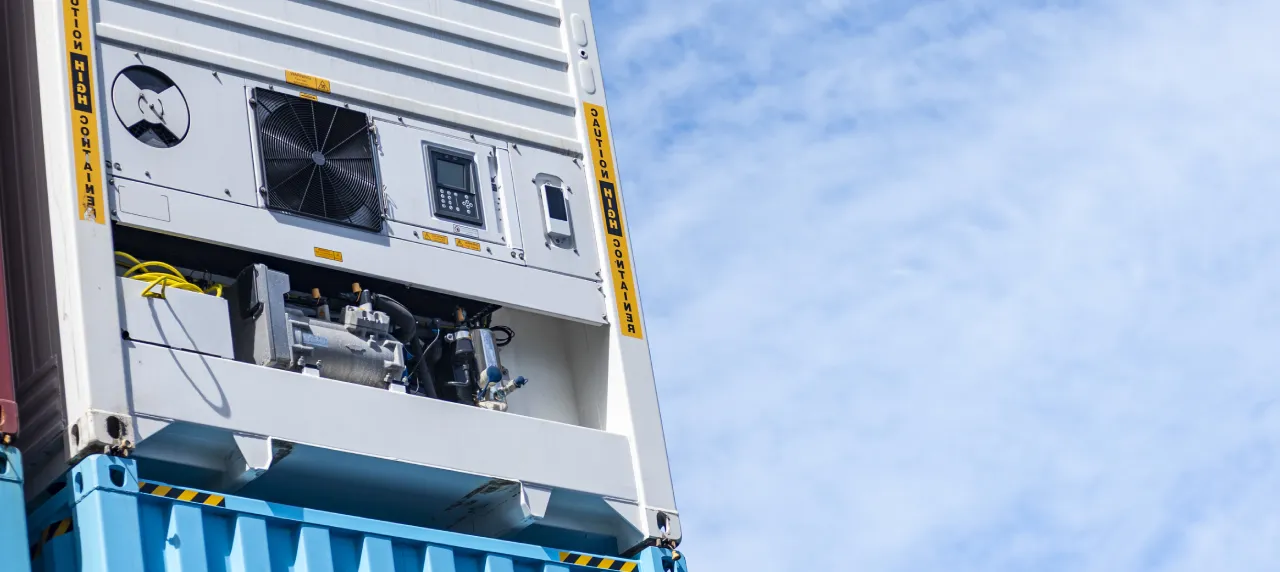
Once packed, the ocean reefer container travels to the port via specialized motor carriers. Because reefer containers require electrical power to run their cooling compressors, motor carriers mount diesel-powered generator sets (gensets) directly to the container chassis or frame. Gensets ensure continuous power during highway or rail transport.

Major U.S. Cold Cargo Ports

Poultry exports flow through major U.S. ports equipped with extensive reefer plug infrastructure:

  • Port of Savannah (GA): A top U.S. poultry export gateway with extensive cold storage capacity.
  • Port of Norfolk / Virginia (VA): Strategic ocean access for Mid-Atlantic and East Coast processors.
  • Port of Houston (TX): Primary hub for Gulf Coast processors shipping to Latin America and Asia.
  • Port of Charleston (SC): Major ocean portal with strong Southeast cold-chain infrastructure.
  • Port of New Orleans (LA): A river-and-rail hub with strong Mississippi River barge connectivity, useful for consolidating Gulf Coast and interior agricultural exports en route to Latin American and Asian markets.
  • Ports of Los Angeles & Long Beach (CA): West Coast gateways for Transpacific trade routes, primarily serving West Coast-origin poultry producers rather than the bulk of national volume, which moves through Southeast and Gulf ports.

Step 7 — Export Documentation

Accurate, compliant documentation is just as vital as continuous refrigeration. Minor typographic errors on official certificates can result in delayed entry, costly port storage fees, or cargo destruction at foreign customs.

Step 8 — Ocean Transportation

Ocean transit represents the longest leg of the export journey. Maintaining cargo integrity across thousands of nautical miles requires sophisticated maritime engineering.

Vessel Power Operations

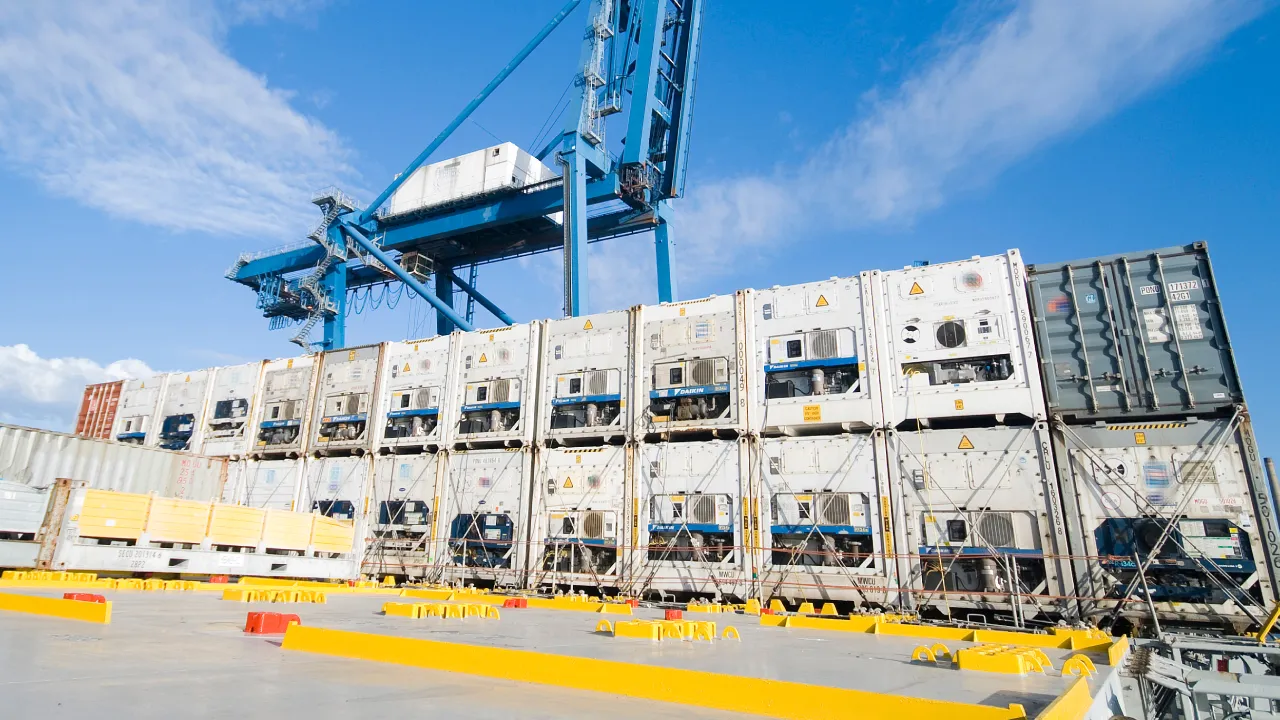
Upon arrival at the ocean port terminal, containers are immediately plugged into port power racks. Once loaded onto the vessel, shipboard technicians plug reefers into the ship’s central electrical grid.

Monitoring Technology

Modern reefer fleets (operated by ocean lines like Maersk, MSC, CMA CGM, and Hapag-Lloyd) feature advanced telematics. These devices continually monitor:

  • Supply Air Temperature: Temperature of air leaving the evaporator coil.
  • Return Air Temperature: Temperature of air returning from the cargo hold.
  • Relative Humidity and Vent Settings: For frozen poultry, fresh air vents remain 100% closed to prevent ambient moisture from entering and causing ice buildup on evaporator coils.

Remote container management (RCM) technology sends real-time satellite updates to vessel engineers and shore operators, alerting them immediately if thermal variances occur.

Step 9 — Import Customs Clearance

Upon arrival at the destination port, cargo transitions to the buyer’s jurisdiction under strict regulatory control.

Customs and Port Clearance

The importer or their designated customs broker submits commercial invoices, packing lists, ocean bills of lading, and original USDA certificates to local customs and border agencies.

Veterinary & Food Safety Inspection

Border health officials inspect physical container seals, examine documentation authenticity, and often draw random product samples to check for pathogen contamination, improper defrosting, or illegal additives.

Final Delivery

Once cleared, port hostlers load the container onto an inland reefer trailer or drayage rig, maintaining thermal power via genset until final offloading at the buyer’s cold storage facility.

The Role of a Freight Forwarder

Managing cold chain exports requires constant operational oversight across disparate vendors.

An experienced freight forwarder simplifies this complex process by acting as a single point of coordination. A forwarder manages:

  • Intermodal drayage and generator equipment dispatching.
  • Cold dock scheduling and transloading supervision.
  • Synchronization of USDA inspection dates with ocean carrier vessel cutoffs.
  • Electronic AES filings and ocean Bill of Lading generation.
  • End-to-end temperature monitoring and exception management.

Real Shipment Case Study

The following project demonstrates how Atlantic Project Cargo executed these principles to manage a time-critical frozen poultry movement.

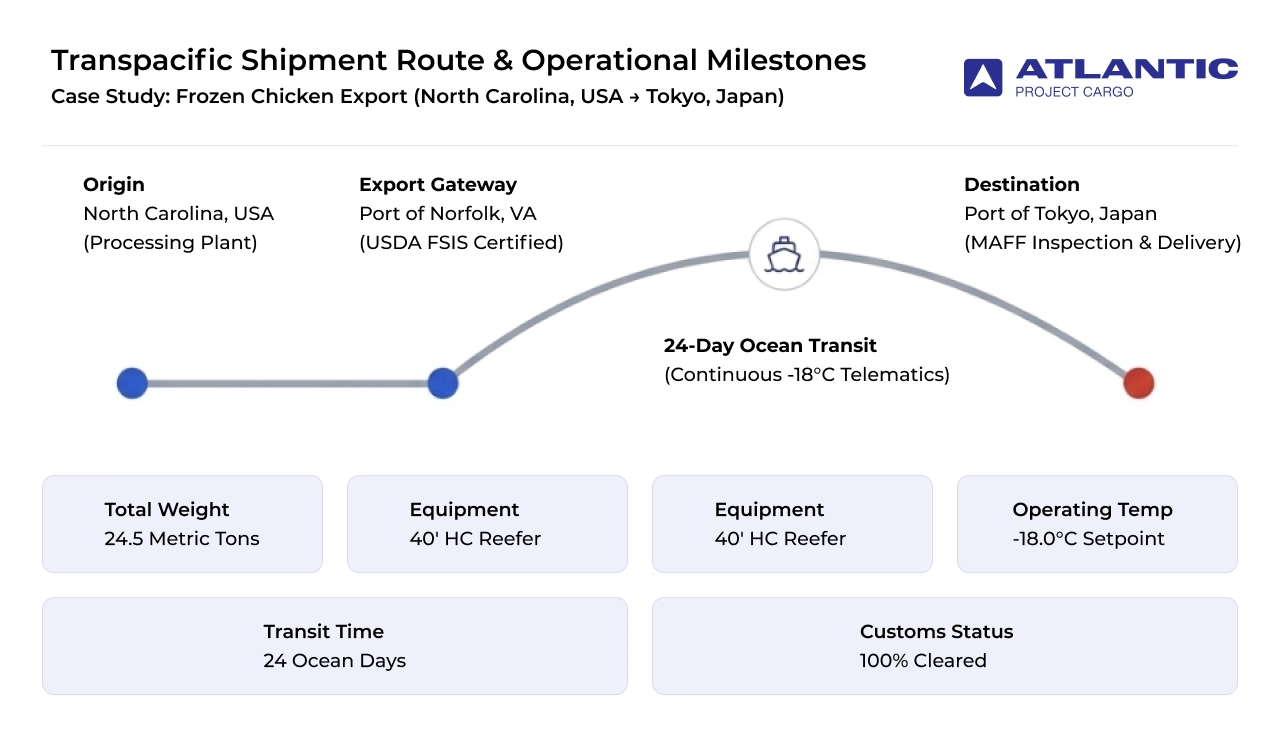
Case Study: Frozen Chicken Export from North Carolina, USA to Tokyo, Japan

Shipment Overview

Factor Details
Cargo Description Frozen Chicken Leg Quarters & Paw Cuts
Shipment Volume 24.5 Metric Tons (54,012 lbs) net weight
Equipment Used 1 x 40' High-Cube Refrigerated Container
Required Operating Temp Setpoint: -18.0°C (-0.4°F) continuous airflow
Origin Point Processing Plant, North Carolina, USA
Export Gateway Port of Norfolk / Virginia International Gateway (VIG)
Destination Port Port of Tokyo, Japan
Total Ocean Transit Time 24 Days (direct/express Transpacific service via Panama Canal)

Customer Challenge

A U.S. poultry exporter needed to move a high-value shipment of frozen chicken parts from North Carolina to Tokyo, Japan. The client faced strict operational demands:

  • Zero Temperature Deviation: The Japanese Ministry of Agriculture, Forestry and Fisheries (MAFF) strictly enforces zero-tolerance policies for defrosted or re-frozen meat.
  • Tight Cutoff Window: Ocean carrier schedule changes required packing, staging, inspecting, and draying the load to the Port of Norfolk within a tight 72-hour window.
  • Synchronized USDA Approval: The USDA FSIS health certificate had to match the ocean vessel voyage details precisely, leaving no margin for documentation errors.

Atlantic Project Cargo Solution

APC designed a streamlined, time-critical logistics solution:

  1. Equipment Dispatch: APC dispatched a specialized reefer drayage truck equipped with an under-slung diesel generator set directly to the North Carolina facility.
  2. Temperature Inspection: Mechanics executed a mandatory Pre-Trip Inspection (PTI) on the 40′ High-Cube reefer unit before dispatch, confirming setpoint calibration at -18°C.
  3. Cold Dock Staging & USDA Sync: APC scheduled an immediate staging window at a port-adjacent refrigerated warehouse in Norfolk. An on-site USDA FSIS inspector examined the lot, signed FSIS Form 9060-5, and affixed official export seals.
  4. Straight Transloading: Product was moved via a direct, closed cold dock from the inland trailer into the ocean container in under 90 minutes, eliminating ambient heat exposure.
  5. Vessel Delivery & Monitoring: APC delivered the sealed container to the Port of Norfolk terminal before the carrier cutoff, verifying power hookup at the port rack. RCM tracking monitored supply and return air temperatures across the 24-day Pacific transit.

Services Coordinated by Atlantic Project Cargo

  • [x] Plant Pickup: Scheduled temperature-controlled intermodal transport.
  • [x] Equipment PTI: Pre-trip testing of container refrigeration machinery.
  • [x] Cold Storage Operations: Direct cold dock staging and dock handling.
  • [x] USDA Coordination: FSIS inspection staging and certificate retrieval.
  • [x] Straight Transloading: Rapid trailer-to-container cargo transfer.
  • [x] AES Filing: Federal customs export clearance generation.
  • [x] Ocean Freight Booking: Direct booking on express Transpacific service.
  • [x] RCM Tracking: Continuous monitoring of reefer setpoint data.
  • [x] Destination Support: Customs document packet transmission to Japanese broker.

Shipment Results

  • 100% Thermal Integrity: Continuous RCM logs showed a steady temperature profile between -18.0°C and -18.4°C throughout the entire voyage.
  • Flawless MAFF Clearance: Japanese inspectors cleared the shipment upon arrival without delays, fines, or quarantine holds.
  • On-Time Delivery: The cargo reached the buyer’s distribution center in Tokyo within the target schedule, preserving fresh product quality.

Types of Temperature-Controlled Cargo We Handle

APC manages cold-chain transport for a wide variety of temperature-sensitive global commodities:

  • Frozen Meat & Poultry: Chicken parts, turkey, frozen beef cuts, pork loin, and offal.
  • Seafood: Frozen salmon, shrimp, crab, squid, and industrial fish blocks.
  • Dairy Products: Export butter, cheese wheels, milk powder, and cream formulations.
  • Fresh Produce & Fruits: Apples, citrus, berries, grapes, and table vegetables (utilizing controlled atmosphere reefer technology).
  • Confectionery & Ice Cream: Deep-freeze ice cream (-25°C) and climate-controlled chocolates (+15°C).
  • Pharmaceuticals & Biologics: Specialized temperature-controlled healthcare products.

Frequently Asked Questions

Frozen poultry is exported through an unbroken cold chain. Meat is processed and blast-frozen at USDA-inspected plants, stored at deep-freeze warehouses, inspected by federal authorities, transloaded into insulated ocean reefer containers, and moved via refrigerated trucks, rail, and container ships to foreign ports.

Frozen poultry must be shipped at a continuous setpoint of -18°C (0.4°F) or lower. Deep-frozen items, such as specialty cuts or long-transit products, are sometimes carried at -20°C to -25°C (-4°F to -13°F) to preserve quality.

Key export documents include:

  • Commercial Invoice
  • Detailed Packing List
  • Ocean Bill of Lading (B/L)
  • USDA FSIS Form 9060-5 (Export Certificate of Wholesomeness)
  • Automated Export System (AES) Internal Transaction Number (ITN)
  • Destination-specific veterinary health certificates and Certificates of Origin.

Straight transloading is the direct transfer of refrigerated cargo from an inland over-the-road trailer into an ocean reefer container across a climate-controlled loading dock. This process bypasses extended warehouse storage, cutting handling costs and reducing cold chain exposure.

USDA FSIS inspection is required by federal law and international treaties to certify that exported meat products are wholesome, disease-free, processed in sanitary facilities, and compliant with the destination nation’s health regulations.

Ocean transit times vary significantly by routing. On direct/express services via the Panama Canal, U.S. East Coast to East Asia can run 20–30 days; on standard transshipment routings, the same lanes often take 32–44 days. Confirm the specific service type with your carrier before setting a delivery commitment.

Major poultry export ports include the Port of Savannah, Port of Norfolk, Port of Houston, Port of New Orleans, Port of Charleston, and the Ports of Los Angeles and Long Beach.

Yes. Atlantic Project Cargo offers end-to-end refrigerated freight forwarding, including inland drayage, cold storage dock scheduling, USDA staging, AES customs filing, ocean freight booking, and destination arrival tracking.

Yes. Modern reefer equipment features Remote Container Management (RCM) telematics that transmit real-time data via satellite and cellular networks. Operators monitor supply air, return air, GPS location, and power status continuously.

A break in the cold chain allows cargo temperatures to rise, leading to surface thawing, moisture loss, freezer burn, or bacterial growth. Thermal deviation can cause destination health authorities to reject the entire shipment, leading to cargo destruction or forced return at the exporter’s expense.

Request a Frozen Poultry Shipping Quote

Managing refrigerated exports requires a logistics partner with expertise in strict temperature control, regulatory compliance, and ocean carrier scheduling.

Whether you are shipping full reefer container loads of frozen poultry, beef, pork, or seafood, Atlantic Project Cargo delivers tailored logistics solutions:

  • Complete Cold Chain Integration: From plant pickup to overseas delivery.
  • Reefer Intermodal Drayage: Reliable genset-equipped trucking networks.
  • USDA Inspection Coordination: Seamless dock staging and certificate alignment.
  • Global Ocean Freight Access: Competitive reefer vessel allocation on key trade lanes.


Need reliable reefer shipping for your next export?

Get Your Free Quote Today!

Read More

August 17, 2026
Heavy Equipment Shipping from the USA to Venezuela: Complete Shipping Guide
Heavy equipment can be shipped from the USA to Venezuela by RoRo, flat rack, container, or breakbulk shipping depending on the machine's size, weight, condition,...
Reviewed by
Victoria Moseicuka
August 16, 2026
Shipping Container Types and Sizes: Complete Guide for 2026
Selecting the correct equipment prevents cargo damage and avoids wasted money. You must evaluate five specific logistical factors before booking your freight. Cargo type dictates whether...
Reviewed by
Victoria Moseicuka
August 10, 2026
Heavy Equipment Shipping from the USA to Argentina: Costs, Transit Time & Import Guide
Heavy equipment can be shipped from the USA to Argentina by RoRo, flat rack, breakbulk, or container shipping depending on the machine's size, weight, dimensions,...
Reviewed by
Victoria Moseicuka
Share via