
Hours of operations:
9AM - 5PM / UTC -5 (EST)
October 27, 2026 23 min

Top 10 Ports in the UAE: Best Shipping Hubs for International Cargo & Heavy Equipment

Worldwide Shipping
Americas · Europe · Asia Pacific · Africa
100,000+
Shipments Worldwide
20+ Years
In Heavy Cargo Logistics
4.9 Rating
on Google · 50+ reviews
Licensed Freight Forwarding Company
Home Insights Top 10 Ports in the UAE: Best Shipping Hubs for International Cargo & Heavy Equipment

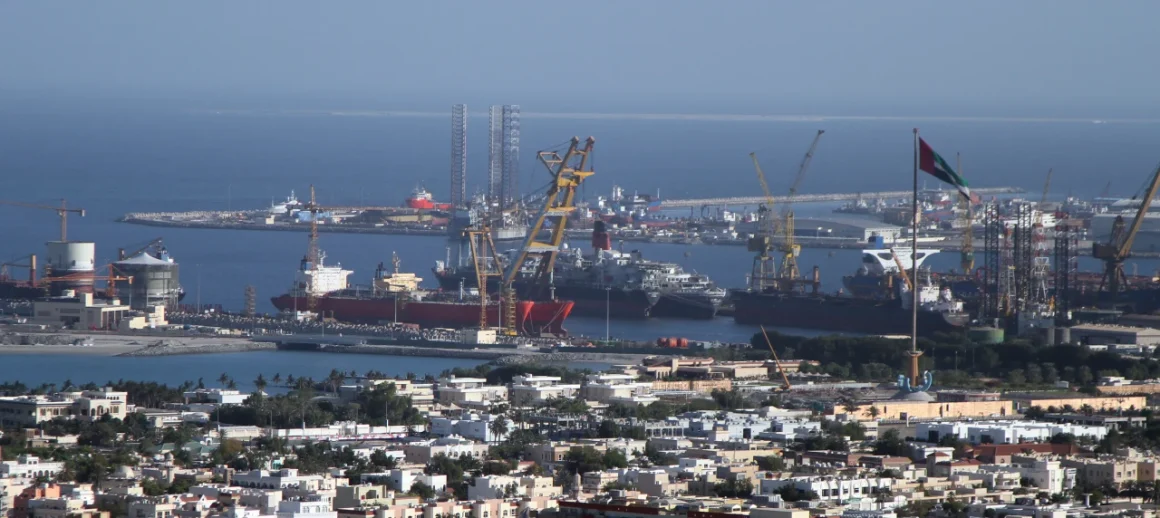
Jebel Ali and Khalifa handle most of the UAE’s container, RoRo, and project cargo. Since the 2026 closure of the Strait of Hormuz, the east-coast ports of Khor Fakkan and Fujairah have become the country’s main entry points. Which one is right comes down to more than cargo type and dimensions. It hinges on whether the freight stays in the UAE or moves onward to Saudi Arabia, Qatar, Oman, or another Gulf market. Get that call right and you save on inland trucking, customs steps, and transit days. Get it wrong and the machine lands at the wrong end of the country.

What makes the UAE different from almost anywhere else you might ship to is its role as the region’s transshipment engine: the point where cargo from Asia, Europe, and the Americas enters the Gulf and fans out to a dozen neighboring markets. That re-export role shapes every port decision, and it runs through this whole guide. By the end you’ll know which port suits containers, which handles oversized machinery, which sits outside the Strait of Hormuz, and how to match that to where your cargo needs to end up.

Shipping update, October 2026: The Strait of Hormuz has been largely closed to commercial shipping since late February 2026. Most UAE-bound cargo now discharges at Khor Fakkan or Fujairah on the Gulf of Oman and moves on by road or rail. Where this guide recommends a port inside the Gulf, treat it as the final destination; the ship will usually call on the east coast. See the full update below.

Quick Facts About the UAE’s Port Network

If you only read one section, make it this one.

MetricInformation
Major commercial portsAround a dozen across the seven emirates
Largest portJebel Ali (Dubai), 15.5 million TEUs in 2025, ninth in the world
Main gateways during the Hormuz closureKhor Fakkan and Fujairah
Largest multipurpose / industrial portKhalifa Port (Abu Dhabi)
Main importsMachinery, vehicles, electronics, foodstuffs, construction materials
Main non-oil exports & re-exportsRe-exported goods, gold, aluminum, steel, petrochemicals
Major trading partnersChina, India, Saudi Arabia, USA, EU
Best ports for heavy equipmentJebel Ali and Khalifa; Hamriyah for oilfield cargo; Fujairah or Khor Fakkan while Hormuz is closed (confirm crane capacity)

Jebel Ali is the headline number: 15.5 million TEUs in 2025, ninth in the world and the only UAE port in the global top ten. Since the Hormuz closure, though, much of its cargo has arrived overland from the east-coast ports.

Why Choosing the Right UAE Port Matters

Port selection sets the cost and speed of the whole shipment. Pick the port that lines up with your cargo and your destination, and everything downstream gets easier.

Here’s what moves when you change ports.

  • Inland transportation is the big one: land a machine bound for Abu Dhabi at a Dubai port and you’ve bolted a cross-emirate heavy-haul run onto the bill.
  • Re-export efficiency turns on free zone access, since onward cargo clears far more smoothly through a free-zone port.
  • Customs clearance speed varies with the terminal’s experience and free zone status, transit time with how often carriers call and whether your box is feedered onward, and shipping costs with per-port handling and whether the crane you need is even on site.
  • Cargo handling is the hard limit. A port without a heavy-lift crane cannot take your crusher at any price.

For heavy equipment shipping to the UAE, that last point decides the shortlist first. A 90-ton machine needs a port built to lift it, ruling out most of the list and leaving the few that qualify.

The UAE’s Port Infrastructure Overview

The UAE built its logistics infrastructure deliberately, and it shows across every cargo type. The UAE’s cargo ports span container, bulk, breakbulk, and RoRo, and the container ports the UAE relies on rank among the busiest anywhere.

  • Container terminals anchor the system, led by Jebel Ali’s four terminals and roughly 19.4 million TEUs of capacity across 100-plus berths.
  • Free zones sit alongside the quays – JAFZA is one of the world’s largest – letting cargo land, store, and re-export without entering UAE customs territory.
  • RoRo terminals handle rolling cargo, while breakbulk and heavy-lift facilities manage oversized freight, with Jebel Ali alone moving 5.4 million tonnes of breakbulk in 2024, up 23%.
  • Logistics parks cluster warehousing around the ports.

Etihad Rail links the ports into the national freight network. Since September 2026, a container train runs three times a week from Fujairah to the Industrial City of Abu Dhabi (ICAD), where cargo clears customs. With the UAE’s dense highway network and Gulf shipping connections on top, cargo can enter at one port and reach almost any Gulf market by sea, road, or rail.

The UAE as a Global Re-export Hub

Re-export is the most important idea in this guide: a huge share of what lands in the country was never meant to stay there. It arrives, sits briefly in a free zone, and moves on to a neighboring country, and that pattern shapes which port you should choose.

Why does so much cargo route this way? Geography and free zones together. The UAE sits at the midpoint between Asia, Europe, and Africa, a natural consolidation point for Gulf-bound cargo. Once there, free zones like JAFZA let goods be stored, repackaged, or split into smaller consignments without formally entering UAE customs territory – no import duty until the cargo enters a local market, plus clean paperwork for onward export.

Typical re-export routes run from a UAE port to Saudi Arabia, Qatar, Oman, Kuwait, Bahrain, East Africa, and India. A distributor might import a full container of machinery parts into JAFZA, hold it, then ship components onward to three Gulf countries as orders arrive. Jebel Ali is the heart of this system, one of the world’s most important transshipment hubs precisely because JAFZA sits beside it, giving cargo a frictionless path from ship to storage to onward vessel or truck.

If your cargo is bound for a market beyond the UAE, you want free zone access and strong onward connections – which points to Jebel Ali or Khalifa over a smaller local port. While Hormuz is closed, cargo landed at Khor Fakkan or Fujairah can still reach JAFZA and KEZAD through bonded road and rail corridors.

Major Trade & Logistics Corridors

For cargo moving on to another Gulf market, the entry port and the onward leg are planned together. This table covers the main onward corridors; destinations inside the UAE are covered in the destination section further down.

Final DestinationPort(s) to ConsiderOnward LegWhile Hormuz is closed
Saudi ArabiaJebel Ali or KhalifaBy road or by seaKhor Fakkan or Fujairah, then by road
QatarJebel AliBy sea, or by road through Saudi ArabiaKhor Fakkan or Fujairah, then by road through Saudi Arabia
OmanKhor Fakkan / FujairahBy roadNo change
Kuwait & BahrainJebel AliBy sea or roadKhor Fakkan or Fujairah, then by road

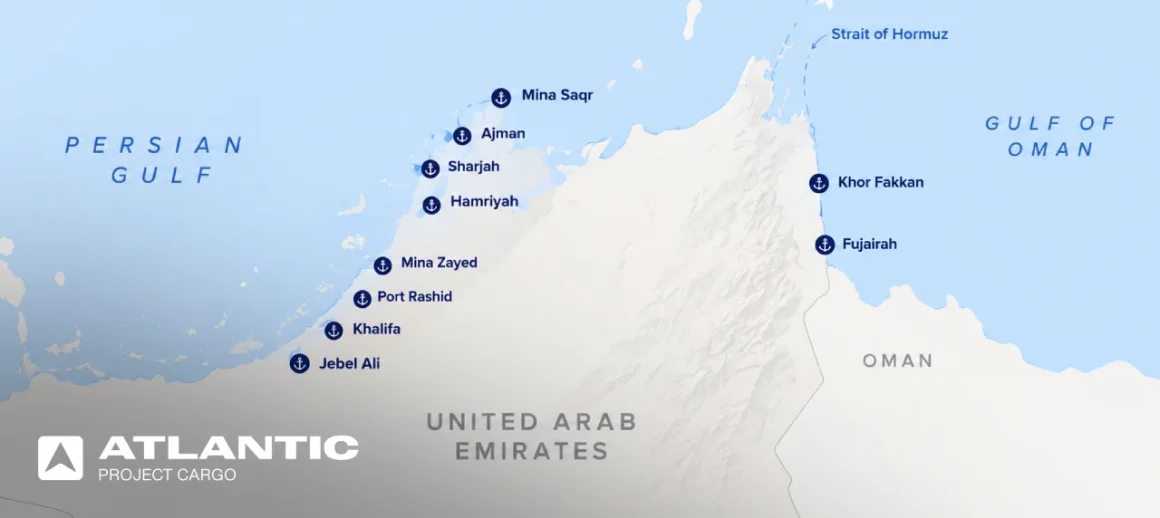
Map of Major UAE Ports

The map makes one strategic point clear: the UAE has coastline on two bodies of water. Most ports sit inside the Arabian Gulf, reached via the Strait of Hormuz. But Fujairah and Khor Fakkan face the Gulf of Oman outside the Strait, which matters enormously when Hormuz traffic is disrupted.

Quick Comparison Table

Here’s every port measured against the capabilities that matter for cargo decisions.

Capability ratings reflect each port’s general positioning and infrastructure focus; confirm specific crane capacities and current service availability with your forwarder before booking an oversized shipment.

PortContainersRoRoBreakbulkHeavy EquipmentFree ZoneBest For
Jebel AliExcellentYesExcellentExcellentJAFZAContainers, heavy-lift, and re-export cargo
KhalifaExcellentYesStrongStrongKEZADAbu Dhabi & industrial cargo
Port RashidLimited (cruise focus)LimitedLimitedLimitedNoCruise, some general cargo
FujairahGrowingLimitedYesModerateYesBunkering, Gulf-of-Oman gateway, rail link to Abu Dhabi
Khor FakkanExcellent (main UAE gateway during the Hormuz closure)LimitedModerateModerateNoMain container gateway while Hormuz is closed; transshipment
Mina ZayedModerateLimitedModerateModerateNoAbu Dhabi general & cruise cargo
HamriyahModerate–StrongLimitedStrongModerateYesIndustrial & oilfield cargo
Mina SaqrBulk focusLimitedStrongModerateNoBulk, aggregates, northern emirates
Sharjah (Khalid)ModerateLimitedModerateModerateYesSharjah regional cargo
AjmanLimitedLimitedLimitedLimitedYesLocal & light cargo

Top 10 Ports in the UAE

The two largest ports get a full profile; the rest are summarized more briefly.

1. Jebel Ali Port

Overview. Jebel Ali is the largest port in the region, handling everything from containers to the heaviest project pieces.

Location. Dubai, on the Arabian Gulf coast, roughly 35 km southwest of the city center.

Annual throughput. 15.5 million TEUs in 2025, ninth in the world, plus 5.67 million tonnes of breakbulk.

Main cargo types. Containers, breakbulk, RoRo, heavy-lift and project cargo, and the full spectrum of re-export freight.

Infrastructure. Four container terminals, 19.4 million TEUs of annual capacity, over 100 berths, a 25-km quay, and dedicated breakbulk, RoRo, and heavy-lift terminals – all sitting alongside JAFZA, one of the world’s largest free zones.

Heavy equipment capabilities. Extensive. Jebel Ali moved wind turbines, heavy machinery, and structural steel through 2024, with the crane capacity and laydown space oversized cargo demands.

RoRo availability. Yes. Dedicated RoRo handling for wheeled and self-propelled machinery; DP World handled a record 1.5 million vehicles across its Dubai terminals in 2025.

Breakbulk capabilities. Excellent, with 2025 volumes the highest in nearly two decades.

Advantages. The largest capacity and carrier network in the Gulf, the region’s leading free zone, and dedicated facilities for every cargo type.

Limitations. It sits inside the Strait of Hormuz. Since the 2026 closure, direct vessel calls have fallen sharply and much of its cargo now arrives overland from the east-coast ports. As the busiest port, it can also see congestion at peak times.

Best for. Containers, heavy equipment, and project cargo bound for Dubai and the surrounding emirates, and re-export cargo staged in JAFZA.

2. Khalifa Port

Overview. Khalifa is Abu Dhabi’s flagship and industrial powerhouse, a heavily automated port built to serve the capital and its manufacturing zones.

Location. Abu Dhabi, on the Arabian Gulf coast, between Abu Dhabi city and Dubai.

Annual throughput. The anchor of AD Ports’ container business, with Khalifa accounting for around 9.6 million TEUs of the group’s capacity and the great majority of its UAE volume.

Main cargo types. Containers, industrial and project cargo, breakbulk, and RoRo.

Infrastructure. One of MENA’s first semi-automated container ports, tied into KEZAD and served by road, rail, and a new CMA Terminals facility opened in late 2024.

Heavy equipment capabilities. Strong, especially for Abu Dhabi’s industrial projects, with breakbulk and heavy-lift handling and direct KEZAD access.

RoRo availability. Yes.

Breakbulk capabilities. Strong, supported by the port’s industrial orientation.

Advantages. The best choice for Abu Dhabi and the western UAE, with cutting-edge automation, deep KEZAD integration, and excellent intermodal links.

Limitations. Also inside the Strait of Hormuz. For cargo destined for Dubai or the northern emirates, Jebel Ali is usually the better fit.

Best for. Abu Dhabi-bound cargo, industrial machinery, and shipments tied to KEZAD’s manufacturing base.

3. Mina Rashid (Port Rashid)

Overview. Once Dubai’s main commercial gateway, Port Rashid has handed that role to Jebel Ali and reinvented itself around cruise traffic.

Location. Dubai, on the Arabian Gulf coast, close to the city center.

Annual throughput. No longer a container port; its container business moved to Jebel Ali.

Main cargo types. Cruise passengers, general cargo, occasional breakbulk.

Infrastructure, heavy equipment, RoRo & breakbulk. Redeveloped for cruise operations, with limited commercial cargo, heavy-lift, RoRo, and breakbulk capability across the board.

Advantages. Central Dubai location and strong cruise facilities.

Limitations. Minimal container and heavy equipment capability, since Jebel Ali absorbed its former cargo role.

Best for. Cruise operations and light general cargo, not heavy equipment or project cargo.

4. Port of Fujairah

Overview. Fujairah is the UAE’s east-coast anchor and one of the world’s great bunkering ports, and it sits outside the Strait of Hormuz, which makes it a strategic alternative gateway whenever traffic through the Strait is disrupted.

Location. Fujairah, Gulf of Oman coast, outside the Strait of Hormuz.

Annual throughput. A massive bunkering and bulk hub with a growing container business.

Main cargo types. Bunkering, bulk, general cargo, and growing container volumes.

Infrastructure & capabilities. Deep-water berths, world-class bunkering, and general cargo capacity linked to Abu Dhabi by a three-times-weekly Etihad Rail container service to ICAD, launched in September 2026; moderate and rising heavy equipment capability, limited RoRo, and solid breakbulk.

Advantages. Its position outside Hormuz is its defining strength, a resilient entry point when the Strait is congested, plus deep-water access and top-tier bunkering.

Limitations. A smaller container operation than the Gulf giants, and congested since the Hormuz closure., with onward road transport needed to reach Dubai and Abu Dhabi.

Best for. Bunkering, bulk cargo, and any shipment that benefits from a Gulf-of-Oman gateway outside the Strait.

5. Khor Fakkan Port

Overview. Khor Fakkan is a deep-water transshipment specialist on the east coast, and like Fujairah, its position outside the Strait of Hormuz gives shippers an alternative to the Gulf ports. Since the 2026 Hormuz closure, it has become the UAE’s main container gateway.

Location. Sharjah’s east-coast enclave, Gulf of Oman, outside the Strait of Hormuz.

Annual throughput. About 8,000 TEUs a week before the Hormuz closure, rising to about 65,000 a week by July 2026. Annual capacity is being raised from 3.5 million to 5 million TEUs.

Main cargo types. Transshipment containers with regional feeder connections.

Infrastructure & capabilities. Deep-water berths for large container vessels, connected inland by road, with an agreement signed to link it to Etihad Rail to Sharjah and the Gulf ports; moderate, container-focused heavy equipment capability, limited RoRo, moderate breakbulk.

Advantages. Deep water, strong transshipment efficiency, and a Gulf-of-Oman location that keeps cargo moving when Hormuz is disrupted.

Limitations. Container-focused rather than heavy-lift; reaching the Gulf cities means an onward land leg.

Best for. Containers bound anywhere in the UAE while Hormuz is closed, plus transshipment.

6. Mina Zayed

Overview. Abu Dhabi’s original port, Mina Zayed (Zayed Port) has shifted most container business to Khalifa and now serves general cargo, cruise, and community functions.

Location. Abu Dhabi, Arabian Gulf coast, near the city center.

Annual throughput. A general cargo and cruise port with 21 berths across 510 hectares and; its container traffic has moved to Khalifa.

Main cargo types. General cargo, breakbulk, and cruise.

Infrastructure & capabilities. Established berths with cruise and community developments; moderate for general and breakbulk cargo, limited RoRo, though Khalifa is Abu Dhabi’s heavy-lift choice.

Advantages. Central Abu Dhabi location and a useful complement to Khalifa for general cargo.

Limitations. Heavy container and industrial traffic has moved to Khalifa; less suited to major project cargo.

Best for. Abu Dhabi general cargo, breakbulk, and cruise operations.

7. Hamriyah Port

Overview. Hamriyah is Sharjah’s industrial and free-zone port, suited to oilfield, industrial, and breakbulk cargo, and anchored by one of the region’s larger free zones.

Location. Sharjah, Arabian Gulf coast, north of Dubai.

Annual throughput. An industrial and breakbulk port anchored by the roughly 30-square-kilometre Hamriyah Free Zone; volumes weight toward oilfield, bulk, and project cargo rather than containers, so it reports tonnage rather than a headline TEU figure.

Main cargo types. Industrial cargo, oilfield equipment, bulk, and breakbulk.

Infrastructure & capabilities. Anchored by the Hamriyah Free Zone Authority, with berths geared to industrial and oil-and-gas cargo; moderate to strong for industrial and oilfield machinery and breakbulk, limited RoRo.

Advantages. Free zone access, an industrial orientation, and genuine capability for oilfield and heavy industrial cargo.

Limitations. A smaller container operation and less general connectivity than Jebel Ali.

Best for. Industrial cargo, oilfield equipment, and breakbulk tied to Sharjah’s free zone.

8. Mina Saqr

Overview. Mina Saqr, in Ras Al Khaimah, is the UAE’s leading bulk and aggregates port, serving the northern emirates from the Arabian Gulf coast.

Location. Ras Al Khaimah, at the northern end of the UAE, on the Arabian Gulf coast inside the Strait of Hormuz.

Annual throughput. The UAE’s principal bulk port, moving tens of millions of tonnes of aggregates and cement a year – it is one of the world’s largest bulk aggregate export ports – and it reports tonnage rather than container TEUs.

Main cargo types. Bulk, aggregates, cement, and some breakbulk.

Infrastructure & capabilities. Deep-water berths built for bulk carriers, with strong breakbulk capability alongside the bulk focus and limited RoRo.

Advantages. Leading bulk capability, deep water, and a position serving Ras Al Khaimah’s quarrying and industrial base.

Limitations. Bulk-focused rather than a container or RoRo port, and, like the other Gulf-coast ports, inside the Strait of Hormuz.

Best for. Bulk cargo, aggregates, and industrial materials.

9. Port of Sharjah (Port Khalid)

Overview. Port Khalid is Sharjah’s main Gulf-coast commercial port, a versatile mid-sized facility serving the emirate’s trade and industry.

Location. Sharjah, Arabian Gulf coast, adjacent to Dubai.

Annual throughput. Over 2 million TEUs of container capacity, handling the majority of Sharjah’s container traffic alongside general and RoRo cargo.

Main cargo types. Containers, general cargo, and breakbulk.

Infrastructure & capabilities. Container and general cargo berths with free-zone access; moderate for general and breakbulk cargo, limited RoRo.

Advantages. A convenient Sharjah location, versatile handling, and proximity to Dubai’s markets.

Limitations. Smaller scale than Jebel Ali or Khalifa; larger project cargo belongs at the bigger hubs.

Best for. Sharjah and northern-emirates regional cargo, containers, and general freight.

10. Ajman Port

Overview. Ajman is a compact port serving the smallest emirate, handling local and light cargo with a nearby free zone.

Location. Ajman, Arabian Gulf coast, north of Sharjah.

Annual throughput. A compact port handling local and light cargo; it does not publish a major TEU figure, operating well below the scale of the main hubs.

Main cargo types. General cargo, light containerized freight, and some breakbulk.

Infrastructure & capabilities. Container and general cargo berths backed by the Ajman Free Zone; limited heavy equipment, RoRo, and breakbulk capability.

Advantages. Free zone access and convenience for local Ajman cargo.

Limitations. Limited capacity and heavy equipment capability; larger cargo belongs at the major hubs.

Best for. Local and light cargo serving Ajman and its immediate region.

Which UAE Port Should You Choose?

Start with the cargo type: it rules out most ports straight away.

Cargo TypePort(s) to ConsiderWhy
Heavy equipmentJebel Ali or KhalifaHeavy-lift and breakbulk terminals at both; the right one depends on the destination and the crane capacity the unit needs
Industrial machineryKhalifa or Jebel Ali; Hamriyah for oilfield cargoKEZAD integration for Abu Dhabi; JAFZA for Dubai and re-export; Hamriyah’s free zone for Sharjah industry
Construction equipmentJebel Ali or KhalifaBoth handle oversized units and feed major regional projects
Agricultural equipmentJebel Ali or KhalifaRoRo and breakbulk options at both plus onward re-export links
Project cargoJebel Ali or KhalifaDedicated heavy-lift handling at both; the vessel services available decide between them
ContainersJebel Ali or KhalifaThe two largest container operations in the UAE
Re-export cargoJebel AliJAFZA and transshipment connectivity make it the re-export hub

Note: While the Strait of Hormuz is closed, read Jebel Ali or Khalifa as the final destination. The ship will usually discharge at Khor Fakkan or Fujairah, and the cargo will continue by road or rail.

For a deeper look at how these machines move, our guide to shipping heavy equipment from/to the UAE walks through the methods and costs in detail.

Choosing a Port Based on Your Final Destination

Cargo type tells you what a port must handle; destination tells you where to land it so you’re not trucking it back across the country. Both have to line up.

Final DestinationPort(s) to Consider
DubaiJebel Ali
Abu DhabiKhalifa
SharjahPort Khalid or Hamriyah
Northern Emirates (Ajman, Umm Al Quwain, Ras Al Khaimah)Mina Saqr, Hamriyah, or Port Khalid
Fujairah & east coastFujairah or Khor Fakkan

For Saudi Arabia, Qatar, Oman, Kuwait, and Bahrain, see the corridors table earlier in this guide. When cargo type and destination point at different ports, such as an oversized machine bound for a market a smaller port can’t serve, cargo capability wins, and you plan the inland leg around it, ideally with a forwarder.

Inland Transportation from UAE Ports

Landing the cargo is only half the job; moving it from quay to site is the other half. Truck transport covers domestic moves on an excellent highway network, cross-border road transport carries re-export cargo onward to Saudi Arabia, Oman, and the Gulf through established customs corridors, and heavy haul handles oversized units on multi-axle trailers.

Oversized permits are required beyond standard road limits – build the lead time in or risk stalling at the gate. Free zone logistics let re-export cargo stage without entering customs territory, and regional distribution fans goods across the Gulf by road, sea, and rail.

For oversized cargo, the inland leg deserves as much planning as the ocean leg. A machine that clears the port but can’t legally reach the site hasn’t arrived.

Shipping Heavy Equipment to the UAE

Heavy equipment reaches the UAE five main ways, depending on size, weight, and whether the machine runs.

  • RoRo suits self-propelled machines that drive aboard, the cheapest route when it qualifies.
  • Flat rack carries oversized units craned onto an open platform.
  • Open top containers take tall equipment loaded through the roof.
  • Breakbulk handles the largest, heaviest pieces lifted onto the vessel – crushers, cranes, and outsized plant.
  • Standard containers work for compact machinery, attachments, and parts.

Choosing between them is its own decision, and we’ve broken it down in RoRo vs Flat Rack vs Open Top Container, while Types and Sizes of Shipping Containers covers the box dimensions that decide whether a machine fits inside one at all. For the heaviest cargo, our breakbulk shipping guide explains how oversized pieces move end to end.

Major Shipping Routes to the UAE

The UAE’s central position means it’s well connected to every major manufacturing region, though transit times vary widely by origin.

Cargo from the USA routes from the East or Gulf Coast via the Mediterranean and Suez or around Africa, roughly four to six weeks depending on the service and routing. Europe runs via Suez in two to three weeks under normal conditions; allow considerably longer while the Red Sea and Hormuz disruptions continue China and East Asia are the shortest major lanes at two to three weeks. India is closer still, often under a week, part of why it’s such an active trade partner. Japan and South Korea run around three weeks via Asian hubs.

Transit Times from Major U.S. Ports

For cargo moving from the United States specifically, here are approximate ocean transit ranges to the main UAE gateways.

US PortJebel AliKhalifaFujairah
Houston~30–40 days~30–40 days~28–38 days
New York / New Jersey~28–38 days~28–38 days~26–36 days
Los Angeles / Long Beach~30–42 days~30–42 days~28–40 days
Savannah~28–38 days~28–38 days~26–36 days

Note: These are indicative ranges for normal conditions. Current routings around the Red Sea and Hormuz can add significant time, so confirm live schedules.

Current Shipping Update (October 2026)

Since late February 2026, the conflict involving Iran has largely closed the Strait of Hormuz to commercial shipping. As of mid-October it remained effectively closed. Much of the UAE’s seaborne trade shifted to the Gulf of Oman ports outside the Strait, with cargo moving on to Khalifa, Jebel Ali, and Sharjah through a bonded customs corridor and an Etihad Rail land bridge.

At Khor Fakkan, weekly container throughput rose from about 8,000 TEUs before the closure to 65,000 TEUs by July 2026, and Gulftainer announced a $2 billion investment plan covering the terminal’s expansion, inland logistics parks, and shipping services, as reported by The National.

In September 2026, Etihad Rail and AD Ports Group launched a three-times-weekly container train covering the roughly 200 km between Fujairah and Abu Dhabi’s industrial city, as announced by AD Ports Group on 20 September 2026

Together with disruption in the Red Sea, this has pushed many carriers onto longer routings, so transit times and port rotations can differ from the typical ranges in this guide. Confirm live schedules at booking.

Import Requirements for Heavy Equipment

Getting cargo through UAE customs is straightforward when the paperwork is right.

  • UAE Customs requires a commercial invoice, bill of lading, packing list, and certificate of origin, and documentation must be consistent across every form – mismatched serial numbers or values are a common cause of holds.
  • Goods entering the UAE market generally pay 5% customs duty under the GCC common external tariff, plus 5% VAT. Free-zone re-export cargo is treated differently.
  • Import permits may apply to certain categories.
  • Free zone procedures let goods enter JAFZA or KEZAD without immediate duty (the mechanism behind the whole re-export model).
  • Re-export documentation must be in order for onward cargo.
  • The importer of record must be registered with UAE customs and hold a customs client code.

Because free zone and standard import routes are treated so differently, confirm which one applies to your shipment before it sails. Our customs clearance guide for heavy equipment covers the process.

Port Selection Checklist

Before you book, run your shipment against this list.

  • Cargo dimensions and weight, against the receiving port’s crane capacity
  • Final destination, in the UAE or beyond
  • Shipping method, and whether the port has RoRo or heavy-lift facilities for it
  • Free zone staging, if the cargo will be re-exported
  • Customs route: standard import or free zone, and the documents each needs
  • Delivery timeline, including permit lead time for any oversized inland move
  • Strait of Hormuz exposure, and whether a Gulf of Oman port would add resilience

Why Atlantic Project Cargo Uses These Ports

Choosing a UAE port isn’t about picking the biggest name – it’s about matching the shipment to the facility that moves it best. That’s the logic we apply to every booking.

We start from the cargo’s dimensions and its final destination, check which ports have the services and handling the shipment needs, and plan the inland leg, permits included, before the cargo sails. The point isn’t loyalty to one port. It’s putting each shipment where it moves best.

FAQ

Jebel Ali in Dubai, by a wide margin. It handled 15.5 million TEUs in 2025, ninth in the world – its highest since 2015 – making it the only UAE port among the world’s top ten container ports and the region’s leading trade and logistics hub. While the Strait of Hormuz is closed, most UAE container cargo enters through Khor Fakkan instead.”
Jebel Ali, followed by Khalifa Port in Abu Dhabi.
It depends on the machine and the destination. Jebel Ali and Khalifa both have heavy-lift and breakbulk facilities, with Khalifa often the better fit for Abu Dhabi and KEZAD.
Jebel Ali and Khalifa both offer dedicated RoRo handling for wheeled and self-propelled machinery. ebel Ali has the most extensive, with a record 1.5 million vehicles handled across DP World’s Dubai terminals in 2025.
Jebel Ali is the main re-export hub, thanks to JAFZA and its transshipment connections, while Khalifa and KEZAD serve Abu Dhabi. While Hormuz is closed, re-export cargo usually lands at Khor Fakkan or Fujairah and reaches JAFZA or KEZAD through bonded corridors.
Jebel Ali and Khalifa both handle project cargo; the better choice depends on the destination and the vessel services available.
Roughly four to six weeks by ocean under normal routings, and longer while the Red Sea and Hormuz disruptions continue. depending on the US port, the service, and the routing. Confirm current schedules at booking.
A commercial invoice, bill of lading, packing list, and certificate of origin at minimum, with possible import permits for certain categories. Free-zone and standard-import routes are handled differently, so confirm which applies before shipping.

Request a Customized Shipping Quote

Every UAE shipment turns on the same few questions: what’s the cargo, where’s it ultimately headed, and does it need to move onward through the Gulf? Answer those and the right port, and the right shipping method, follow. The most useful next step is a quote built on your actual cargo and destination rather than a generic rate.
Atlantic Project Cargo handles ocean freight, project cargo, breakbulk and RoRo shipping, heavy equipment logistics, customs clearance, and door-to-door delivery across the UAE and the wider Gulf as one coordinated service.

Shipping Insights & Guides

Largest Farm Equipment Manufacturers in the USA
November 15, 2023

Largest Farm Equipment Manufacturers in the USA

The agricultural sector stands as a cornerstone of the United States economy, vital for both domestic needs and global food supply. In this era of large-scale agriculture, farmers increasingly depend...

Reviewed by Nick Yadryshnikov Nick Yadryshnikov
Read
Top 10 Tractor Companies in the World
May 20, 2026

Top 10 Tractor Companies in the World

The global farm tractor market is a crucial segment of the agricultural industry, with an expected total value of around $66.1 billion by 2027. While specific rankings can vary slightly...

Reviewed by Nick Yadryshnikov Nick Yadryshnikov
Read
Top 10 Construction Equipment Manufacturers
June 26, 2026

Top 10 Construction Equipment Manufacturers

The global construction equipment industry has entered a new era. Driven by surging infrastructure investment, rapid urbanization, and a technology wave spanning electrification, autonomy, and AI-powered fleet management, the market...

Reviewed by Victoria Moseicuka Victoria Moseicuka
Read
John Deere’s Most Powerful Tractors Yet: the New 2025 9RX Series
April 23, 2024

John Deere’s Most Powerful Tractors Yet: the New 2025 9RX Series

John Deere has released its most powerful tractor to date, the 2025 9RX series. This ground-up redesign has increased horsepower and efficiency, allowing farmers to cover more ground and reduce...

Reviewed by Nick Yadryshnikov Nick Yadryshnikov
Read
Top 10 RV Manufacturers in 2026: Who’s Building America’s Best Rigs?
June 18, 2026

Top 10 RV Manufacturers in 2026: Who’s Building America’s Best Rigs?

The American love affair with recreational vehicles isn’t slowing down. Whether it’s remote workers trading cubicles for campgrounds or retirees finally hitting the open road, RV culture is firmly embedded...

Reviewed by Victoria Moseicuka Victoria Moseicuka
Read
Top 15 Combine Harvester Producers
February 13, 2024

Top 15 Combine Harvester Producers

In the previous article we discussed the Top 10 Tractor Companies, today we will focus on harvesters. From the huge plains of the US to the rice paddies of Asia,...

Reviewed by Nick Yadryshnikov Nick Yadryshnikov
Read
Top 10 Biggest Farms in the US
June 12, 2025

Top 10 Biggest Farms in the US

The agricultural landscape of the United States is huge and varied, but certain farms stand out not just for their heritage or production, but for their sheer scale. These operations...

Reviewed by Nick Yadryshnikov Nick Yadryshnikov
Read
Guide how to Import a Car to the United States
September 27, 2024

Guide how to Import a Car to the United States

Car import into the U.S. can be challenging with potential pitfalls: laws, requirements, and paperwork. However, with the right guidance and understanding of the process, it can be a straightforward...

Reviewed by Maryana Serafinas Maryana Serafinas
Read
Top 10 World Bulldozer Manufacturers
February 20, 2024

Top 10 World Bulldozer Manufacturers

In our previous article we had a look at the Top 15 harvester producers, today we will focus on bulldozers. Bulldozers are a crucial part of construction and agriculture. Their...

Reviewed by Victoria Moseicuka Victoria Moseicuka
Read
What Are the Top 10 Biggest and Busiest Ports in the US?
April 8, 2024

What Are the Top 10 Biggest and Busiest Ports in the US?

Today we are starting a series of articles related to the world’s biggest ports, and we will start with the United States. The United States has a wide network of...

Reviewed by
Read