
Hours of operations:
9AM - 5PM / UTC -5 (EST)
October 30, 2026 14 min

How Boat Transport Cross-Country Works

Cross-country boat transport moves a vessel between coasts or inland states, usually by truck on a specialized trailer, and sometimes by sea on a flat rack or yacht carrier.
Worldwide Shipping
Americas · Europe · Asia Pacific · Africa
100,000+
Shipments Worldwide
20+ Years
In Heavy Cargo Logistics
4.9 Rating
on Google · 50+ reviews
Licensed Freight Forwarding Company
Home Insights How Boat Transport Cross-Country Works

Cross-country boat transport moves a vessel between coasts or inland states, usually by truck on a specialized trailer, and sometimes by sea on a flat rack or yacht carrier. The method, route, permits, and cost are all set by one thing more than any other: the boat’s dimensions on the trailer. A 22-foot fishing boat and a 45-foot cruiser can travel the same highway, but the second needs permits in every state, escort vehicles, and a route planned around bridges.

This guide explains how boat transport cross-country works in practice: the size thresholds that trigger permits, each transport method, what it costs, how boats without trailers are loaded, and how Atlantic Project Cargo plans domestic and international boat moves.

Typical Boat Sizes and Transportation Requirements

The legal width for a truck and load on US highways is 102 inches (8.5 feet), set federally under 23 CFR 658.15. There is no federal height limit. Most states set height limits between 13’6″ and 14’6″ (Alaska allows 15 feet, and some states are lower on secondary roads); Florida and New York allow 13’6″ and California and Texas 14 feet.

Anything above those limits is an oversize load and needs a permit from each state on the route.

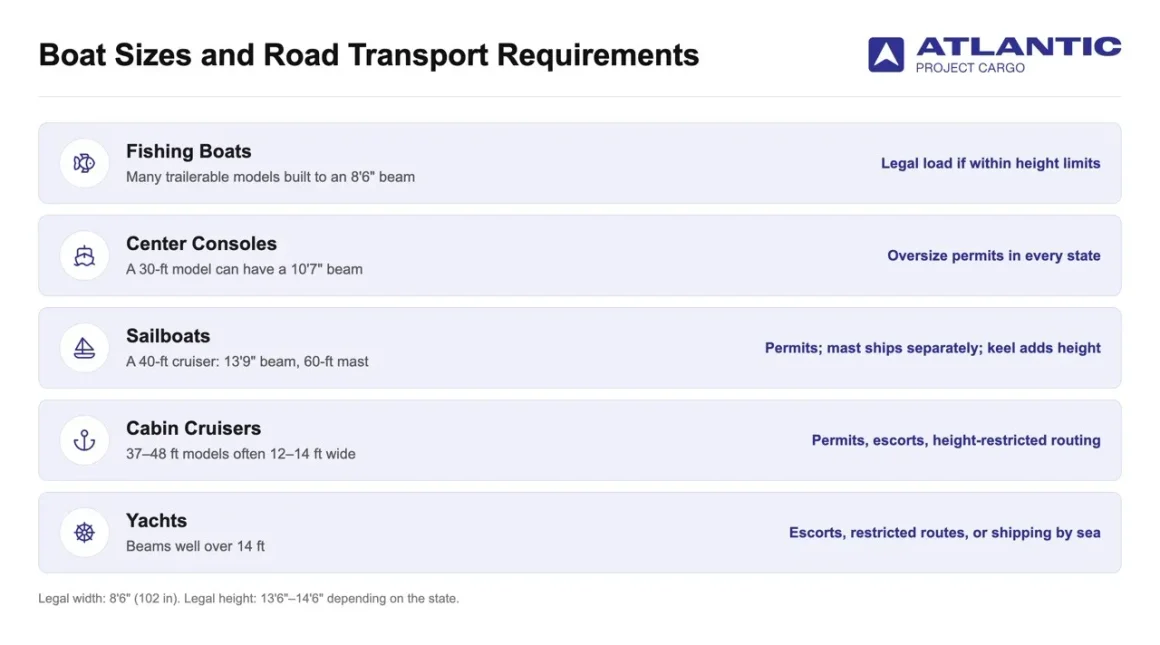
Boat TypeTypical SizeWhat It Usually Triggers
Fishing boatsMany trailerable models built to an 8’6″ beamLegal load, no permits if height allows
Center consolesA 30-ft model often has a 10’+ beamOversize permits in every state
SailboatsA 40-ft cruiser can have a 13’9″ beam and 60-ft mastOversize permits; mast shipped separately; keel adds height
Cabin cruisers37–48 ft models often 12–14 ft wide and up to 15 ft tall on the trailerPermits, escorts, and height-restricted routing
YachtsBeams well over 14 feetEscorts, restricted routes, or shipping by sea

Real specifications show how quickly a boat crosses the line. The Grady-White Canyon 306 center console is 30’6″ long with a 10’7″ beam, already more than two feet over the legal width. A Beneteau Oceanis 40.1 sailboat has a 13’9″ beam and an air draft of about 60 feet, so its mast must be unstepped and shipped separately, and its keel raises the hull on the trailer.

  • Oversize classification: width over 8’6″, height over the state’s limit, or length over the state’s limit makes the load oversize.
  • Permits: each state issues its own. A Florida-to-California move crosses several states, and each permit sets the route, travel times, and conditions.
  • Escort vehicles: thresholds differ by state. In Florida, loads 12 to 14 feet wide need at least one escort, and loads 14 to 16 feet wide need two, one of which must be a law enforcement escort. In Texas, the TxDMV requires one escort for loads over 14 feet wide and front and rear escorts over 16 feet.
  • Height poles: Tall loads may need a lead escort with a height pole that checks clearances ahead of the load.
  • Routing restrictions: Texas limits most oversize moves to daylight hours, and bans loads over 14 feet wide on major holidays. Florida restricts movement on major holidays; weekend travel is generally allowed unless the permit says otherwise.

This is why oversized boat transport costs more than moving a legal-size boat the same distance: every foot of beam adds permits, escorts, and time.

Methods of Transportation

There are five main ways to move a boat across the country. For international moves, RoRo and breakbulk shipping are also options, covered below. The right one depends on the boat’s size, whether it is seaworthy, and whether the origin and destination are on the water.

Overland Transport

Overland transport is the most common method for boat hauling across the country. The boat travels on its own trailer or on a carrier trailer, such as a hydraulic boat trailer, step deck, or lowboy.

  • How it works: the boat is loaded at a marina, yard, or home, supported on bunks or stands, strapped at structural points, and driven to the destination.
  • Best use cases: most boats up to about 14 feet wide, including center consoles, cabin cruisers, and sailboats with masts unstepped.
  • Vessel limitations: very wide or tall boats need special routing, and some routes cannot be used at all.
  • Advantages: door-to-door service, the fastest option for most boats, and no port handling.
  • Disadvantages: permits and escorts add cost above legal dimensions, and weather or holiday restrictions can delay oversize loads.
  • Common scenario: a 30-foot center console moving from Florida to Texas on a hydraulic trailer with oversize permits.

Container Shipping

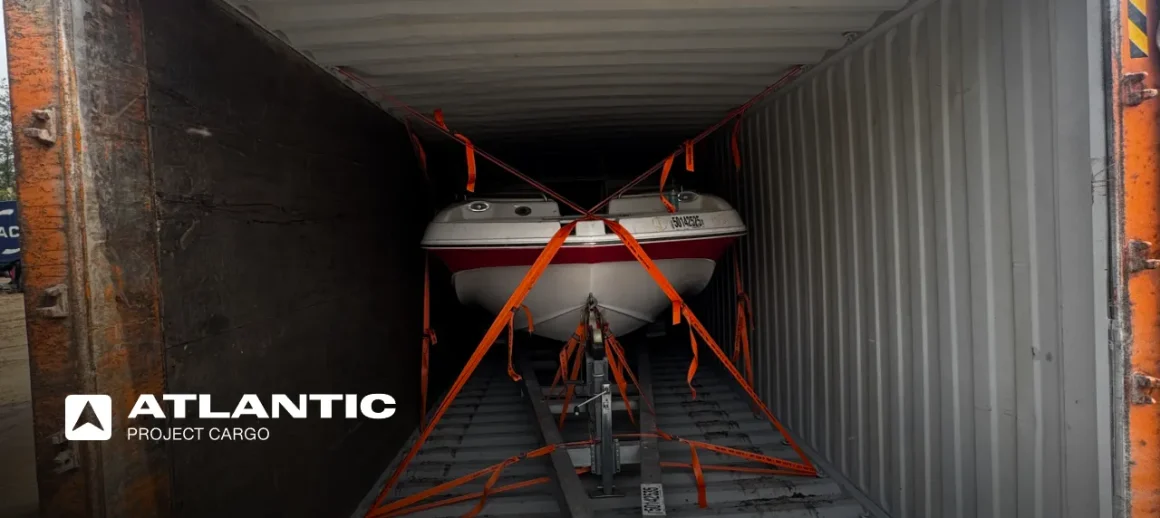
Container shipping suits small craft that fit inside a 40-foot container, including jet skis, dinghies, and small boats on trailers.

  • How it works: the boat, often on its trailer, is loaded and braced inside a standard or High Cube container.
  • Best use cases: personal watercraft, small sport boats, and international moves of small boats.
  • Vessel limitations: the boat must fit the container’s door and interior dimensions, which rules out most boats over about 7.5 feet wide, since a 40-foot High Cube door is roughly 7’8″ wide.
  • Advantages: full weather and theft protection, and the lowest ocean cost for small craft.
  • Disadvantages: size limits, and it is rarely used for domestic moves.

Flat Rack Shipping

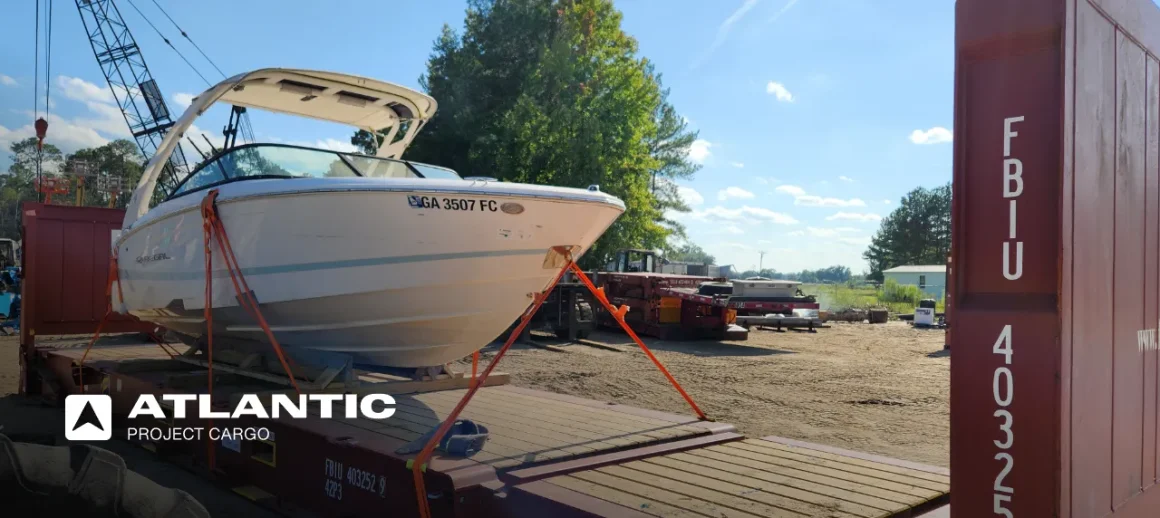
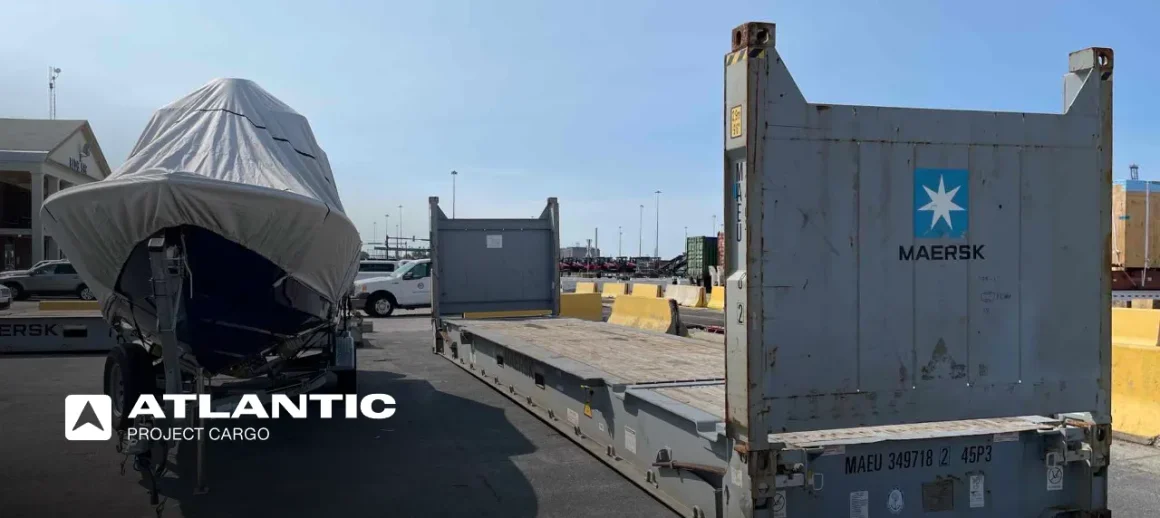
Flat rack shipping carries boats too large for a container on an open platform aboard a container ship. The hull sits in a cradle lashed to the rack.

  • How it works: the boat is craned into a custom cradle on the flat rack, lashed at structural points, protected for the voyage, and loaded at the port.
  • Best use cases: international moves of boats too wide for a container, up to roughly 16 feet wide.
  • Vessel limitations: the flat rack’s weight and dimension limits, and the lift capacity at both ports.
  • Advantages: regular container sailings, which give more routes and dates than yacht carriers.
  • Disadvantages: crane lifts, cradles, and out-of-gauge surcharges add cost, and deck cargo is exposed to salt and sun.
  • Common scenario: a 37-foot express cruiser exported from Fort Lauderdale to a Mediterranean port.

Yacht Transport Ships

Yacht transport ships carry larger yachts either lift-on/lift-off, where a crane lifts the yacht aboard, or float-on/float-off, where the ship partly submerges, and the yacht floats onto its deck.

  • How it works: the yacht is lifted or floated aboard, set on cradles, welded or lashed in place, and discharged at the destination.
  • Best use cases: large yachts and moves that are too wide for the road.
  • Vessel limitations: fixed schedules and a limited set of ports.
  • Advantages: no road permits, and suitable for yachts no trailer can carry.
  • Disadvantages: slower, less frequent sailings, and the boat usually needs delivery to and from the loading port.

The Jones Act restricts moving cargo by water between two US ports to US-built, US-flag, US-crewed vessels. For East Coast to West Coast moves, foreign-flag yacht carriers commonly discharge at foreign ports instead: DYT, for example, lists Port Everglades to Golfito, Costa Rica, and Ensenada, Mexico, which it describes as “a 90-minute drive from San Diego”. The yacht then continues to its US destination under its own power or by road.

Our yacht sailing schedule lists current international yacht transport routes.

Delivery Captain Services

A delivery captain operates a seaworthy boat to its destination under its own power.

  • Best use cases: coastal moves, such as along the East Coast, for boats built for open water.
  • Vessel limitations: the boat must be seaworthy, and very long routes add fuel, crew, and wear.
  • Advantages: no trailer or permits, and the boat arrives ready to use.
  • Disadvantages: engine hours and wear, weather delays, and, for Florida to California, a voyage through the Panama Canal that is usually slower and costlier than trucking.

Transport Method Comparison

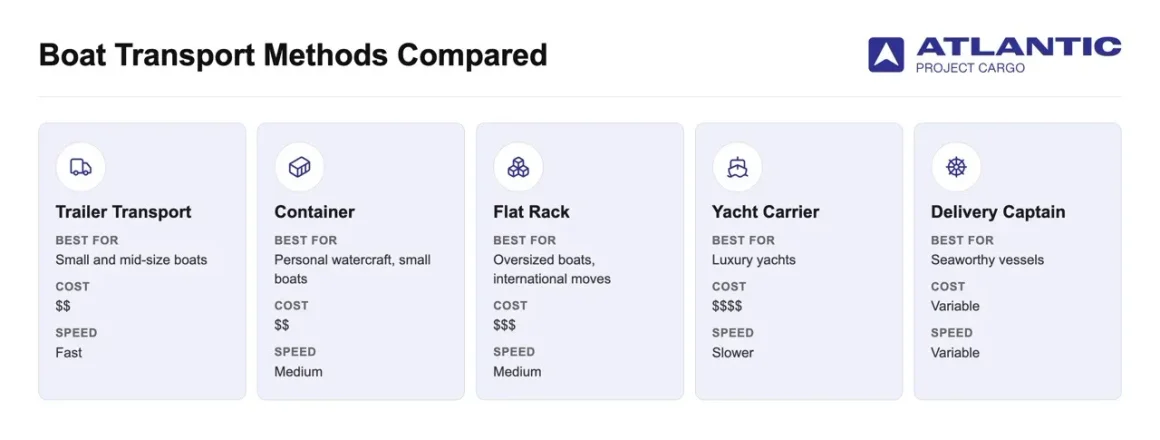
MethodBest ForCost RangeTransit Speed
Overland (Trailer) TransportSmall and mid-size boats$$Fast
Container ShippingPersonal watercraft and small boats (mainly international$$Medium
Flat Rack ShippingOversized boats, international moves$$$Medium
Yacht CarrierLarge yachts$$$$Slower
Delivery CaptainSeaworthy vesselsVariableVariable

For most boat shipping across the country, trailer transport is the default. Flat rack shipping and yacht carriers make sense when the boat is too large for the road or is moving internationally.

How Much Does Cross-Country Boat Transport Cost?

How much does boat transport cost across the country? For a boat within legal dimensions, trucking typically runs about $2 to $3 per mile on long hauls over 1,000 miles, and oversized loads add about $1 to $2 per mile for permits and a single escort; loads that need two escorts or a police escort can cost considerably more. Loading, cradles, storage, and wrapping are extra.

The main cost drivers:

  • Transport distance: longer hauls cost more in total but less per mile.
  • Boat dimensions: width and height decide permits, escorts, and routing, and are usually the biggest factor.
  • Weight: heavier boats need bigger trailers and trucks.
  • Permit requirements: each state on an oversize route charges for its permit.
  • Escort vehicles: each escort adds cost, and some states require two or a police escort.
  • Trailer requirements: a road-legal owner’s trailer is cheaper than a carrier trailer or custom cradle.
  • Route complexity: mountain passes, low bridges, and restricted roads lengthen the route.
  • Seasonality: spring and fall are busy, as owners move boats between seasons.
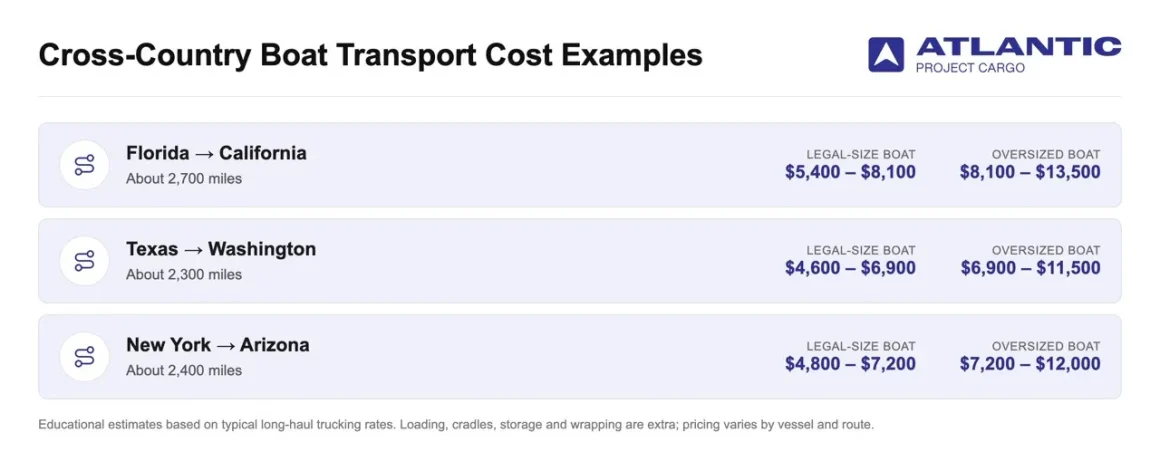
RouteApprox. DistanceLegal-Size BoatOversized Boat
Florida → CaliforniaAbout 2,700 miles$5,400 – $8,100$8,100 – $13,500
Texas → WashingtonAbout 2,300 miles$4,600 – $6,900$6,900 – $11,500
New York → ArizonaAbout 2,400 miles$4,800 – $7,200$7,200 – $12,000

These are educational estimates based on typical long-haul trucking rates. Actual pricing varies with the boat’s specifications, the permits and escorts required, route conditions, and timing, so a boat transport quote for your vessel is the only reliable figure.

Can a Boat Be Transported Without a Trailer?

Yes. Many boats, especially larger yachts, have no road trailer, and professional boat transport services load them directly at a marina or yard.

  • Marina pickup: the boat is hauled out at the marina and loaded on-site, so it never needs its own trailer.
  • Travel lifts: a marina travel lift raises the boat in slings so a hydraulic trailer can back underneath.
  • Crane loading: where no travel lift is available, a mobile crane lifts the boat, with slings positioned at the hull’s lifting points.
  • Custom cradles: a steel or timber cradle shaped to the hull’s deadrise supports it along structural points for road or sea transport.
  • Flat rack shipping: for international moves, the cradled boat is craned onto a flat rack and lashed at reinforced points.
  • Yacht transport solutions: large yachts can be lifted or floated onto a yacht carrier.

Loading is planned around the boat’s weight, lifting points, and the equipment available at both ends. That planning is what prevents stress cracks and gelcoat damage.

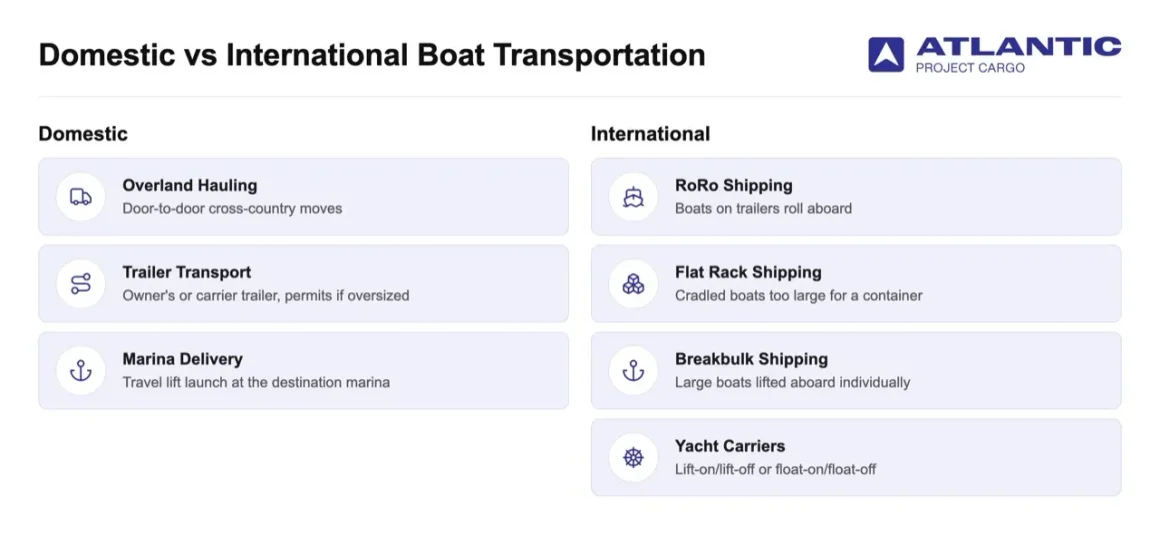
Domestic vs International Boat Transportation

Domestic boat transport usually means overland hauling, while international moves rely on ocean shipping methods.

Domestic transportation:

  • Overland hauling: the standard for cross-country moves, door-to-door.
  • Trailer transport: on the owner’s trailer or a carrier trailer, with permits for oversized boats.
  • Marina delivery: delivery to the destination marina, often with a travel lift for launching.

International transportation:

  • RoRo shipping: boats on their trailers roll aboard a RoRo vessel.
  • Flat rack shipping: cradled boats too large for a container.
  • Breakbulk shipping: large boats and yachts lifted aboard individually.
  • Yacht carriers: lift-on/lift-off or float-on/float-off for large yachts.

Domestic moves are usually fastest and cheapest by road. International moves add export filing, destination customs, and port handling, so the method depends on the boat’s size and the available sailings. Our guide to international boat shipping covers the export process.

Boats on trailers can often use our RoRo shipping service.

Larger vessels move as project cargo through our breakbulk shipping service.

Recent Project Examples

Axopar 37 XC — Fort Lauderdale, USA to Palma de Mallorca, Spain

At 11.5 meters long and about 3.35 meters on the beam, the Axopar 37 XC could not fit in a container. Our yard team built a steel-and-timber cradle profiled to the hull’s deadrise, shrink-wrapped the boat over a padded frame, and wrapped deck fittings, electronics, and glass individually.

The boat was craned onto a flat rack and chained at reinforced points. We filed the US export declaration (AES), and because there is no direct flat rack service to Palma, the boat crossed to a Mediterranean hub and continued by feeder vessel. The move took seven weeks from booking to handover. Read the full Axopar 37 XC case study.

Boat Shipping Process

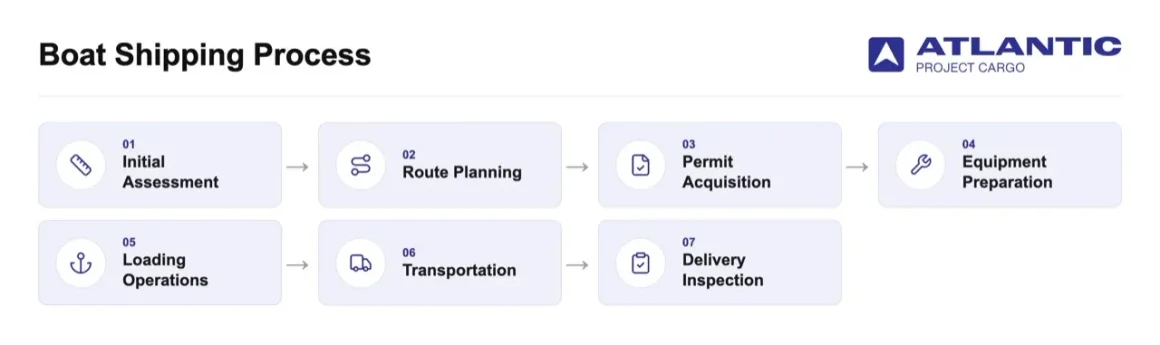
Professional cross-country boat transport runs through seven steps:

  1. Initial assessment: we confirm the boat’s make, model, length, beam, height on the trailer, weight, towers or arches, and trailer condition. Height on the trailer is measured, not taken from the brochure, because keels and cradles add height.
  2. Route planning: we plan a route that avoids low bridges, weight-restricted structures, and roads closed to oversize loads, and we check each state’s travel-time rules.
  3. Permit acquisition: for oversized boats, we obtain permits from every state on the route and book escorts where required.
  4. Equipment preparation: we select the trailer, cradle, or flat rack, and arrange the travel lift or crane at pickup.
  5. Loading operations: the boat is lifted, set on supports at structural points, and secured with straps that do not crush the hull or rails.
  6. Transportation: the driver follows the permitted route, checks tie-downs at stops, and moves only in permitted hours.
  7. Delivery inspection: the boat is inspected against the pickup condition report before it is unloaded or launched.

Preparing Your Boat for Transport

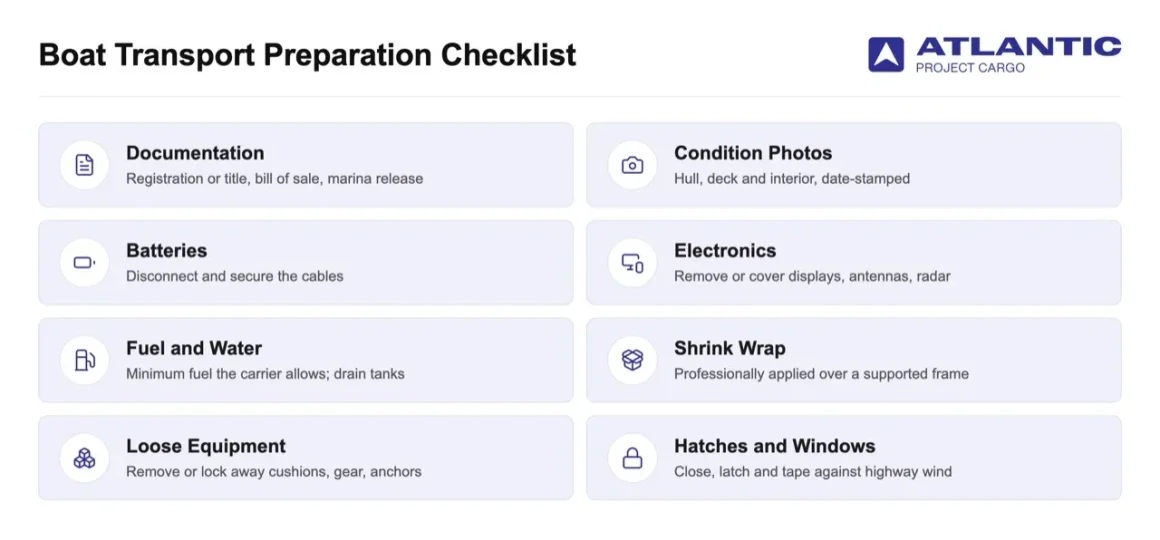
Use this checklist before pickup:

  • Documentation: have the registration or title, bill of sale if recently purchased, and any marina release ready.
  • Condition photos: photograph the hull, deck, and interior from every side, with date stamps.
  • Batteries: disconnect batteries and secure the cables to prevent electrical drain or shorts.
  • Electronics: remove or cover displays, antennas, and radar domes.
  • Fuel: keep fuel to the minimum the carrier allows, to reduce weight and fire risk, and drain water and holding tanks.
  • Shrink wrapping: have it applied professionally over a supported frame, so it does not tear and flap at highway speed.
  • Loose equipment: remove life jackets, cushions, anchors, and personal items, or lock them inside the cabin.
  • Hatches and windows: close, latch, and tape hatches and windows against highway wind.

Lowering the height is often the easiest saving: removing a bimini top, antenna, radar arch, or outriggers can keep the load under a state’s height limit or avoid a height-pole escort.

Common Mistakes and How to Avoid Them

  • Quoting brochure dimensions: height on a trailer or cradle is often greater than listed. Measure the loaded height.
  • Assuming the owner’s trailer is road-ready: bad tires, bearings, or lights can stop the move. Have the trailer inspected first.
  • Leaving the tower or arch on: a few inches can push the load over the legal height and require permits, or, on taller loads, a height-pole escort. Remove what comes off easily.
  • Skipping the condition record: without dated photos, damage claims are hard to settle.
  • Booking too late in spring or fall: busy seasons fill trucks and permits take time.
  • Overlooking insurance: carrier liability is limited, so confirm coverage before the move. Our cargo insurance covers the boat’s value in transit.

Choosing a Boat Hauling Company

A boat hauling company for a cross-country move should be able to show:

  • Oversize experience: permits, escorts, and routing for wide and tall loads.
  • Loading capability: travel lift, crane, and custom cradle work, not only boats on their own trailers.
  • Clear insurance: written coverage for the boat’s value in transit.
  • International capability: flat rack, RoRo, breakbulk, and yacht carrier options when the move goes overseas.

Atlantic Project Cargo handles cross country yacht transport, marina-to-marina moves, and international boat shipping. Our yacht transport services cover each of these methods.

Questions About Boat Transport

A load up to 8’6″ wide travels without a width permit. Legal height in most states is 13’6″ to 14’6″, measured with the boat on the trailer. Anything wider or taller needs a permit from each state on the route.
Fixed equipment can stay. Remove or lock away loose items, life jackets, water sports gear, and portable electronics, because they can shift and cause damage.
Yes, if it is applied professionally over a supported frame. Poorly applied wrap can tear and damage the gelcoat.
Yes. We ship boats internationally by RoRo, flat rack, breakbulk, and yacht carrier, including export filing and port handling.
Yes, if it is road-ready. We inspect the tires, brakes, lights, and bearings before departure.
Carrier liability is limited, so confirm coverage in writing and consider cargo insurance for the boat’s full value. Dated photos at pickup support any claim.
A steel or timber support built to the hull’s shape. It carries the boat at its structural points when no trailer is used, such as on a flat rack or yacht carrier.
Reduce the boat’s dimensions: removing towers, arches, or outriggers can avoid permits or height-pole escorts. Booking early and staying flexible on dates also helps.

Get a Boat Transport Quote

Get a Boat Transport Quote

For an accurate boat transport quote, send us the boat’s make and model, length, beam, height on the trailer, weight, pickup and delivery locations, and whether it has a road-legal trailer.

Shipping Insights & Guides

Largest Farm Equipment Manufacturers in the USA
November 15, 2023

Largest Farm Equipment Manufacturers in the USA

The agricultural sector stands as a cornerstone of the United States economy, vital for both domestic needs and global food supply. In this era of large-scale agriculture, farmers increasingly depend...

Reviewed by Nick Yadryshnikov Nick Yadryshnikov
Read
Top 10 Tractor Companies in the World
May 20, 2026

Top 10 Tractor Companies in the World

The global farm tractor market is a crucial segment of the agricultural industry, with an expected total value of around $66.1 billion by 2027. While specific rankings can vary slightly...

Reviewed by Nick Yadryshnikov Nick Yadryshnikov
Read
Top 10 Construction Equipment Manufacturers
June 26, 2026

Top 10 Construction Equipment Manufacturers

The global construction equipment industry has entered a new era. Driven by surging infrastructure investment, rapid urbanization, and a technology wave spanning electrification, autonomy, and AI-powered fleet management, the market...

Reviewed by Victoria Moseicuka Victoria Moseicuka
Read
John Deere’s Most Powerful Tractors Yet: the New 2025 9RX Series
April 23, 2024

John Deere’s Most Powerful Tractors Yet: the New 2025 9RX Series

John Deere has released its most powerful tractor to date, the 2025 9RX series. This ground-up redesign has increased horsepower and efficiency, allowing farmers to cover more ground and reduce...

Reviewed by Nick Yadryshnikov Nick Yadryshnikov
Read
Top 10 RV Manufacturers in 2026: Who’s Building America’s Best Rigs?
June 18, 2026

Top 10 RV Manufacturers in 2026: Who’s Building America’s Best Rigs?

The American love affair with recreational vehicles isn’t slowing down. Whether it’s remote workers trading cubicles for campgrounds or retirees finally hitting the open road, RV culture is firmly embedded...

Reviewed by Victoria Moseicuka Victoria Moseicuka
Read
Top 15 Combine Harvester Producers
February 13, 2024

Top 15 Combine Harvester Producers

In the previous article we discussed the Top 10 Tractor Companies, today we will focus on harvesters. From the huge plains of the US to the rice paddies of Asia,...

Reviewed by Nick Yadryshnikov Nick Yadryshnikov
Read
Top 10 Biggest Farms in the US
June 12, 2025

Top 10 Biggest Farms in the US

The agricultural landscape of the United States is huge and varied, but certain farms stand out not just for their heritage or production, but for their sheer scale. These operations...

Reviewed by Nick Yadryshnikov Nick Yadryshnikov
Read
Guide how to Import a Car to the United States
September 27, 2024

Guide how to Import a Car to the United States

Car import into the U.S. can be challenging with potential pitfalls: laws, requirements, and paperwork. However, with the right guidance and understanding of the process, it can be a straightforward...

Reviewed by Maryana Serafinas Maryana Serafinas
Read
Top 10 World Bulldozer Manufacturers
February 20, 2024

Top 10 World Bulldozer Manufacturers

In our previous article we had a look at the Top 15 harvester producers, today we will focus on bulldozers. Bulldozers are a crucial part of construction and agriculture. Their...

Reviewed by Victoria Moseicuka Victoria Moseicuka
Read
What Are the Top 10 Biggest and Busiest Ports in the US?
April 8, 2024

What Are the Top 10 Biggest and Busiest Ports in the US?

Today we are starting a series of articles related to the world’s biggest ports, and we will start with the United States. The United States has a wide network of...

Reviewed by
Read