Hours of operations:
9AM - 5PM / UTC -5 (EST)
October 30, 2026 18 min

Top Ports in Peru: Major Shipping Hubs for Heavy Equipment & Mining Cargo

Explore Peru’s major ports for heavy equipment, mining cargo, containers, and project freight. Compare Callao, Chancay, Matarani, Paita, and other shipping hubs.
Worldwide Shipping
Americas · Europe · Asia Pacific · Africa
100,000+
Shipments Worldwide
20+ Years
In Heavy Cargo Logistics
4.9 Rating
on Google · 50+ reviews
Licensed Freight Forwarding Company
Home Insights Top Ports in Peru: Major Shipping Hubs for Heavy Equipment & Mining Cargo

Callao is Peru’s primary maritime gateway, handling the large majority of the country’s container trade near Lima. Chancay, opened in late 2024 just north of Callao, has quickly become an important new Pacific hub for Asia trade, and Matarani in the south is the key port for mining logistics and the Arequipa region. For heavy equipment and mining cargo, though, the biggest or nearest port is not automatically the right one: the final destination, the inland route, and the machine’s dimensions matter as much as the ocean leg. This guide helps you match the cargo and the destination to the port that serves them best.

Peru sits on the Pacific coast of South America, which puts its ports on direct trade lanes to Asia and North America, and its economy leans heavily on mining, so a large share of what moves through its ports is machinery inbound and mineral concentrate outbound. Because so much of that cargo is bound for mine sites in the Andes rather than for Lima, choosing a port is really about choosing a whole route, from the vessel to the quay to the road or rail that finishes the journey.

Quick Facts About Peru’s Major Ports

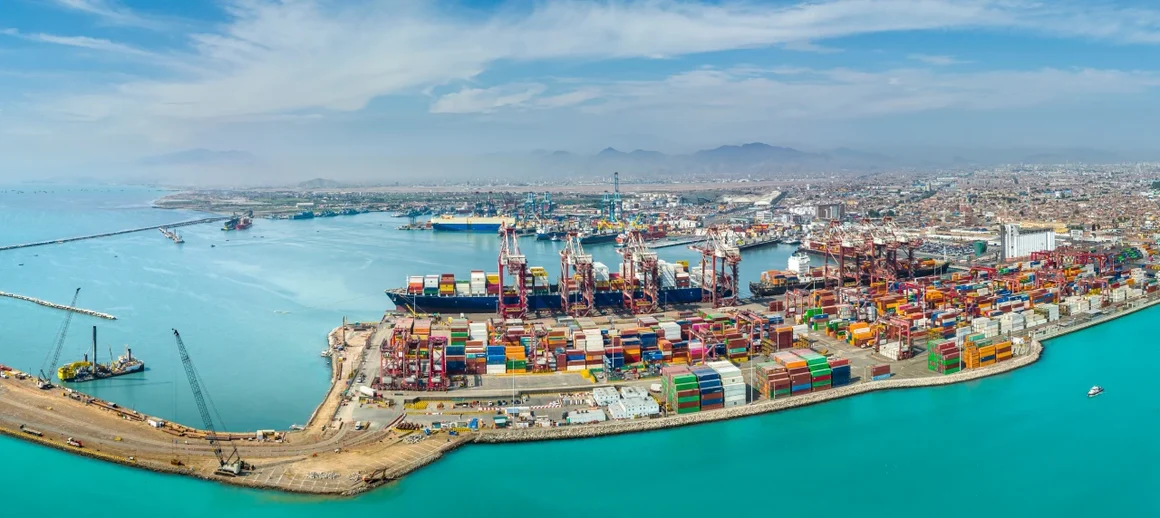
Aerial view of the Port of Callao container terminal, Peru's main commercial gateway near Lima

Here is the short version before the detail. The biggest ports in Peru cluster around Lima and the mining south, and the table sums up what each of the main Peru ports does.

CategoryPort / Information
Main commercial gatewayPort of Callao (near Lima)
Major container hubPort of Callao
Major new logistics hubPort of Chancay (opened November 2024)
Key southern portPort of Matarani (Arequipa)
Important northern portPort of Paita
Important ports for mining / project cargoMatarani and Ilo (southern mining); Callao and Chancay (central)
Main international trade connectionsAsia (especially China), North America, and Latin America

Why Choosing the Right Port in Peru Matters

Among the cargo ports in Peru, the right one is whichever delivers the lowest total logistics cost, not the lowest ocean freight rate. For a container of standard goods those two often line up, but for heavy equipment and mining cargo they frequently do not, because the inland leg from the quay to the site can dwarf the sea leg in both cost and difficulty.

Peru’s Port Infrastructure and International Trade

The Peru shipping ports that matter run down the Pacific coast, anchored by Callao near Lima and now joined by the new deep-water terminal at Chancay. These seaports in Peru fall into container gateways, mineral terminals, and regional multipurpose ports. The international ports in Peru that carry the most trade connect to Asia and North America. Machinery imports arrive from the United States, Asia, and Europe, while copper and other concentrates flow outward, much of it through the southern ports closest to the mines. Matching cargo to the right type of port is the first decision.

Peru’s Ports and the Mining Industry

Mining logistics in Peru is what makes port selection here different from most countries, because the cargo is heavy, the destinations are remote, and the terrain in between is some of the most difficult on earth. Peru is one of the world’s largest copper producers, and its mines sit high in the Andes, often hundreds of kilometres inland from the coast and thousands of metres up.

The mining equipment shipped to Peru is exactly the kind that complicates a shipment: mining trucks, excavators, wheel loaders, crushers, drilling equipment, generators, conveyors, processing equipment, and outsized industrial components. Getting a machine like that from a quay to a mine involves heavy-haul trucking, oversized-cargo routes, mountain roads with real restrictions, and careful project scheduling. Two ports may both be able to receive the machine, yet one can sit on a far better road or rail corridor to the site than the other.

That is why the location of the mine or project can decide the port. A concentrate exporter or a mine in the south of the country is often better served by Matarani, which has a dedicated rail link into the southern mining belt, than by routing everything through Callao and trucking it the length of the country. The port that looks obvious on a map is not always the port that moves the machine most cheaply or safely.

Map of Major Ports in Peru

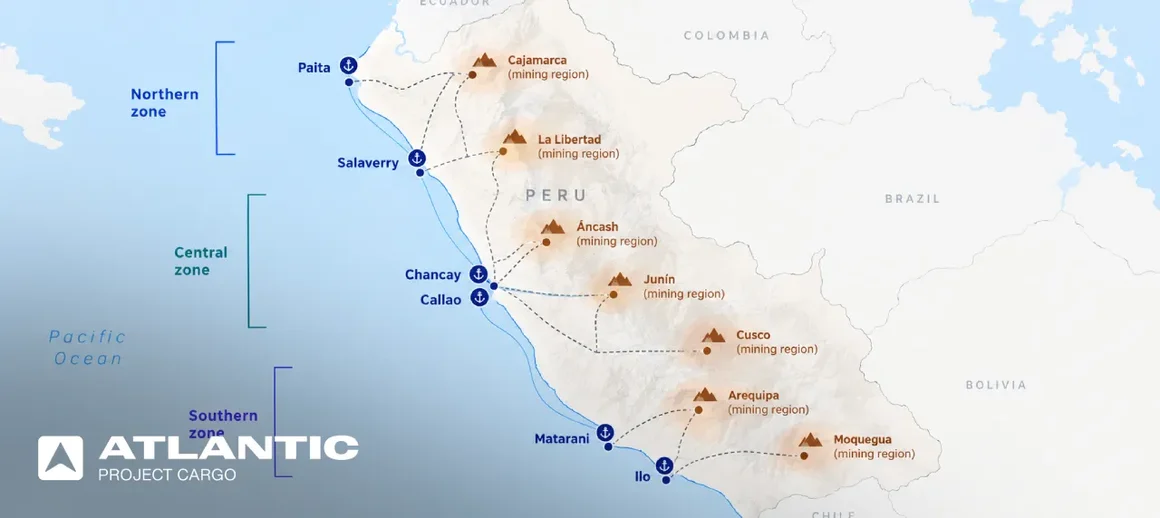
Map of major ports in Peru: Paita, Salaverry, Chancay, Callao, Matarani and Ilo with mining regions and northern, central and southern zones

The coastline divides naturally into three service areas. Paita and Salaverry serve the north, Callao and Chancay anchor the centre around Lima, and Matarani and Ilo serve the south and the southern mining regions. The reason the map matters is simple: the closer the destination port is to the final site, the shorter and cheaper the inland leg tends to be, and for heavy cargo that inland leg is where routes succeed or fail.

Quick Comparison of Peru’s Major Ports

PortRegionContainersBreakbulk / Project CargoMining RelevanceBest For
CallaoCentral (Lima)Very highYesHighThe default gateway for most cargo and destinations
ChancayCentral (north of Lima)Growing (new)Multipurpose berthsGrowingAsia-Pacific container trade and central-Peru cargo
MataraniSouth (Arequipa)LimitedYesVery highSouthern mining cargo and concentrate export
PaitaNorthModerateLimitedLow to moderateNorthern cargo and agricultural exports
SalaverryNorth-centralLowLimitedLow to moderateBulk and general cargo for the northern interior
IloSouthLowLimitedModerateSouthern regional and mining-related cargo

Capabilities differ by terminal and change over time, so any specific handling requirement should be confirmed with the port or operator before booking.

Major Ports in Peru

The six profiles below run from the primary gateway to the regional ports. Callao, Chancay, and Matarani carry more detail because they matter most to heavy-equipment and mining shipments.

1. Port of Callao

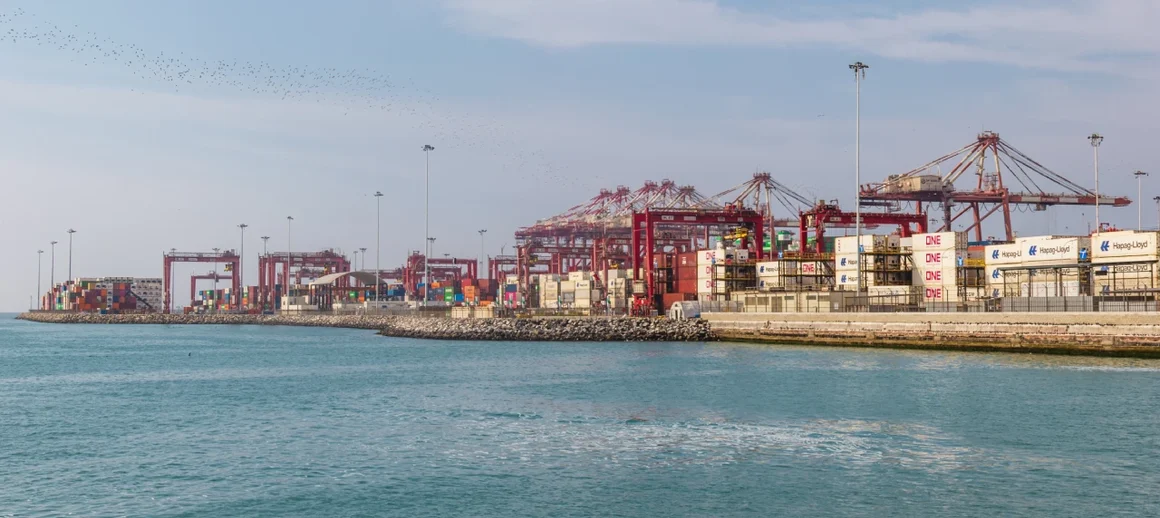
Container cranes and stacked containers at the Port of Callao, Peru

Callao is Peru’s principal maritime gateway and its busiest container port by a wide margin, sitting right beside Lima on the central coast. It operates through two terminals: the South Terminal operated by DP World and the North Terminal operated by APM Terminals. According to Peru’s National Port Authority, the complex accounts for more than 80% of the country’s container traffic.

Together the two terminals moved roughly three million TEU in 2024 (about 1.9 million at DP World and 1.1 million at APM Terminals), according to Peru’s National Port Authority as reported by DatamarNews. In 2025, volume rose to about 3.3 million TEU, according to APN data analysed by ComexPerú.

Callao’s capability grew sharply in 2024. DP World’s Bicentennial Pier, a $400 million expansion inaugurated that June, extended the South Terminal quay past one kilometre and lifted its annual capacity toward 2.7 million TEU, letting it berth three ultra-large container vessels at once, as reported by Port Technology. In 2025 the terminal became the first on South America’s west coast to move more than two million TEU in a single year.

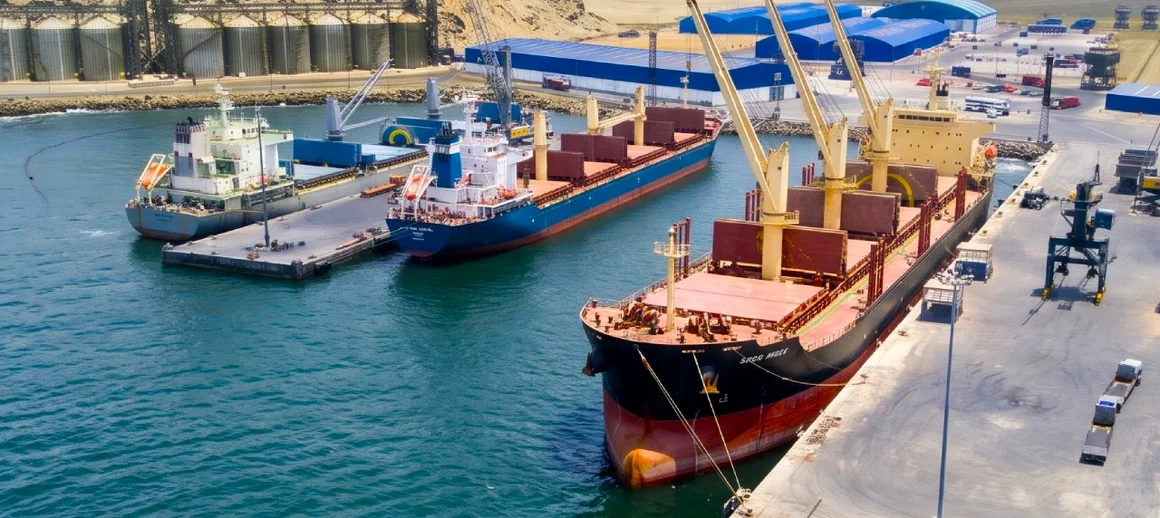
For heavy equipment and project cargo shipped to Peru, Callao’s advantages are its scale, the depth of its shipping-line connections, and its position as the natural distribution point for Lima and central Peru. It receives machinery imports of every kind and offers the widest choice of vessels and services in the country. Its main limitation for oversized cargo is congestion and the cost of the long inland haul when the final destination sits far to the north or south.

Callao often still makes sense even when the destination is outside Lima, because the vessel choice and service frequency are so much greater than at the regional ports. Whether it does comes down to comparing the ocean saving against the inland cost, which is the calculation this guide keeps returning to.

2. Port of Chancay

Chancay is Peru’s newest major port and its first greenfield mega-port, located roughly 70 to 80 kilometres north of Lima and operated by COSCO Shipping Ports, which holds a 60% stake alongside the Peruvian mining company Volcan, as reported by Seatrade Maritime. It opened in November 2024 and received its port operating licence from the National Port Authority in June 2025, making it very much a current facility rather than a plan, though one still ramping up.

The Phase 1 terminal that is operational today spans 1,500 metres with four berths, two for containers and two multipurpose, and a natural draft of up to 17.8 metres, deep enough for the largest container ships. Its designed Phase 1 capacity is around one million TEU a year, six million tonnes of bulk cargo, and 160,000 vehicles, and a 1.8-kilometre tunnel connects the terminal to its inland access complex near the Pan-American Highway. Its headline feature is a direct container route to Shanghai that cuts the crossing to roughly 23 days.

It is worth being precise about what is current and what is not. The direct Asia service, the four berths, and the Phase 1 capacity above are operational. Today’s berths are reported to take ships of up to about 22,000 TEU. The often-quoted 24,000-TEU capability and a build-out toward 1.5 million TEU belong to planned future expansion, not to today’s terminal. In 2025, its first full year, Chancay handled about 231,000 TEU, well below its design capacity, which shows how early in its ramp-up the port still is.

For machinery and industrial imports bound for central Peru, Chancay adds a genuine second option to Callao, with modern handling and strong Asia connectivity. Its multipurpose berths give it real potential for general and project cargo, though its network of shipping services is younger and narrower than Callao’s, so the right choice between the two depends on the specific service and destination.

Callao vs Chancay: Which Port Should Importers Consider?

Neither port is universally better; they suit different shipments. Callao offers the deepest choice of services and the established infrastructure of Peru’s main gateway, while Chancay offers a new deep-water terminal with fast, direct Asia connectivity and, so far, less congestion than Callao.

FactorCallaoChancay
LocationBeside Lima, central coast~78 km north of Lima
International connectivityWidest global service network in PeruStrong, direct Asia routes; network still growing
Container servicesVery high volume, all major linesGrowing, anchored by COSCO
Heavy / project cargoEstablished, high capacityMultipurpose berths; newer capability
Asia-Pacific tradeWell servedPurpose-built for it, ~23 days to Shanghai
Inland distributionMature road links to Lima and beyondTunnel access to the Pan-American Highway; the 70–80 km distance lengthens the inland leg for Lima-bound cargo
Best suited forMost cargo, broadest vessel choice, non-Asia originsAsia-origin container cargo and central-Peru destinations

The decision comes down to the cargo, the shipping line and service you need, the origin, the final destination, the inland route, and the total logistics cost. For a US-origin machine, for instance, Callao’s wider service choice often matters more than Chancay’s Asia advantage.

3. Port of Matarani

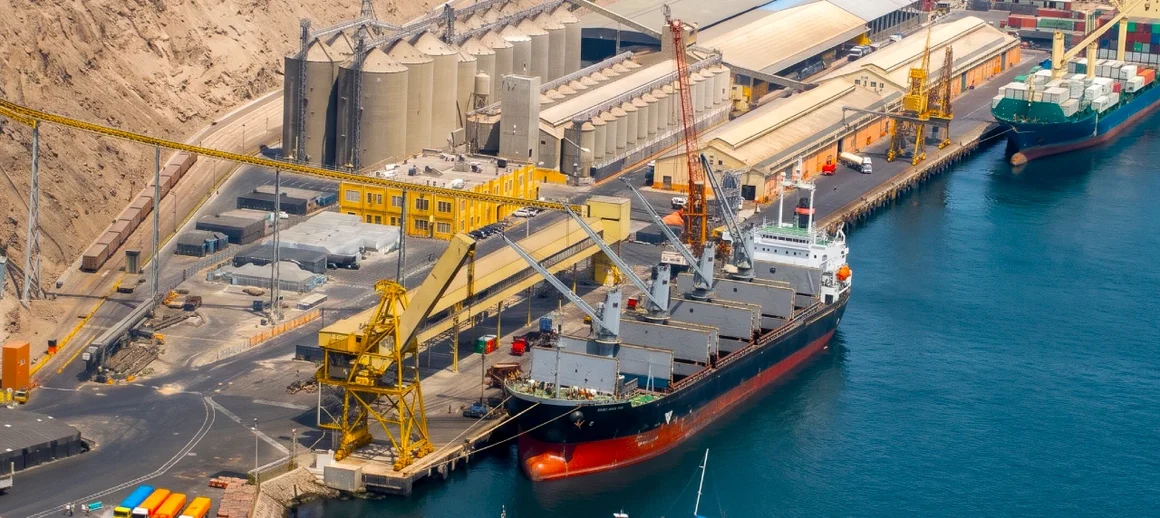
Port of Matarani in Arequipa, southern Peru's key port for mining cargo

Matarani is southern Peru’s principal port and the country’s most important terminal for mining logistics, on the coast of the Arequipa region and operated by TISUR. It is a genuinely multipurpose port, but its defining role is mineral concentrate export. Per IDB Invest, Matarani handles more than 8.3 million tonnes of cargo a year, including over 4.5 million tonnes of mineral concentrates, and moves more than 4% of the world’s copper concentrate trade.

What makes Matarani matter for heavy equipment is the same thing that makes it matter for concentrate: its inland connections into the southern mining belt. The port sits at the end of road-rail corridors serving major copper operations including Cerro Verde, Las Bambas, and Antapaccay. Las Bambas concentrate, for example, is trucked to the Pillones transfer station and then railed about 295 km to Matarani. Oversized machinery bound for these mines usually moves by road the whole way. The port also serves as a trade gateway for landlocked Bolivia. For a machine bound for a mine in the south, landing it at Matarani can mean a far shorter and simpler heavy-haul move than routing through Callao and trucking it hundreds of kilometres south.

The port handles general and project cargo alongside its mineral business, with the cargo-handling equipment and storage that its mining clients require. A $700 million expansion agreed with the Peruvian state in 2025 is set to increase berthing and cargo-handling capacity, but that programme is a planned future development rather than current capability. Matarani is the more practical routing when the destination is a southern mine or the Arequipa region; it is not a substitute for Callao’s scale on general container trade.

4. Port of Paita

Paita is the main port of northern Peru and the country’s second-busiest container terminal, located about 500 nautical miles north of Callao and operated by Terminales Portuarios Euroandinos. According to Peru’s National Port Authority, as reported by DatamarNews, it handled roughly 309,000 TEU in 2024, a fraction of Callao’s volume but significant for the region it serves.

Paita’s trade is built on northern Peru’s agricultural exports, mangoes, grapes, bananas, and fishmeal among them, with general cargo, vehicles, and fertilizer on the import side. For equipment bound for the north of the country, Paita can make clear logistical sense: landing a machine there rather than at Callao avoids a long northbound inland haul. Its handling infrastructure is geared to containers and regional trade rather than to heavy project cargo, so oversized machinery needs its capabilities confirmed case by case.

5. Port of Salaverry

Port of Salaverry near Trujillo on Peru's north-central coast

Salaverry serves the north-central coast near Trujillo in the La Libertad region, handling mainly bulk and general cargo. It is an artificial harbour protected by breakwaters, and its trade centres on bulk commodities, minerals, grains, fertilizers, and sugar, together with general cargo for the surrounding agricultural and mining interior.

Salaverry is a regional port rather than a project-cargo hub, and its container and heavy-lift capabilities are limited compared with Callao or Paita. It fits cargo bound for the northern interior that suits its bulk and general-cargo handling, and it is undergoing modernization intended to broaden what it can handle. For oversized or heavy equipment, it should not be assumed suitable without checking current capabilities directly.

6. Port of Ilo

Ilo is a southern port in the Moquegua region, handling regional trade, bulk solids and liquids, and industrial cargo, and it has a long association with mining through the Southern Peru Copper operations in the area. Southern Peru runs its own terminal at Ilo, separate from the public port, to export its concentrate. It also holds strategic importance as a potential gateway for Bolivian trade.

Within Peru’s southern port network, Ilo is a smaller and more specialized facility than Matarani, which remains the dominant southern port for mining logistics and general project cargo. Ilo fits particular regional and industrial flows in the far south, but for most heavy-equipment and mining shipments to the region, Matarani or Callao will offer the stronger combination of handling capability and inland connectivity.

Best Ports in Peru for Heavy Equipment and Mining Cargo

For heavy equipment shipped to Peru, the right port depends on the cargo type as much as the destination. The table below matches common equipment and cargo categories to the ports worth considering, based on their verified roles, and every recommendation stays conditional on the specific machine and route.

Cargo TypePort(s) to ConsiderWhy
Heavy equipmentCallao; Matarani for the southWidest handling and services at Callao; Matarani for southern sites
Mining machineryMatarani, CallaoMatarani’s road-rail corridors to southern mines; Callao for central and northern routes
Construction equipmentCallao, ChancayCentral-Peru distribution and broad vessel choice
Agricultural equipmentCallao, PaitaCallao for scale; Paita for the northern farming regions
Industrial machineryCallao, ChancayStrong handling and inland links for central Peru
Project cargoCallao, MataraniEstablished project-cargo handling at both
Containerized equipmentCallao, Chancay, PaitaThe country’s main container terminals
Breakbulk cargoCallao, MataraniMultipurpose and project-cargo capability

These are starting points based on each port’s current, verified role. The final choice still depends on vessel availability, the machine’s dimensions, and the inland leg to the site.

Choosing a Port Based on Your Final Destination in Peru

Where the cargo is going is often the deciding factor, because the inland leg drives so much of the total cost. The table below works from the destination back to the port.

Final Destination / RegionPort(s) to ConsiderLogistics Considerations
Lima / Central PeruCallao, ChancayShort inland legs; widest service choice
Northern PeruPaita, CallaoPaita avoids a long northbound haul for containerized or smaller equipment; Callao for oversized or breakbulk machinery
North-central / La LibertadSalaverry, CallaoSalaverry for bulk and general cargo; confirm heavy-lift capability first
ArequipaMataraniClosest major port; established regional links
Southern PeruMatarani, Ilo, CallaoSouthern coast and interior access; Callao where service frequency outweighs the longer inland haul
Southern mining regionsMataraniRail and road links into the copper belt

A destination near a regional port does not always mean that port is the answer if the vessel service or handling capability is not there.

Inland Transportation from Peruvian Ports

For heavy equipment and mining cargo, the port-to-site leg is often the hardest and most expensive part of the whole journey. Peru’s mines sit high in the Andes, so a machine landed on the coast may face a long climb on mountain roads with tight curves, weight limits, and altitude to contend with.

That inland move can involve heavy-haul trucking, oversized-cargo permits, route surveys to confirm a machine will physically fit the road, and careful scheduling around the terrain and the mine’s own timetable. Remote sites and difficult final-mile access add further cost and planning. Selecting the port and planning the inland leg are one decision, not two.

Breakbulk, RoRo or Container Shipping to Peru?

Breakbulk, RoRo or container shipping of heavy equipment to Peru

Whether a machine moves to Peru as breakbulk, RoRo, or in a container follows from its size, weight, and whether it runs. A compact or containerizable machine may travel in a standard container; a taller or wider one may go on a flat rack or in an open top; a running, wheeled machine may suit RoRo where a service exists; and the largest or heaviest pieces move as breakbulk. A wheel loader that drives, for example, is a natural RoRo or flat-rack candidate, while a crusher or a mining truck is usually breakbulk.

Because Atlantic Project Cargo covers these methods in depth elsewhere, the short version is enough here. For the largest and heaviest pieces, our breakbulk shipping guide explains how they move.

For oversized but craneable machines, see our flat rack shipping guide.

For anything that fits a box, our container types and sizes guide covers the standard options.

Shipping Heavy Equipment from the USA to Peruvian Ports

Shipping heavy equipment from the USA to Peruvian ports

For equipment shipped from the United States, the destination port depends on the US origin and the ocean services available, the cargo’s dimensions and weight, the shipping method, the final destination in Peru, and the inland transport it will need. The available ocean services shape the answer: a machine from the US Gulf or East Coast bound for a central-Peru site will usually route to Callao for its service choice, while a southern mining destination may favour a service into Matarani.

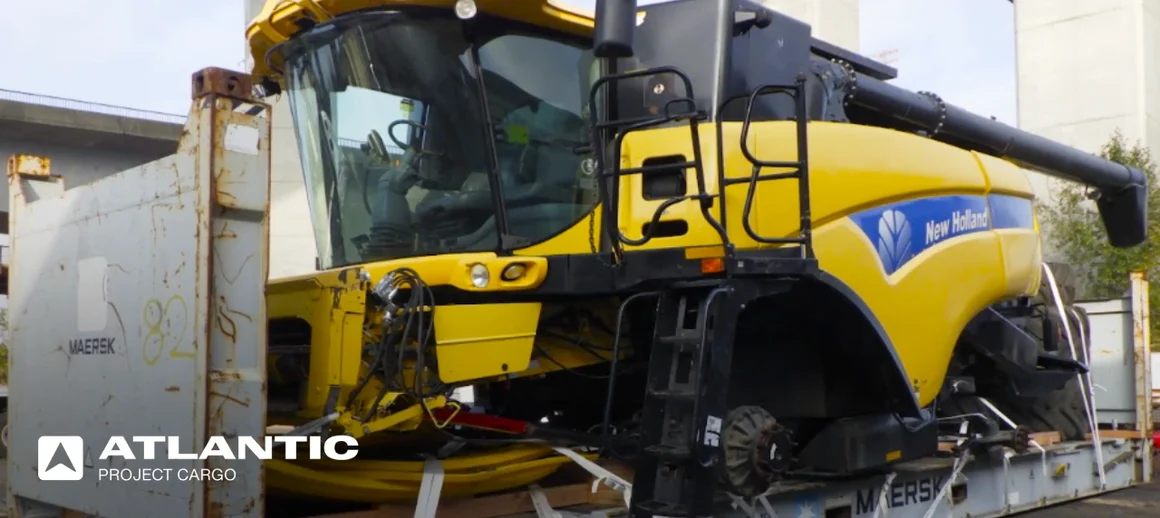
Our New Holland CX8090 combine project from the USA to Peru is one example of this kind of move handled end to end. The full USA-to-Peru process, covering customs, duties, cost structure, and transit times, is a larger subject than port selection alone and is best treated in a dedicated guide; here the focus stays on choosing the right destination port for the cargo and route.

How to Choose the Right Port in Peru

Work through these steps in order:

  1. Determine the final destination in Peru.
  2. Confirm the machine’s actual dimensions and weight.
  3. Select the shipping method: container, flat rack, open top, RoRo, or breakbulk.
  4. Check which ports have suitable ocean services from your origin.
  5. Verify the port can handle the machine as it will arrive.
  6. Map the road or rail leg from each candidate port to the site.
  7. Flag heavy-haul permits, route surveys, and road restrictions early.
  8. Confirm customs and terminal requirements at the chosen port.
  9. Compare the total logistics cost, not the sea rate alone.

Frequently Asked Questions About Ports in Peru

Callao is the largest port in Peru, handling roughly three million TEU across its two terminals in 2024 and the large majority of the country’s containerized trade. It sits on the central coast beside Lima.
Callao is Peru’s main shipping port, with the widest choice of shipping lines and services in the country.
Callao suits most cargo thanks to its scale and service choice, while Matarani is often better for machinery bound for southern mining regions.
Matarani leads for southern mines, with road-rail corridors to major copper operations, while Callao handles mining equipment for central and northern sites. Ilo plays a smaller southern role.
Neither is universally better. Chancay often suits Asia-origin container cargo for central Peru, and Callao suits most other cargo and origins.
Matarani is the principal port for southern Peru, with Ilo serving a smaller regional role further south.
Matarani is the closest major port to Arequipa, with established road and rail connections.
Yes. Machinery that cannot be containerized is commonly shipped as breakbulk through ports with project-cargo capability, chiefly Callao and Matarani.
By heavy-haul road transport, and in some southern cases by rail, often with oversized-load permits and route surveys for the mountain roads.
Callao for central Peru and the widest service choice, Matarani for southern mining regions and Arequipa, and Paita for the north.

Need Help Choosing the Right Port in Peru?

Atlantic Project Cargo evaluates the complete route rather than quoting the cheapest ocean rate in isolation, matching the ocean route, destination port, and inland delivery to your machine and its final destination in Peru.

For heavy equipment and mining cargo bound for Peru, that whole-route view is what separates a low freight quote from a low delivered cost. Tell us what you are shipping and where it needs to go, and we will map the port and the route to match.

Request a Shipping Estimate

Shipping Insights & Guides

Largest Farm Equipment Manufacturers in the USA
November 15, 2023

Largest Farm Equipment Manufacturers in the USA

The agricultural sector stands as a cornerstone of the United States economy, vital for both domestic needs and global food supply. In this era of large-scale agriculture, farmers increasingly depend...

Reviewed by Nick Yadryshnikov Nick Yadryshnikov
Read
Top 10 Tractor Companies in the World
May 20, 2026

Top 10 Tractor Companies in the World

The global farm tractor market is a crucial segment of the agricultural industry, with an expected total value of around $66.1 billion by 2027. While specific rankings can vary slightly...

Reviewed by Nick Yadryshnikov Nick Yadryshnikov
Read
Top 10 Construction Equipment Manufacturers
June 26, 2026

Top 10 Construction Equipment Manufacturers

The global construction equipment industry has entered a new era. Driven by surging infrastructure investment, rapid urbanization, and a technology wave spanning electrification, autonomy, and AI-powered fleet management, the market...

Reviewed by Victoria Moseicuka Victoria Moseicuka
Read
John Deere’s Most Powerful Tractors Yet: the New 2025 9RX Series
April 23, 2024

John Deere’s Most Powerful Tractors Yet: the New 2025 9RX Series

John Deere has released its most powerful tractor to date, the 2025 9RX series. This ground-up redesign has increased horsepower and efficiency, allowing farmers to cover more ground and reduce...

Reviewed by Nick Yadryshnikov Nick Yadryshnikov
Read
Top 10 RV Manufacturers in 2026: Who’s Building America’s Best Rigs?
June 18, 2026

Top 10 RV Manufacturers in 2026: Who’s Building America’s Best Rigs?

The American love affair with recreational vehicles isn’t slowing down. Whether it’s remote workers trading cubicles for campgrounds or retirees finally hitting the open road, RV culture is firmly embedded...

Reviewed by Victoria Moseicuka Victoria Moseicuka
Read
Top 15 Combine Harvester Producers
February 13, 2024

Top 15 Combine Harvester Producers

In the previous article we discussed the Top 10 Tractor Companies, today we will focus on harvesters. From the huge plains of the US to the rice paddies of Asia,...

Reviewed by Nick Yadryshnikov Nick Yadryshnikov
Read
Top 10 Biggest Farms in the US
June 12, 2025

Top 10 Biggest Farms in the US

The agricultural landscape of the United States is huge and varied, but certain farms stand out not just for their heritage or production, but for their sheer scale. These operations...

Reviewed by Nick Yadryshnikov Nick Yadryshnikov
Read
Guide how to Import a Car to the United States
September 27, 2024

Guide how to Import a Car to the United States

Car import into the U.S. can be challenging with potential pitfalls: laws, requirements, and paperwork. However, with the right guidance and understanding of the process, it can be a straightforward...

Reviewed by Maryana Serafinas Maryana Serafinas
Read
Top 10 World Bulldozer Manufacturers
February 20, 2024

Top 10 World Bulldozer Manufacturers

In our previous article we had a look at the Top 15 harvester producers, today we will focus on bulldozers. Bulldozers are a crucial part of construction and agriculture. Their...

Reviewed by Victoria Moseicuka Victoria Moseicuka
Read
What Are the Top 10 Biggest and Busiest Ports in the US?
April 8, 2024

What Are the Top 10 Biggest and Busiest Ports in the US?

Today we are starting a series of articles related to the world’s biggest ports, and we will start with the United States. The United States has a wide network of...

Reviewed by
Read