Hours of operations:
9AM - 5PM / UTC -5 (EST)
October 14, 2026 23 min

How Much Does It Cost to Ship Heavy Equipment Internationally? (2026 Guide)

Worldwide Shipping
Americas · Europe · Asia Pacific · Africa
100,000+
Shipments Worldwide
20+ Years
In Heavy Cargo Logistics
4.9 Rating
on Google · 50+ reviews
Licensed Freight Forwarding Company
Home Insights How Much Does It Cost to Ship Heavy Equipment Internationally? (2026 Guide)

International heavy equipment shipping costs typically range from approximately $2,000 to $25,000+ depending on equipment dimensions, weight, shipping method, origin, destination, and market conditions. A compact machine in a container sits at the low end. A tracked excavator on a flat rack sits in the middle. A crane or mining machine moving as breakbulk can pass $50,000.

The heavy equipment shipping cost varies because every machine takes up different vessel space and needs different handling, so heavy equipment shipping rates are quoted machine by machine. International equipment shipping also adds costs that a domestic truck move never has: ocean freight, port charges at both ends, export documents, customs clearance, and duties and taxes at destination. That is why a freight quote is only part of the budget. Buyers who compare total landed cost, not just the ocean freight line, are the ones who stay on budget.

This guide covers average shipping costs, pricing by equipment type and transport method, route examples, the charges buyers most often miss, and practical ways to lower the cost to ship heavy equipment. All figures are illustrative 2026 planning ranges. Actual rates depend on the machine, the route, and the vessel schedule at the time of booking.

Heavy Equipment Shipping Cost Calculator

To estimate heavy equipment transport cost, you need eight details: the equipment type, make and model, weight, dimensions, pickup location, destination, shipping method, and delivery requirements. With those, a forwarder can price the inland haul, the ocean freight, and the port handling for your specific machine instead of guessing.

Information NeededExample
Equipment TypeExcavator
Make & ModelCAT 320
Weight48,000 lbs
Dimensions31′ x 10′ x 11′
Pickup LocationHouston, TX
DestinationUAE
Shipping MethodFlat Rack
Delivery RequirementsPort-to-port

Each variable moves the price in its own way:

  • Type and model: whether the machine runs, drives aboard, or can be partly disassembled.
  • Weight: the trailer, the crane, and road permits.
  • Dimensions: the vessel space you pay for, usually the biggest cost driver.
  • Pickup location: the inland haul to the export port.
  • Destination: the ocean route, destination port charges, and import rules.
  • Shipping method: the pricing model, whether RoRo, container, flat rack, or breakbulk.
  • Delivery requirements: port or door delivery, deadlines, and site access at destination.

Request a Shipping Quote

Heavy Equipment Shipping Cost Overview

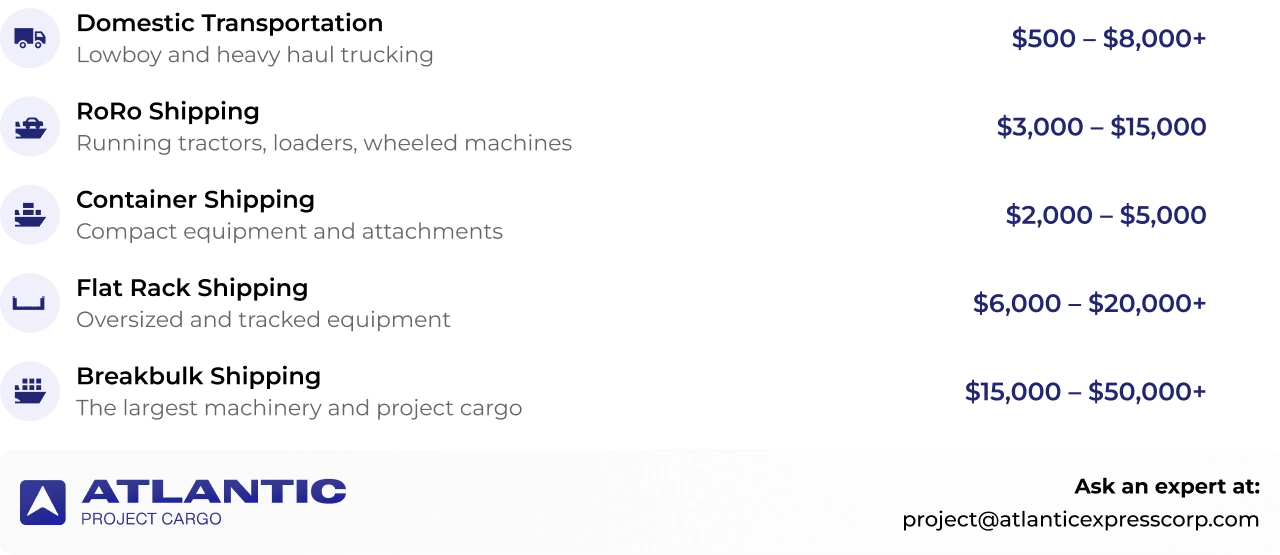
The international heavy equipment shipping cost for most machines falls between $2,000 and $25,000 in ocean freight, and the shipping method explains most of that spread. Container and RoRo shipping sit at the lower end; flat rack and breakbulk shipping sit at the higher end because they need cranes, lashing, and extra vessel space.

Shipping TypeTypical Cost Range
Domestic Transportation$500 – $10,000+
RoRo Shipping$3,000 – $15,000
Container Shipping$2,000 – $5,000
Flat Rack Shipping$6,000 – $20,000+
Breakbulk Shipping$15,000 – $50,000+

These ranges cover transport only. Actual pricing depends on the machine’s specifications, the route, and whether the equipment needs permits, cleaning, or disassembly before it ships.

Summary: average shipping cost ranges at a glance. Container: 2,000–5,000. RoRo: 3,000–15,000. Flat rack: 6,000–20,000+. Breakbulk: 15,000–50,000+. Domestic trucking: 500–8,000+. Illustrative 2026 ranges; your quote depends on the machine and route.

Freight Cost vs Total Landed Cost

Freight cost is what you pay to move the machine; total landed cost is everything you pay until the machine is cleared and delivered. The gap between the two is where most equipment budgets break, because port charges, customs, duties, taxes, insurance, and inland delivery usually sit outside the ocean freight quote.

Cost ComponentIncluded in Freight?
Ocean FreightYes
Port ChargesNo
Customs ClearanceNo
Duties & TaxesNo
Cargo InsuranceUsually No
Inland TransportationNo

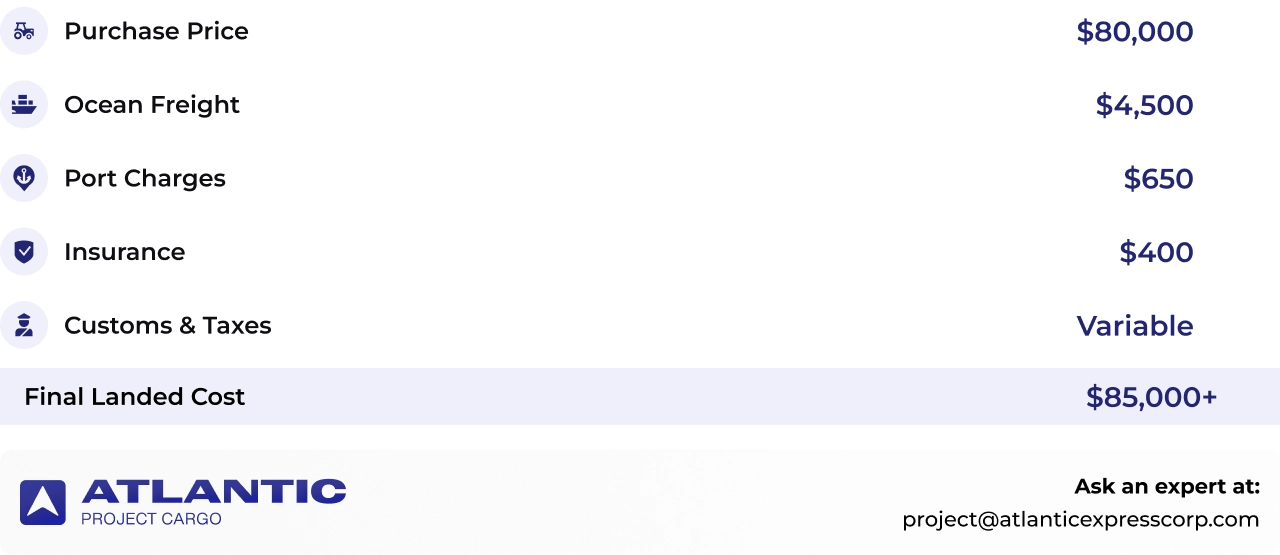
Example: John Deere Tractor, USA to Germany

ItemCost
Purchase Price$80,000
Ocean Freight$4,500
Port Charges$650
Insurance$400
Customs Duty (assumed 0% for illustration)$0
Import VAT (19% of ~$84,900 CIF value)~$16,131
Final Landed Cost~$101,681

Freight is $4,500 of this budget, but import VAT alone is more than three times that. Port charges and insurance add another $1,050.

Taxes are calculated differently by country. The EU, UAE, and Saudi Arabia charge VAT on the CIF value (machine + freight + insurance) plus any duty. Australia values goods FOB for customs duty, then charges 10% GST on the customs value plus duty, international freight, and insurance. Rates: Australia 10% GST, UAE 5% VAT, Saudi Arabia 15% VAT, Germany 19% import VAT, plus any customs duty for the machine’s tariff classification.

Can you reclaim it? For VAT- or GST-registered businesses, import VAT/GST is often recoverable, so it works mainly as a cash-flow cost rather than a final one. Private buyers and unregistered businesses usually cannot reclaim it. Our customs clearance guide explains how this works.

Key Takeaway: Freight cost and landed cost are not the same thing.

Who Pays What? Incoterms and Your Quote

Two quotes for the same machine can look very different simply because they use different Incoterms. The Incoterm in your purchase contract decides which costs the seller covers and which you pay.

IncotermSeller paysBuyer pays
EXW (Ex Works)Nothing beyond making the machine availableEverything: loading, inland haul, export clearance, freight, import costs
FOB (Free on Board)Inland haul, export clearance, loading onto the vesselOcean freight, insurance, destination costs
CIF (Cost, Insurance & Freight)Everything to the destination port, including minimum insuranceDestination port charges, customs, duties, taxes, delivery
DAP (Delivered at Place)Everything to the named destinationImport clearance, duties, and taxes
DDP (Delivered Duty Paid)Everything, including duties and taxesUnloading only

FOB and CIF are meant for RoRo, flat rack, and breakbulk cargo loaded directly onto the vessel. For containerized machinery, FCA and CIP are the correct equivalents. CIF insurance only has to meet minimum cover, so check whether it matches the machine’s full value.

How Much Does Heavy Equipment Shipping Cost?

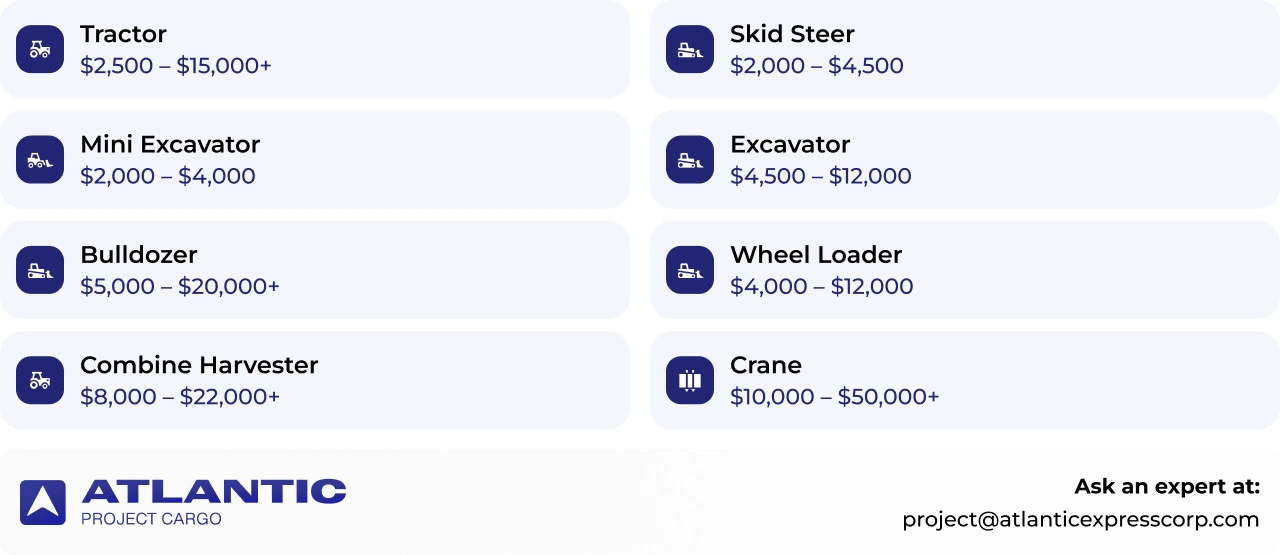
The cost to ship heavy equipment internationally ranges from about $2,000 for a mini excavator in a container to $50,000+ for a crane moving as breakbulk. Domestic transport for the same machines runs from about $500 to $10,000+, depending on distance and permits.

Equipment TypeDomestic TransportInternational Shipping
Tractor$500 – $6,000$2,500 – $15,000+
Skid Steer$500 – $1,500$2,000 – $4,500
Mini Excavator$500 – $1,500$2,000 – $4,000
Excavator$1,500 – $5,000$4,500 – $12,000
Bulldozer$1,500 – $6,000$5,000 – $20,000+
Wheel Loader$1,500 – $4,500$4,000 – $12,000
Combine Harvester$3,000 – $7,000$8,000 – $22,000+
Crane$3,000 – $10,000+$10,000 – $50,000+

Dimensions often affect pricing more than weight. Ocean carriers sell space. A tractor with dual wheels that is 12 feet wide can take up the room of two standard vehicles on a RoRo deck, and the carrier charges for all of it. A compact but heavy machine can cost less to ship than a lighter one that is wide and tall.

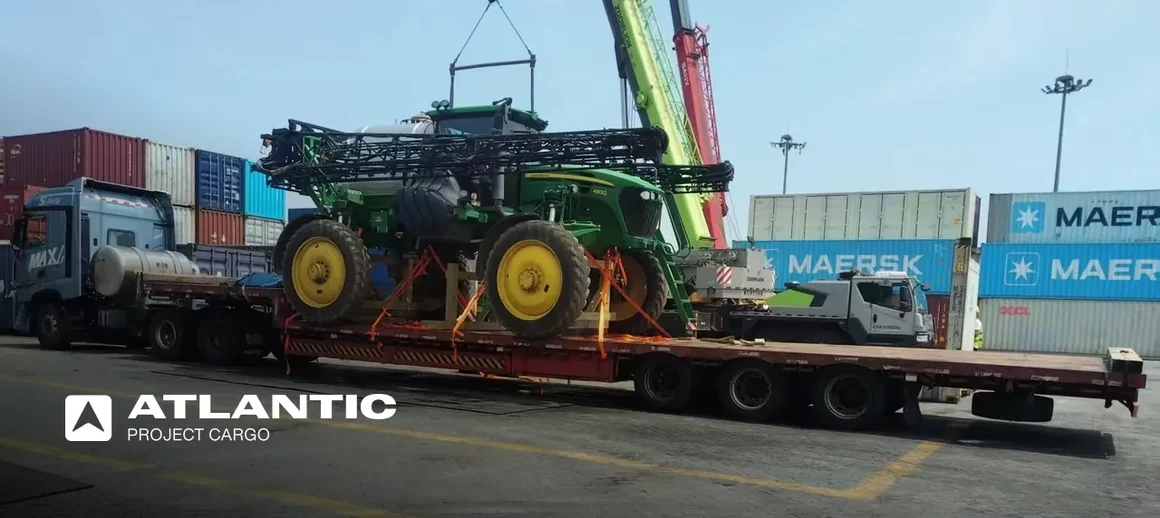
Oversized cargo increases costs because it cannot use standard slots. A machine that sticks out past a flat rack’s edges costs the carrier the container slots beside or above it, so the carrier charges for them. Oversized loads also need road permits and sometimes escorts on the way to the port.

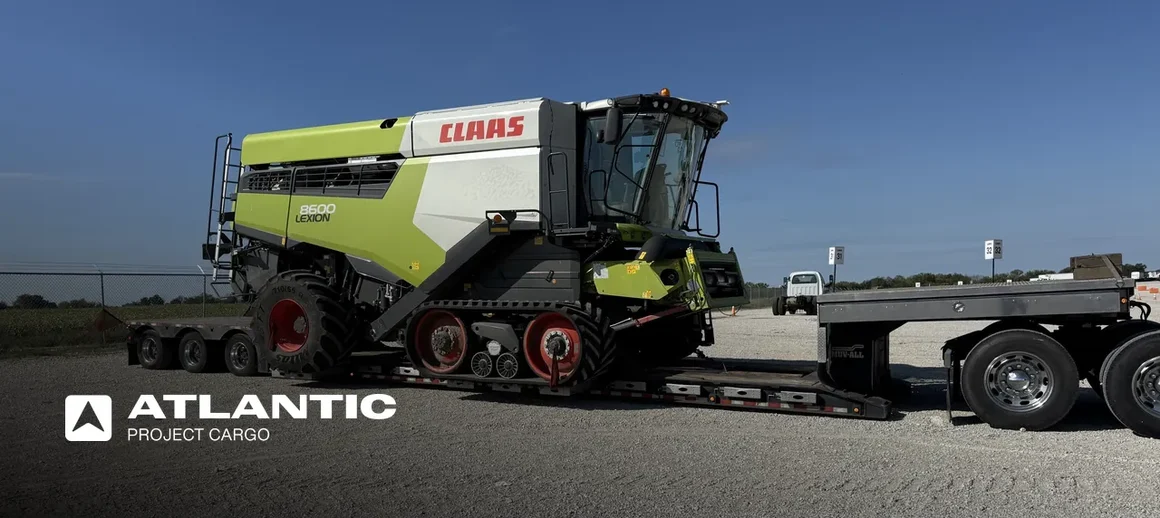
Equipment type matters because it decides the shipping method. A running wheel loader drives onto a RoRo vessel. A non-running bulldozer has to be craned onto a flat rack. A combine usually ships with its header removed and carried separately. Same weight class, very different quotes.

Heavy Equipment Shipping Cost by Transport Method

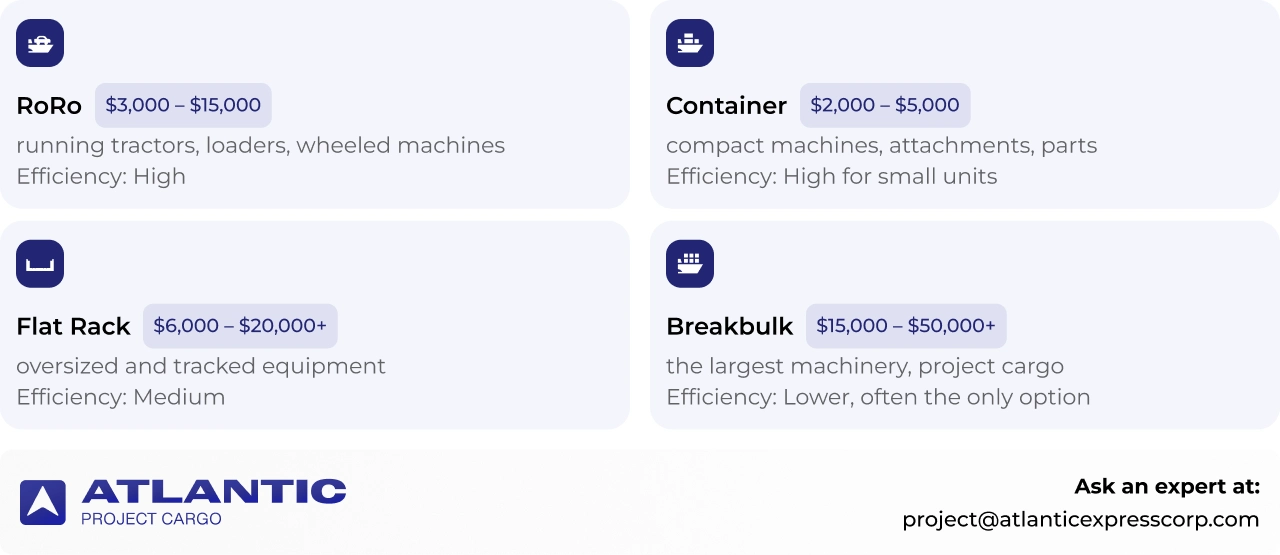
The shipping method sets the pricing model, so it is the first decision that shapes your heavy equipment shipping rates. RoRo is priced by volume, container shipping by the container, flat rack shipping by the rack plus oversize surcharges, and breakbulk shipping by the individual lift and stowage plan.

RoRo Shipping Cost

RoRo shipping typically costs $3,000 to $15,000 for a tractor, loader, or other self-propelled machine. RoRo carriers usually price by cubic meters, so length × width × height sets the bill. A John Deere 8R measuring about 6.0 × 2.5 × 3.3 meters takes up 49.5 cubic meters; at an illustrative $110 per cubic meter, the ocean freight comes to about $5,445.

  • Suitable equipment: running tractors, wheel loaders, telehandlers, mobile cranes, combines, and machines on roll trailers.
  • Advantages: no container, no crane lift, and frequent sailings on major lanes.
  • Limitations: the machine must run or ride a roll trailer, and fewer ports have RoRo service.

Flat Rack Shipping Cost

Flat rack shipping typically costs $6,000 to $20,000+ for oversized equipment too wide or tall for a closed container. The price combines the flat rack rate, surcharges for container slots the cargo blocks, and port handling. In one illustrative CAT 320 example, a $4,500 rate plus $3,200 in oversize surcharges and $1,200 for lashing came to $8,900 for the ocean segment.

  • Oversized equipment: excavators, dozers, and tracked machines.
  • Port handling costs: crane lifts at both ports, plus lashing and blocking.
  • Loading requirements: accurate dimensions, secure lashing points, and often bucket or cab removal.

Container Shipping Cost

Container shipping typically costs $2,000 to $5,000 for compact equipment that fits a 20-foot or 40-foot container, with the best weather protection of any method.

  • Compact equipment: small tractors, compact track loaders, and generators.
  • Attachments: buckets, breakers, and augers packed around the machine.
  • Mini excavators: most fit once the bucket is positioned correctly.
  • Skid steers: often two per 40-foot container, lowering the cost per machine.

Check our shipping container types and sizes guide before assuming a machine fits.

Breakbulk Shipping Cost

Breakbulk shipping typically costs $15,000 to $50,000+ for machines too large or heavy for any other method. Each piece is lifted aboard individually, so pricing follows the lift, the vessel, and the port’s heavy-lift capacity.

  • Large machinery: crawler cranes, mining haul trucks, and large dozers.
  • Industrial equipment: generators, transformers, and crushers.
  • Project cargo: multi-piece shipments with an engineered loading plan.
Shipping MethodTypical CostBest ForCost Efficiency
RoRo$3,000 – $15,000Running tractors, loaders, wheeled machinesHigh
Container$2,000 – $5,000Compact machines, attachments, partsHigh for small units
Flat Rack$6,000 – $20,000+Oversized and tracked equipmentMedium
Breakbulk$15,000 – $50,000+The largest machinery, project cargoLower, but often the only option

Which Shipping Method Is Usually the Cheapest?

RoRo is usually the cheapest method for running wheeled equipment, and container shipping is usually the cheapest for compact machines that fit inside a box. Flat rack and breakbulk cost more because they need cranes, lashing, and extra vessel space.

MethodUsually cheapest forWhy
ContainerCompact machines and attachmentsFixed box rate; skid steers and attachments can share one container
RoRoRunning wheeled machinesDrives aboard; no crane lift, container, or lashing
Flat RackOversized or tracked machinesThe only option when a machine is too big for a box and can’t drive aboard
BreakbulkThe largest machinery and project cargoOften the only option above flat rack limits

RoRo is often the most economical international option because the machine drives aboard under its own power. There is no crane lift, no container to rent, and no lashing to a flat rack. The carrier charges for the deck space the machine occupies, and on busy lanes such as the US to Europe and the Middle East, sailings are frequent. The catch: RoRo only works for machines that run, and only on routes with RoRo service.

Key Takeaway: The cheapest shipping method depends on equipment dimensions and route availability.

International Heavy Equipment Shipping Costs by Route

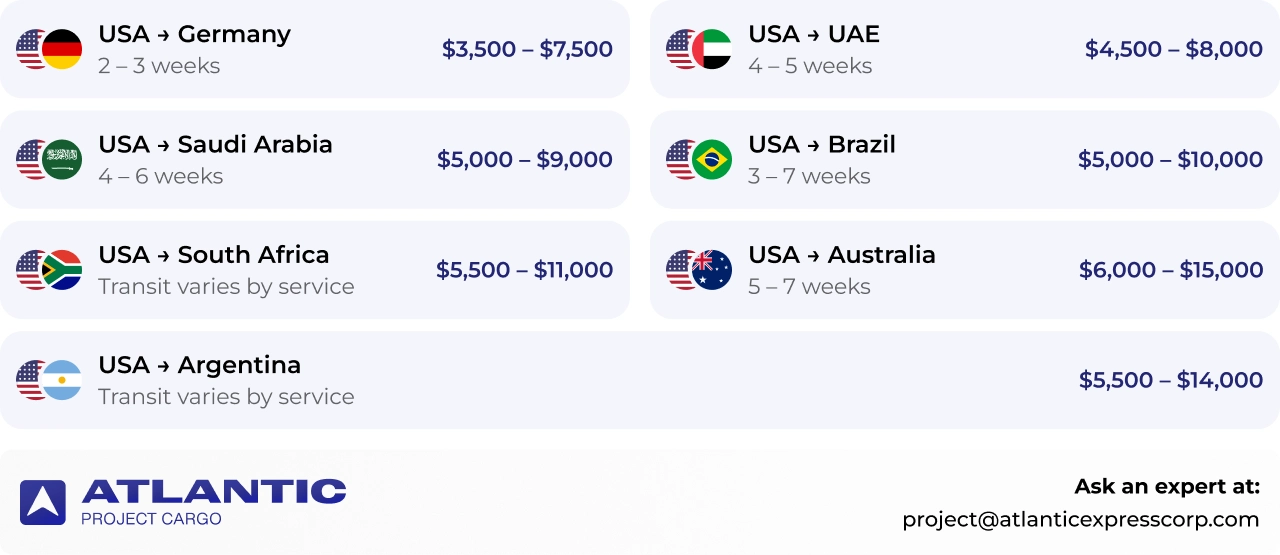
Ocean freight for a mid-size machine from the USA typically runs $3,500 to $14,000, depending on the destination. Short, busy lanes such as the USA to Germany sit at the low end, while long or less frequent lanes such as the USA to Australia or Argentina cost more.

RouteTypical Cost Range
USA → Argentina$5,500 – $14,000
USA → Australia$6,000 – $12,000
USA → UAE$4,500 – $8,000
USA → Saudi Arabia$5,000 – $9,000
USA → Germany$3,500 – $7,500
USA → Brazil$5,000 – $10,000
USA → South Africa$5,500 – $11,000
RouteTypical Transit TimeTypical Cost Range
USA → Australia5 – 7 weeks$6,000 – $12,000
USA → UAE4 – 5 weeks$4,500 – $8,000
USA → Germany2 – 3 weeks$3,500 – $7,500
USA → Brazil3 – 7 weeks$5,000 – $10,000
USA → Saudi Arabia4 – 6 weeks$5,000 – $9,000

Ranges are illustrative ocean freight estimates for a mid-size tractor, loader, or excavator. They exclude destination duties, taxes, and inland delivery.

Several things set route pricing:

  • Route-specific pricing factors: distance, carrier competition, and direct versus transshipment service. Argentina also has its own rules for used machinery; see our USA to Argentina guide.
  • Transit times: longer voyages and infrequent sailings raise costs and storage risk.
  • Port infrastructure: ports with RoRo terminals and heavy-lift cranes, such as Jebel Ali or Bremerhaven, handle equipment efficiently.
  • Destination market conditions: Australia requires used machinery to arrive free of soil and plant material, as our USA to Australia guide explains.
  • Import taxes: Brazil has a complex import tax structure; see our USA to Brazil guide.

One 2026 factor affects RoRo rates specifically. USTR’s Section 301 port fees of $46 per net ton on foreign-built vehicle carriers are suspended until November 9, 2026. Unless USTR extends the suspension, they resume for US port calls from November 10, 2026, and carriers may pass the cost on as a surcharge. For sailings after that date, ask your forwarder whether your RoRo quote includes it.

Domestic Heavy Equipment Transportation Costs

Domestic heavy machinery transport usually costs $2 to $6 per mile, with short hauls priced higher per mile than long ones. Oversized loads add permit and escort costs on top.

  • Lowboy trailers carry tall machines low enough to clear bridges and overpasses.
  • Heavy haul transportation uses multi-axle trailers for machines above standard road weight limits.
  • Oversize permits are issued state by state, so a multi-state move needs a permit for each state.
  • Escort requirements depend on each state’s width, height, and length thresholds, and escorts add to the per-mile cost.

For international buyers, this equipment transportation leg is usually the haul from the seller to the export port.

Cost Per Mile Breakdown

DistanceTypical Rate
0–200 Miles$4.00 – $6.00+ per mile
200–500 Miles$3.00 – $4.50 per mile
500–1,000 Miles$2.50 – $3.50 per mile
1,000+ Miles$2.00 – $3.00 per mile

Oversized loads typically add $1.00 to $2.00 per mile for permits and escort vehicles.

Heavy Equipment Shipping Cost by Equipment Type

International ocean freight runs from about $2,500 for a compact tractor to $50,000+ for a crane, and each machine type has its own size, method, and range.

Tractor Shipping Cost

  • Typical dimensions: a John Deere 8R row crop tractor is about 6.0 × 2.5 × 3.3 meters.
  • Shipping methods: RoRo for running tractors, container for compact tractors, flat rack for articulated or tracked models.
  • Cost range: $2,500 – $15,000+.
  • Factors affecting pricing: dual wheels, cab height, front loaders, and cleaning. See our tractor shipping cost guide.

Excavator Shipping Cost

  • Typical dimensions: a CAT 320 is about 31 × 10 × 11 feet in transport position.
  • Shipping methods: container for minis, flat rack or roll trailer for mid-size units, breakbulk for mining excavators.
  • Cost range: $2,000 – $4,000 (mini); $4,500 – $12,000 (20–30 tons); $12,000 – $25,000+ (50 tons).
  • Factors affecting pricing: tracks, boom position, and bucket removal. See our excavator shipping guide.

Bulldozer Shipping Cost

  • Typical dimensions: mid-size dozers weigh around 20 tons, and the blade often pushes the width past 10 feet.
  • Shipping methods: flat rack, often with the blade removed; breakbulk for the largest models.
  • Cost range: $5,000 – $20,000+.
  • Factors affecting pricing: blade width, rippers, and undercarriage cleaning. See our construction equipment shipping services.

Combine Harvester Shipping Cost

  • Typical dimensions: a New Holland CR9070 is about 10.5 × 3.5 × 4.0 meters without its header.
  • Shipping methods: RoRo, with the header on a separate trailer or flat rack.
  • Cost range: $8,000 – $22,000+.
  • Factors affecting pricing: volume, header size, and cleaning crop residue from hard-to-reach areas. See our agricultural equipment shipping services.

Wheel Loader Shipping Cost

  • Typical dimensions: mid-size loaders commonly weigh 15 to 25 tons; the bucket sets overall width.
  • Shipping methods: RoRo for running loaders, flat rack for non-running units.
  • Cost range: $4,000 – $12,000.
  • Factors affecting pricing: bucket removal, tire condition, and running condition.

Crane Shipping Cost

  • Typical dimensions: mobile cranes are long road vehicles; crawler cranes ship in sections, with boom, counterweights, and tracks separate.
  • Shipping methods: RoRo for mobile cranes; flat rack and breakbulk for crawler cranes.
  • Cost range: $10,000 – $50,000+.
  • Factors affecting pricing: number of pieces, counterweight weight, and destination lift capacity. See our crane transport services.

What Factors Affect Heavy Equipment Shipping Costs?

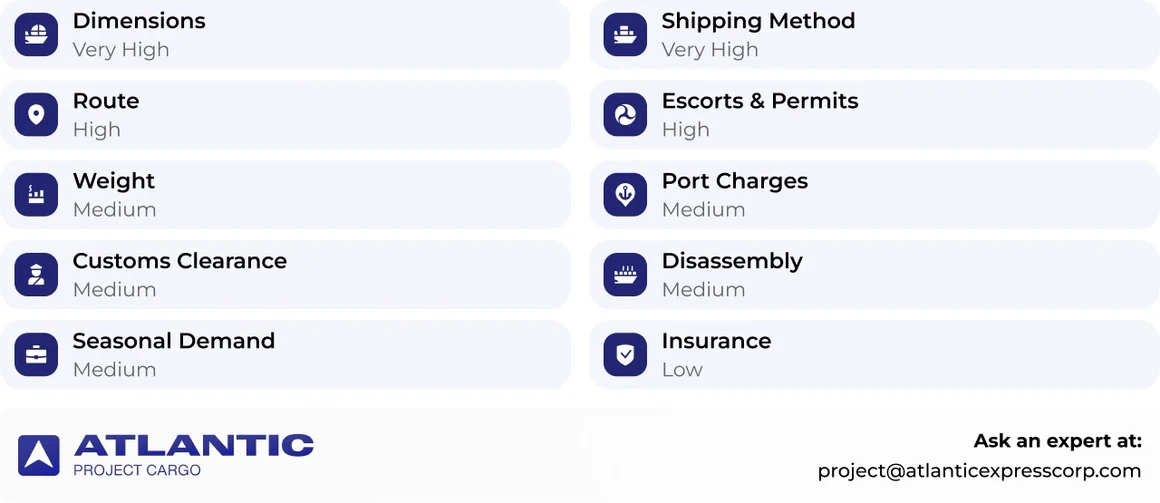
Dimensions and shipping method have the largest effect on heavy equipment transport cost, followed by the route, permits, and weight. Insurance is usually the smallest line in the budget.

FactorImpact on Cost
DimensionsVery High
Shipping MethodVery High
RouteHigh
WeightMedium
Port ChargesMedium
Customs ClearanceMedium
InsuranceLow
Escorts & PermitsHigh
DisassemblyMedium
Seasonal DemandMedium
  • Dimensions: the vessel space you pay for, and whether the machine is oversized.
  • Shipping method: each method has its own pricing model.
  • Route: distance, carrier competition, and sailing frequency.
  • Weight: sets trailer, crane, and permit requirements. For flat rack and breakbulk, ocean freight is often billed per freight ton (the greater of weight in metric tons or volume in cubic meters, called W/M), and RoRo carriers add heavy-unit surcharges above set weight limits.
  • Port charges: terminal handling at both ends, plus lashing.
  • Customs clearance: broker fees, inspections, duties, and taxes.
  • Insurance: usually a percentage of the insured value.
  • Escorts and permits: required for oversized heavy machinery transport by road.
  • Disassembly: costs labor but can move a machine to a cheaper method.
  • Seasonal demand: vessel space tightens before planting and harvest.

What Increases Heavy Equipment Shipping Costs the Most?

Dimensions and shipping method increase heavy equipment shipping costs the most, because together they decide how much vessel space the machine takes and how it must be handled.

Cost DriverImpact
DimensionsVery High
Shipping MethodVery High
RouteHigh
WeightMedium
InsuranceLow

Dimensions often matter more than weight because ships run out of space before they run out of lifting capacity. On a RoRo vessel, you pay for cubic meters. On a flat rack, width and height beyond the rack’s edges cost you the neighboring slots. A 25-ton machine that fits the rack can cost less than a 20-ton machine that hangs over its sides. Removing a bucket, folding a boom, or taking off dual wheels can cut the bill more than any weight saving.

Additional Costs Buyers Often Overlook

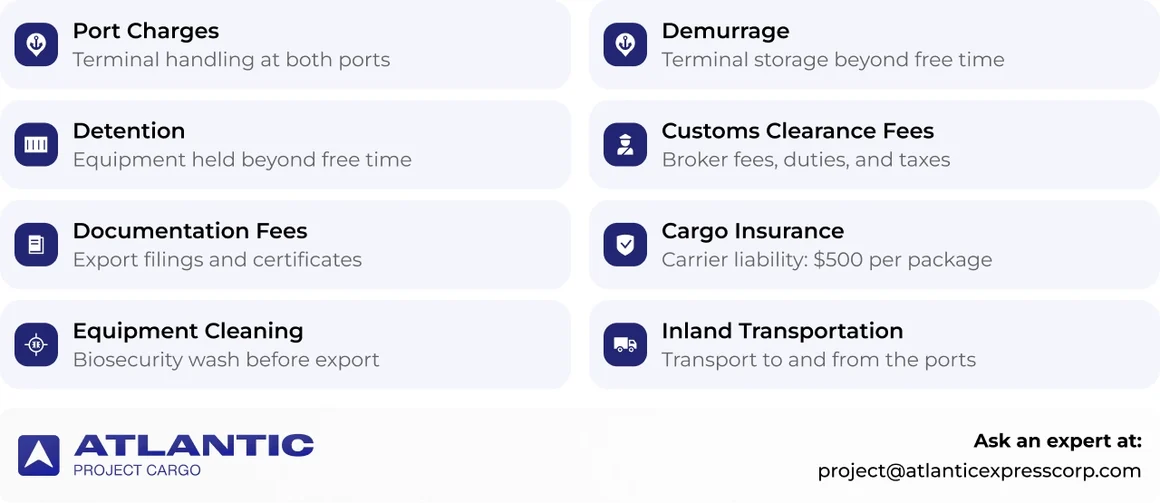
In international equipment shipping, the costs buyers most often miss are port charges, demurrage, detention, customs clearance, documentation, insurance, cleaning, and inland delivery at both ends. None of them are usually in the ocean freight quote.

Port Charges

Terminal handling applies at both ports. For a RoRo tractor, it often runs a few hundred dollars per port; flat rack and breakbulk cargo cost more because of crane lifts and lashing.

Demurrage

Demurrage is billed per day when cargo or a loaded container stays at the terminal beyond its free time, usually because of missing documents or slow customs clearance. Our guide to demurrage and detention explains free time.

Detention

Detention is billed when you keep the carrier’s container or flat rack outside the terminal beyond its free time, often because unloading at the site is delayed.

Customs Clearance Fees

Broker fees cover the import filing; duties and taxes are separate and usually much larger. For US imports, our customs brokerage services handle the filing.

Documentation Fees

Export filings, certificates of origin, and inspection certificates each carry fees, and an error on the bill of lading can cause port holds.

For US exports, two requirements cause the most missed sailings. First, Electronic Export Information (EEI) must be filed in AES; for used self-propelled equipment it is required regardless of value. Second, CBP requires the title or ownership documents for used self-propelled vehicles, including self-propelled agricultural and construction machinery, to be presented at the port at least 72 hours before export. A late or mismatched document can leave the machine on the dock while the vessel sails.

For containerized machinery, the seal number must match on every document; see our guide to container seals in international equipment shipping.

Cargo Insurance

Under the US Carriage of Goods by Sea Act, carrier liability can be limited to $500 per package or customary freight unit, far below a machine’s value. Our cargo insurance covers the full value.

Equipment Cleaning Requirements

Australia, New Zealand, and Chile inspect used machinery for soil, seeds, and plant material. An origin wash typically costs $500 to $2,000+; a machine rejected at destination faces re-cleaning, treatment, or return. Our USDA equipment washing and inspection service prepares machines before export.

Inland Transportation

Equipment transportation from the seller to the export port, and from the destination port to your site, is often quoted separately, with permits and escorts for oversized loads.

Carrier Surcharges

Ocean quotes may add fuel surcharges (BAF), peak season surcharges before planting and harvest, war-risk surcharges on routes near conflict zones such as the Red Sea, and regulatory pass-throughs such as US port fees. Ask whether your quote is “all-in” or “base rate plus surcharges.

Summary: The most commonly overlooked shipping expenses are destination port charges, carrier surcharges, demurrage and detention, customs broker fees, duties and taxes, documentation fees, cargo insurance, equipment cleaning, and the inland haul at both ends.

How Much Does It Cost to Ship Equipment Purchased at Auction?

Heavy machinery transport from an auction usually costs the same as for any other machine of that size, plus yard storage, loading, and export preparation that start adding up the day the auction closes. The key is to arrange pickup before the removal deadline.

  • Ritchie Bros.: auctions at yards across the US, each with a removal deadline after which storage can apply.
  • IronPlanet: an online marketplace that, like Ritchie Bros., is part of RB Global; machines often sit at the seller’s location.
  • Machinery Trader: a listing marketplace where the dealer or private seller sets pickup terms.
  • Dealer purchases: dealers often help with loading and paperwork, and some deliver to the port.

Costs to budget for:

  • Yard storage after the removal deadline.
  • Loading fees at some yards.
  • Inland transportation to the export port.
  • Documentation costs: a bill of sale and ownership documents matching the serial number.
  • Export preparation: cleaning, fluid checks, and attachment removal.

Check the export cost before you bid. A cheap machine far from a port, or one that needs heavy cleaning, can cost more to land than a better-located unit.

Key Takeaway: Auction purchase price is only one component of total shipping cost.

Real Heavy Equipment Shipping Cost Examples

Real shipments run from about $5,500 for a tractor by RoRo to $25,000+ for a combine to Australia. These examples are illustrative; pricing varies with the machine, vessel availability, and market conditions.

John Deere 8R Tractor — Texas to Argentina

  • Shipping method: RoRo from Houston or Galveston.
  • Cost range: $5,500 – $9,500 in ocean freight.
  • Why this method was selected: the 8R runs and fits a RoRo ramp without disassembly, so it drives aboard. A tracked 9RX on the same route would need a flat rack and could cost about twice as much.

CAT 320 Excavator — Florida to UAE

  • Shipping method: flat rack.
  • Cost range: $8,000 – $11,000 for the ocean segment.
  • Cost drivers: the excavator is overwidth and overheight, so the carrier adds oversize surcharges for lost slots, and the port charges for lashing and securing.

Combine Harvester — Midwest USA to Australia

  • Shipping method: RoRo, with the header on a separate trailer or flat rack.
  • Cost range: $15,000 – $25,000+, including inland trucking and cleaning.
  • Required preparation: a full biosecurity wash to remove soil, seed, and crop residue, plus header removal. The Midwest-to-port haul often needs oversize permits and escorts.

Wheel Loader — Houston to Saudi Arabia

  • Shipping method: RoRo.
  • Cost range: $5,000 – $9,000.
  • Route considerations: RoRo sailings to Jeddah and Dammam run less often than to Europe, so booking early matters. Saudi Arabia’s 15% VAT belongs in the landed cost.

How to Reduce Heavy Equipment Shipping Costs

The most effective way to reduce heavy equipment shipping costs is to choose the right method for the machine and plan early enough to avoid storage and rush fees.

  • Choose the correct shipping method: a running machine usually costs less on RoRo than on a flat rack.
  • Book early: late bookings can miss sailings, especially before planting and harvest.
  • Avoid storage fees: collect auction equipment on time and clear customs within free time.
  • Prepare the equipment properly: clean it and remove buckets, blades, or dual wheels to reduce dimensions.
  • Consolidate shipments: attachments and small machines can share a container.
  • Select the best export port: frequent sailings to your destination can save more than a shorter inland haul.

Our heavy equipment shipping guide covers each of these steps in more detail.

Common Heavy Equipment Shipping Cost Mistakes

The most expensive mistakes are budgeting for freight alone and giving the forwarder the wrong dimensions. Both are avoidable.

  • Underestimating port charges: flat rack and breakbulk handling costs far more than RoRo.
  • Ignoring destination fees: terminal charges, broker fees, duties, and taxes are paid on arrival.
  • Booking freight too late: the next suitable sailing may be weeks away while storage accrues.
  • Choosing the wrong shipping method: a non-running machine cannot go RoRo without a roll trailer, and paying breakbulk rates for a machine that fits a flat rack wastes money.
  • Skipping cargo insurance: carrier liability is limited, and one damaged machine costs more than years of premiums.
  • Miscalculating dimensions: brochure figures instead of measurements lead to a re-quote at the port.

Summary: most common reasons buyers exceed their transportation budgets Budgeting for freight only, missing destination fees, late bookings that lead to storage charges, wrong dimensions, and no insurance.

What Information Is Needed for an Accurate Shipping Quote?

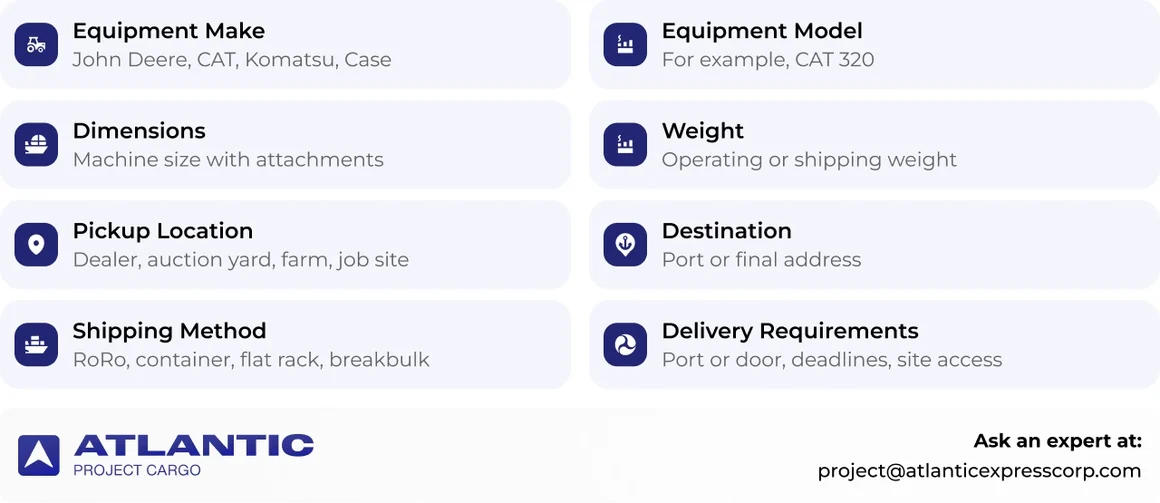
An accurate quote needs eight details: equipment make, model, dimensions, weight, pickup location, destination, preferred shipping method, and delivery requirements. The more precise the information, the fewer surprises later.

  • Equipment make: John Deere, CAT, Komatsu, Case.
  • Equipment model: sets the standard specifications to check.
  • Dimensions: of the actual machine, with attachments.
  • Weight: operating or shipping weight.
  • Pickup location: dealer, auction yard, farm, or job site.
  • Destination: port or final address.
  • Shipping method: your preference, if any.
  • Delivery requirements: port or door delivery, deadlines, and site access.

FAQ

We’ve handled thousands of shipments — here are the most common questions about drayage, pricing, and logistics.
International heavy equipment shipping typically costs $2,000 to $25,000+, depending on the machine’s size, the shipping method, and the route. Domestic transport usually runs $500 to $10,000+.
Shipping a tractor internationally typically costs $2,500 to $15,000+. Compact tractors in containers are at the low end, and articulated tractors on flat racks are at the high end.
Shipping an excavator overseas typically costs $2,000 to $4,000 for a mini excavator and $4,500 to $12,000 for a 20–30 ton machine. 50-ton excavators can pass $25,000, and mining excavators shipped breakbulk can pass $50,000.
RoRo is usually the cheapest way to ship running wheeled equipment. For compact machines, a shared container is often cheaper still.
Yes, usually. RoRo avoids crane lifts, lashing, and oversize surcharges, but it only works for machines that can drive or be towed aboard.
A heavy equipment shipping quote usually includes ocean freight and may include origin inland transport, export documentation, and origin port handling. Check each line against your landed cost list.
Destination port charges, customs broker fees, duties, taxes, cargo insurance, cleaning, and final delivery are often not included.
Port charges for a RoRo tractor often run a few hundred dollars per port. Flat rack and breakbulk cargo cost more because of crane lifts and lashing.
Customs broker fees are usually a small fixed charge per entry. Duties and taxes are the larger cost: for example, 10% GST in Australia, 5% VAT in the UAE, 15% VAT in Saudi Arabia, and 19% import VAT in Germany, plus any customs duty.
Auction equipment costs the same to ship as any other machine of its size, plus possible yard storage, loading fees, and export preparation.
Ocean transit from the USA typically takes 2–3 weeks to Germany, 4–5 weeks to the UAE, 4–6 weeks to Saudi Arabia, and 5–7 weeks to Australia. Inland transport and customs clearance add to the door-to-door time.
It depends on the Incoterm in your purchase contract. Under EXW or FOB the buyer pays the ocean freight; under CIF or DAP the seller does. Under DDP the seller also pays duties and taxes.

Need Help Shipping Heavy Equipment Internationally?

Atlantic Project Cargo ships agricultural equipment, construction equipment, and industrial machinery worldwide. We handle ocean freight, inland trucking, export documentation, and international transportation as one coordinated service, and we quote the full landed cost, not just the freight line. Send us the machine’s details, pickup location, and destination, and we will recommend the most cost-effective method for your equipment.

Shipping Insights & Guides

Largest Farm Equipment Manufacturers in the USA
November 15, 2023

Largest Farm Equipment Manufacturers in the USA

The agricultural sector stands as a cornerstone of the United States economy, vital for both domestic needs and global food supply. In this era of large-scale agriculture, farmers increasingly depend...

Reviewed by Nick Yadryshnikov Nick Yadryshnikov
Read
Top 10 Tractor Companies in the World
May 20, 2026

Top 10 Tractor Companies in the World

The global farm tractor market is a crucial segment of the agricultural industry, with an expected total value of around $66.1 billion by 2027. While specific rankings can vary slightly...

Reviewed by Nick Yadryshnikov Nick Yadryshnikov
Read
Top 10 Construction Equipment Manufacturers
June 26, 2026

Top 10 Construction Equipment Manufacturers

The global construction equipment industry has entered a new era. Driven by surging infrastructure investment, rapid urbanization, and a technology wave spanning electrification, autonomy, and AI-powered fleet management, the market...

Reviewed by Victoria Moseicuka Victoria Moseicuka
Read
John Deere’s Most Powerful Tractors Yet: the New 2025 9RX Series
April 23, 2024

John Deere’s Most Powerful Tractors Yet: the New 2025 9RX Series

John Deere has released its most powerful tractor to date, the 2025 9RX series. This ground-up redesign has increased horsepower and efficiency, allowing farmers to cover more ground and reduce...

Reviewed by Nick Yadryshnikov Nick Yadryshnikov
Read
Top 10 RV Manufacturers in 2026: Who’s Building America’s Best Rigs?
June 18, 2026

Top 10 RV Manufacturers in 2026: Who’s Building America’s Best Rigs?

The American love affair with recreational vehicles isn’t slowing down. Whether it’s remote workers trading cubicles for campgrounds or retirees finally hitting the open road, RV culture is firmly embedded...

Reviewed by Victoria Moseicuka Victoria Moseicuka
Read
Top 15 Combine Harvester Producers
February 13, 2024

Top 15 Combine Harvester Producers

In the previous article we discussed the Top 10 Tractor Companies, today we will focus on harvesters. From the huge plains of the US to the rice paddies of Asia,...

Reviewed by Nick Yadryshnikov Nick Yadryshnikov
Read
Top 10 Biggest Farms in the US
June 12, 2025

Top 10 Biggest Farms in the US

The agricultural landscape of the United States is huge and varied, but certain farms stand out not just for their heritage or production, but for their sheer scale. These operations...

Reviewed by Nick Yadryshnikov Nick Yadryshnikov
Read
Guide how to Import a Car to the United States
September 27, 2024

Guide how to Import a Car to the United States

Car import into the U.S. can be challenging with potential pitfalls: laws, requirements, and paperwork. However, with the right guidance and understanding of the process, it can be a straightforward...

Reviewed by Maryana Serafinas Maryana Serafinas
Read
Top 10 World Bulldozer Manufacturers
February 20, 2024

Top 10 World Bulldozer Manufacturers

In our previous article we had a look at the Top 15 harvester producers, today we will focus on bulldozers. Bulldozers are a crucial part of construction and agriculture. Their...

Reviewed by Victoria Moseicuka Victoria Moseicuka
Read
What Are the Top 10 Biggest and Busiest Ports in the US?
April 8, 2024

What Are the Top 10 Biggest and Busiest Ports in the US?

Today we are starting a series of articles related to the world’s biggest ports, and we will start with the United States. The United States has a wide network of...

Reviewed by
Read